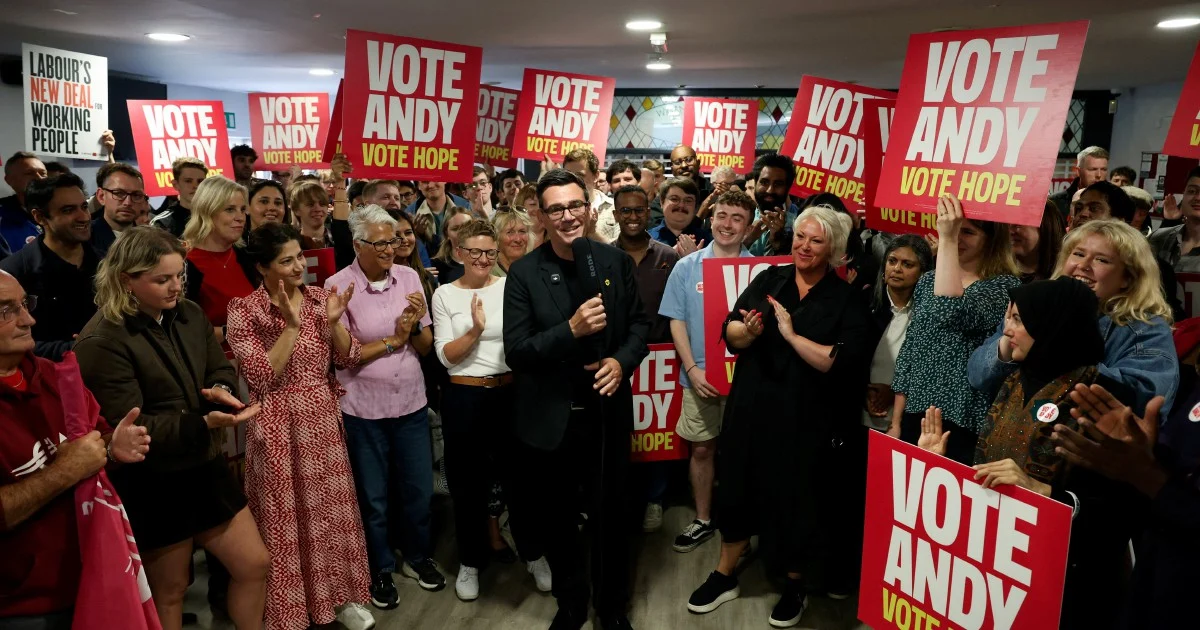
Andy Burnham's political trajectory appears poised to accelerate following Thursday's general election in the Makerfield constituency, a traditionally Labour seat that could serve as his springboard toward the highest offices in British politics. Should the former Manchester mayor secure victory in this northwest England battleground, he would be well-positioned to mount a serious challenge against Prime Minister Keir Starmer within the party hierarchy or across parliament. Yet observers note that Burnham's prospects may owe as much to the internal contradictions plaguing his opponents as to any groundswell of personal support from local voters.
The Makerfield election presents a microcosm of broader turbulence roiling British conservatism. The Conservative Party, wounded by thirteen years in government and recent polling disasters, faces an unprecedented threat from Reform UK, the insurgent populist movement that has cannibalized significant portions of traditional Tory support. This split in the right-wing vote—a phenomenon replicated across numerous constituencies—creates unusual electoral mathematics that fundamentally alters the competitive landscape. Rather than a consolidated rightwing opposition coalescing against Labour, disaffected conservative voters and Reform UK sympathizers are dividing their support, inadvertently fragmenting what would otherwise be a more formidable electoral challenge to the governing party.
For Malaysian and Southeast Asian observers, the Makerfield contest illuminates the broader fragmentation affecting Western democratic systems. Just as Malaysia has witnessed periodic coalitional realignments and the emergence of newer political movements challenging established orders, Britain's rightwing fracture demonstrates that even mature democracies face periods of ideological reorganization. The phenomenon reflects deeper public dissatisfaction with traditional political establishments and the rise of populist alternatives that claim to speak for overlooked constituencies. Understanding these dynamics proves instructive for regional observers tracking similar protest voting and party system volatility across Asia.
Burnham himself represents a particular type of centrist Labour politician—pragmatic, regionally rooted, and concerned with bread-and-butter governance issues rather than ideological purity. His previous roles as Shadow Secretary of State for Health and Social Care and latterly as mayor of Greater Manchester have established him as someone comfortable operating within institutional frameworks while maintaining populist credibility. These credentials position him as a potential alternative to Starmer should the latter's premiership encounter difficulties, or as a formidable figure within a Starmer-led government structure.
The Conservative-Reform UK rivalry extends well beyond personal animosity between political figures. It reflects genuine doctrinal disagreements and competing visions for Britain's rightwing politics. While the Conservatives have attempted to occupy a technocratic center-right position, Reform UK under Nigel Farage has mobilized constituencies animated by grievances over immigration, cultural change, and perceptions of institutional neglect. This ideological gap, combined with organizational competition for activists and media attention, ensures that the two parties spend considerable energy attacking each other rather than coordinating against Labour threats.
Thursday's Makerfield result will provide crucial data about the durability and scope of this rightwing division. Should Burnham win comfortably while Conservative and Reform UK candidates collectively capture a substantial share of local votes, it would suggest that vote-splitting represents a systematic advantage to Labour across numerous seats. Conversely, if one rightwing party consolidates local support at the expense of the other, it might signal incipient reunification or clarification within conservative politics. Either outcome carries implications for Burnham's ability to build parliamentary majorities and advance his leadership ambitions.
For regional analysts, the Makerfield election underscores how electoral system design and voter behavior interact to produce unexpected outcomes. Britain's first-past-the-post arrangement, often criticized for creating distortions, proves particularly consequential when vote splits occur within ideologically aligned parties. Malaysia's own electoral architecture, featuring both first-past-the-post federal contests and proportional representation in certain states, generates different but equally complex strategic considerations for political operators. Studying how established democracies navigate party system fragmentation offers instructive parallels for Malaysian politicians navigating their own coalition arithmetic.
Burnham's potential ascendancy through the Makerfield seat also reflects the resilience of regional power bases within British politics. Despite centralizing tendencies in modern governance, control of significant metropolitan areas and sub-national regions remains a platform for accumulating political capital and demonstrating executive competence. His Manchester base provides both a geographical identity and a claim to represent provincial interests against London-centric politics. This localist dimension resonates across Southeast Asia, where regional and provincial politicians frequently leverage sub-national power as leverage within national political systems.
The immediate aftermath of Thursday's election will likely see intensified Conservative-Reform UK recriminations, with each party blaming the other for split results that benefited Labour. This finger-pointing could precipitate further Conservative organization collapse or conversely drive demands for rightwing reunification. Meanwhile, a successful Burnham victory would enhance his profile within Labour circles and potentially trigger succession planning discussions about Starmer's long-term future. The timing and intensity of such discussions would depend partly on the new government's early legislative record and public approval trajectories.
Critically, observers should resist attributing Burnham's likely Makerfield victory primarily to his personal political skill or appeal. While such qualities matter in electoral politics, the structural advantages flowing from rightwing disunity merit equal analytical weight. Understanding this distinction proves important for assessing whether Burnham's leadership position reflects genuine party member enthusiasm or rather represents a consequence of fragmentation among opponents. In either case, navigating the demands of a Starmer-led government while maintaining independent political capital will require considerable dexterity from Burnham in the months and years ahead.