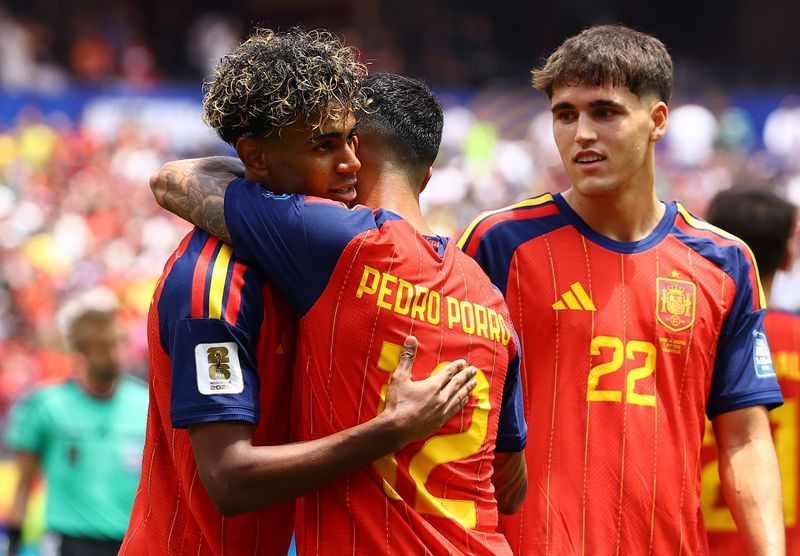
Spain's trajectory through the World Cup has been defined by a single variable: the availability and condition of an 18-year-old winger whose presence on the pitch appears to recalibrate everything about how the defending European champions approach their football. Lamine Yamal's integration into Luis de la Fuente's starting lineup has coincided with a dramatic uplift in performance, most evident in a dominant 3-0 dismantling of Austria that demonstrated Spain's capacity to blend their traditional midfield mastery with explosive wing-based creativity.
The European champions' campaign began inauspiciously, with a goalless stalemate against Cape Verde that exposed uncomfortable truths about their readiness for the tournament. Arriving with a troublesome hamstring injury, Yamal watched from the bench as Spain appeared blunt and lacking the dynamism that characterized their title-winning run through Germany's Euro 2024. The absence of his influence was palpable, as gritty midfield work alone could not generate the kind of attacking momentum required to break down defensive opponents. This early wobble raised legitimate questions about whether Spain's star-studded squad possessed sufficient firepower to maintain their continental dominance on a wider stage.
Yamal's availability represents far more than the simple addition of another attacking player to Spain's tactical framework. His rehabilitation paralleled broader issues affecting De la Fuente's wing setup, with Nico Williams—ordinarily the explosive left-sided complement to Yamal's right-wing menace—also managing fitness concerns. The interplay between these two young talents had formed the cornerstone of Spain's attacking identity throughout Euro 2024, and their simultaneous indisposition threatened to neutralize one of modern Spanish football's great innovations: the marriage of possession-based control with devastating high-speed wing play.
The gradual reintroduction of Yamal into match fitness has traced a clear correlation with Spain's resurgence. Rather than operating as a conventional outside forward confined to the touchline, Yamal's positioning reveals a more nuanced intelligence about how to operate within Spain's structured system. His tendency to drift infield creates the spatial complexity that allows midfield maestros Rodri and Pedri to recycle possession with devastating effect, while his obvious presence on the right compels opposing defenses into tactical commitments that generate opportunities elsewhere. Against Austria, Spain consistently sought to isolate the teenager in one-on-one situations, confident that his individual technical superiority and physical directness would yield progressive advantages.
What distinguished Spain's performance against Austria was the sophistication with which they integrated Yamal's talents into their broader attacking architecture. The introduction of Alex Baena on the left wing created a second avenue of attack that stretched Austria's defensive shape horizontally, while Yamal's movement triggered vertical disorganization. This synergy allowed Spain to operate with multiple attacking dimensions simultaneously—neither purely reliant on midfield dominance nor dependent on wing-based breakthroughs, but rather combining both approaches into something formidable. The fullbacks, particularly Marc Cucurella and Pedro Porro, operated with genuine effectiveness in advanced positions, suggesting that Spain's entire system gains elasticity when Yamal is operating at full capacity.
Yamal's player-of-the-match accolade despite recording neither goal nor assist speaks volumes about how Spain have reconceived individual brilliance within their collective framework. Rather than demanding that their most talented attacking players produce conventional goal-scoring statistics, Spain's coaching staff recognizes that Yamal's primary value lies in his capacity to attract defensive pressure, create spatial advantages for others, and fundamentally alter opposing teams' tactical approaches. This represents a subtle but significant evolution in how Spain deploy their most gifted players, moving beyond the expectation that outstanding individuals must necessarily accumulate personal statistics and toward a model where individual excellence creates conditions for collective success.
Defensively, Spain's performance against Austria illuminated why their early-tournament struggles represented genuine cause for concern. They restricted Austria to zero shots on target—the first instance of such comprehensive defensive control in a World Cup knockout match since Germany's triumph over Argentina in 2014. More broadly, Spain have maintained their remarkable unbeaten streak dating back to their 2022 defeat by Japan, including a World Cup run without conceding a single goal since that Asian setback. These defensive credentials suggest that Spain's primary challenge throughout the tournament stems not from their capacity to prevent opposition breakthroughs but rather from their own ability to generate attacking momentum with sufficient consistency.
The implications of Spain's renaissance extend beyond the statistical record accumulated against middling opponents. Their 2024 European Championship victory established them as genuine tournament contenders, yet early struggles raised questions about whether their particular brand of football—dependent on technical precision, positioning intelligence, and controlled possession—could withstand the intensity of knockout football against the tournament's elite. Yamal's return to sharpness suggests that Spain possess genuine depth of attacking creativity, with their winger capable of influencing matches through subtle positional intelligence and the ability to operate effectively at different areas of the pitch rather than through explosive directness alone.
The structural improvements evident against Austria indicate that De la Fuente has benefited from observing his team's early struggles and adjusting accordingly. The deployment of Baena on the left created the kind of attacking balance that Austria's narrow defensive shape could not adequately address, while Yamal's presence on the right provided the technical foundation for Spain's transition from midfield control into dangerous attacking situations. Rodri's increasingly influential contributions as the match progressed, particularly after halftime, suggested that Spain's midfield conductor requires functional outlets in advanced positions before reaching peak effectiveness.
Looking forward, Spain's potential as World Cup contenders depends fundamentally on maintaining this trajectory of performance while preserving the fitness of key personnel. The early injury issues that affected both Yamal and Williams appear to have resolved, yet tournament football's unforgiving schedule presents constant threats to squad availability. Should Spain maintain their current personnel and performance levels, they possess sufficient individual quality and tactical sophistication to navigate the knockout stages, though their reliance on specific players and patterns means that injury setbacks carry particularly high costs.
Ultimately, Spain's rediscovery of their biting attacking edge represents a validation of both their squad's inherent quality and their coaching staff's willingness to evolve tactically in response to early challenges. Yamal's emergence as a central figure—rather than a peripheral option—in their attacking structure suggests that Spanish football has moved beyond the era where possession and midfield control alone defined competitive success. The teenager's ability to make structured football feel spontaneous, to operate effectively within tight defensive systems while simultaneously creating opportunities for teammates, positions him as the symbolic embodiment of modern Spanish football's ambitions: technically refined, tactically intelligent, yet capable of producing the kind of individual brilliance that tournament football ultimately demands.

