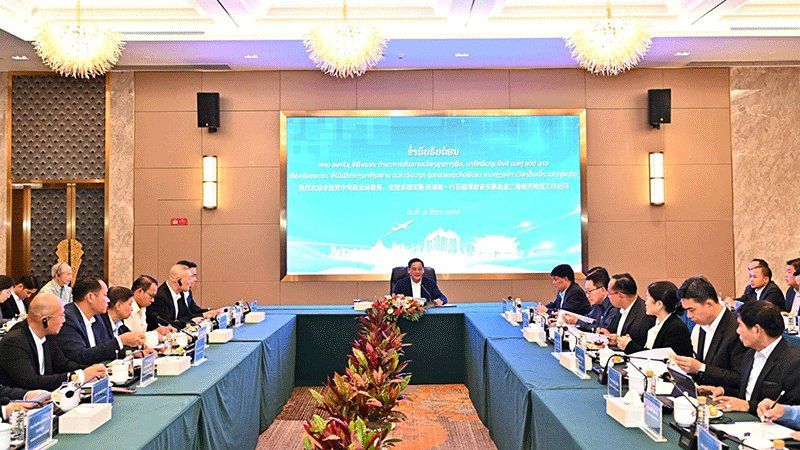
Prime Minister Sonexay Siphandone has signalled his intention to impose stricter controls over the Golden Triangle Special Economic Zone in Bokeo province, acknowledging mounting concerns about the pace of development and the effectiveness of existing governance frameworks. During a working visit to the Zone on Tuesday, 18 August, the Lao leader stressed the need for enhanced regulatory oversight alongside more sustainable approaches to economic expansion, marking a subtle shift in official rhetoric as authorities confront the reality that billions in committed investment have yet to translate into proportional economic gains.
The Golden Triangle Special Economic Zone, straddling the borders of Laos, Myanmar, and Thailand on the banks of the Mekong River, has attracted approximately US$10 billion in cumulative investment since its establishment in 2007, positioning it as one of Southeast Asia's most significant cross-border development initiatives. The Zone sprawls across 10,000 hectares in Tonpheung district, with 3,000 hectares allocated for commercial development and the remaining 7,000 hectares reserved as forested areas, reflecting initial attempts to balance economic expansion with environmental preservation. Yet the gap between ambition and achievement has grown increasingly apparent, with official data revealing that companies operating within the Zone have so far realised only 60 per cent of the activities stipulated in their original investment contracts.
This performance shortfall underscores broader challenges confronting Southeast Asian special economic zones, where infrastructure inadequacies, regulatory inconsistencies, and changing market conditions frequently derail investor expectations. Over the past two decades, the Zone has attracted enterprises spanning manufacturing, real estate, hospitality, finance, retail, tourism, and professional services, creating a diverse economic footprint. However, the gap between registered intentions and delivered outcomes suggests that supervision mechanisms have proven insufficient to ensure compliance or timely project completion. The Prime Minister's intervention signals that Vientiane is not content to accept this trajectory and views the underperformance as symptomatic of deeper institutional weaknesses requiring remedial action.
Sonexay instructed Zone administrators to strengthen the one-stop-service mechanism designed to facilitate investor engagement, recognising that bureaucratic friction remains an obstacle to attracting and retaining quality investment. He highlighted tourism, manufacturing, processing, logistics, education, and public health as priority sectors warranting enhanced development focus, implicitly suggesting that existing sectoral diversity alone does not guarantee sustainable economic expansion. The Prime Minister's emphasis on these particular sectors reflects Vientiane's strategic priorities, where value-added manufacturing and higher-margin tourism could generate greater employment and government revenue than property speculation or retail trade.
A significant concern articulated by the Premier involves the need for more rigorous enforcement of financial discipline within the Zone. He instructed that all commercial transactions—encompassing trade, investment, wage payments, and service provision—be channelled through the Lao banking system rather than informal or cash-based arrangements. This directive addresses longstanding suspicions that the Zone has functioned partially outside formal financial oversight, enabling capital flight and complicating tax collection. By insisting upon banking-system compliance, Vientiane aims to improve both financial transparency and government revenue capture, objectives that become increasingly urgent as development budgets face resource constraints.
Border management represents another focal point in the PM's reform agenda. He directed authorities to strengthen entry and exit controls, acknowledging that the Zone's location at a tri-border junction with proximity to China creates distinctive security and administrative challenges. The Zone currently hosts more than 10,000 registered workers alongside thousands of additional investors, operators, residents, and tourists, creating logistical demands that existing systems apparently struggle to manage effectively. Enhanced controls should allow Vientiane to better monitor worker movements, reduce unlawful cross-border activity, and ensure that labour standards across the Zone remain consistent with national legislation.
The Prime Minister also tasked the Zone's management structures with modernising concession agreements to align more closely with contemporary legal frameworks and international standards. This reflects recognition that many original contracts were negotiated under different regulatory contexts and may contain provisions inadequate to current circumstances. Additionally, Sonexay called for strengthening the effectiveness of the Zone's Management and Administration Committee, the body entrusted with oversight responsibilities, suggesting that existing governance has become diluted or ineffectual. Approximately 400 government officials from multiple sectors are stationed within the Zone, yet their collective impact on performance metrics has plainly fallen short of expectations.
Regional cooperation emerged as a secondary theme in the PM's remarks, with particular emphasis on expanding airline connectivity to the Zone and establishing mechanisms to manage cross-border worker flows more systematically. This reflects understanding that the Zone's strategic value depends partly on seamless integration with neighbouring economies, and that deficiencies in transportation infrastructure or labour administration could deter investment. Greater coordination with Myanmar and Thailand would facilitate multi-country supply chains and enhance the Zone's attractiveness to regional enterprises seeking to exploit proximity advantages.
The geopolitical context surrounding the Zone merits consideration by regional observers. Positioned at the Golden Triangle and adjacent to China's border, the Zone occupies territory of strategic significance to multiple external powers. Laos's insistence on stronger governance and sustainable development may partly reflect pressure from development partners and neighbouring states concerned about the Zone's trajectory. Equally, China's substantial regional economic influence suggests that Beijing's preferences regarding Zone management carry weight in Vientiane's decision-making, particularly regarding investment standards and sectoral priorities.
The challenges facing the Golden Triangle Zone exemplify broader Southeast Asian dilemmas concerning special economic zones. While such zones theoretically offer rapid development pathways and preferential investment conditions, they frequently experience governance difficulties, environmental degradation, and distorted local economies. Laos's decision to demand enhanced regulation and sustainability focus suggests that policymakers are learning from earlier experiences and seeking to correct course. However, translating these intentions into effective implementation will require sustained political commitment, adequate resource allocation to enforcement agencies, and willingness to potentially restrict certain forms of investment that fail to meet tightened criteria.
The Zone's future trajectory will significantly influence Laos's broader economic development prospects and regional standing. Should strengthened oversight succeed in raising performance standards and accelerating project completion rates, the Zone could become a model for effective cross-border economic cooperation in Southeast Asia. Conversely, should regulatory improvements prove insufficiently robust or face resistance from entrenched interests, the Golden Triangle could become emblematic of missed opportunities and misallocated resources. For Malaysian observers, the Zone's evolution carries relevance given Malaysia's own substantial special economic zones and the comparable governance challenges they occasionally encounter in balancing investor accommodation with public interest protection.

