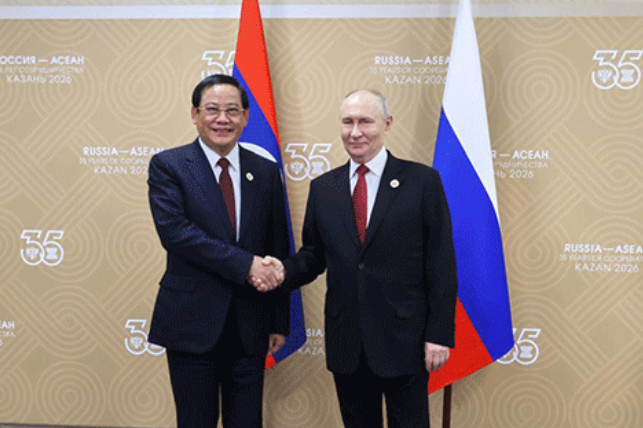
Laos and Russia have moved to consolidate their longstanding diplomatic relationship through a series of high-level engagements, with Prime Minister Sonexay Siphandone concluding an official visit to Moscow and holding substantive discussions with Russian President Vladimir Putin on the sidelines of the Russia-Association of Southeast Asian Nations Summit held in Kazan. The convergence of these meetings underscores both nations' commitment to deepening ties across multiple sectors and maintaining their partnership as Russia intensifies its regional engagement in Southeast Asia.
During his first official visit to Russia since assuming office, Prime Minister Sonexay travelled to Moscow from June 14-17 at the invitation of Russian Prime Minister Mikhail Mishustin. The timing of the visit proved strategically significant, allowing the Lao leader to interact with Putin during a period when Russia is actively strengthening its presence within the ASEAN bloc. This positioning reflects Laos's dual role as both a traditional Russian partner and a significant voice within the regional grouping, particularly given its upcoming chairmanship considerations and growing prominence in Southeast Asian affairs.
President Putin underscored Russia's valuation of the bilateral relationship, emphasising that Laos-Russia ties have consistently been anchored in friendship, mutual respect, and balanced consideration of each other's interests. The Russian leader's explicit acknowledgment of these principles carries particular weight in the current geopolitical environment, signalling continuity in Moscow's approach to smaller neighbours despite international tensions. Putin also recognised Laos's support for expanding Russia-ASEAN cooperation, noting that the relationship between Russia and the regional bloc will reach its 35th anniversary in 2026, a milestone that both sides appear committed to marking through expanded engagement.
A noteworthy element of Putin's remarks involved gratitude towards Laos for its diplomatic courtesies, including President Thongloun Sisoulith's attendance at Russia's Victory Day celebrations in May and the participation of a Lao People's Army unit in a parade commemorating the 80th anniversary of Soviet victory in World War II. These gestures, while ceremonial in nature, carry symbolic weight in Russian foreign policy discourse and demonstrate Laos's willingness to engage with Russia's historical narratives and commemorative practices, strengthening the emotional and historical dimensions of the bilateral relationship.
The centrepiece of the bilateral discussions was the signing of an intergovernmental agreement on cooperation in the peaceful use of nuclear energy. President Putin characterised this accord as a significant achievement, particularly because it establishes the legal and technical framework for constructing a small nuclear power plant utilising Russian technology within Laos. For Laos, a nation seeking to diversify its energy portfolio beyond hydropower, this represents a major development that could reshape the country's energy security calculus. The agreement suggests Russian confidence in Laos's institutional capacity to manage nuclear technology and reflects broader geopolitical interests in strengthening economic interdependencies within the region.
Cooperation between the two nations extends across a remarkably broad spectrum of economic and social sectors. Both sides reviewed collaborative initiatives in energy production, industrial development, agriculture, mining operations, digital economy advancement, banking services, transport infrastructure, tourism promotion, and educational exchange. This diversified engagement pattern indicates that the relationship transcends traditional security or political considerations and encompasses comprehensive economic integration. For Malaysian observers, such multisectoral cooperation underscores the competitive landscape for regional influence and investment partnerships that Southeast Asian nations navigate.
Prime Minister Sonexay reciprocated Putin's diplomatic courtesies by congratulating Russia on its successful hosting of the ASEAN summit, characterising it as a demonstration of Moscow's active participation in regional and international affairs. The Lao premier reiterated his government's consistent policy of cooperation with Russia and emphasised the longstanding nature of the friendship and strategic partnership between the two countries. This emphasis on consistency and longevity appears designed to position Laos-Russia relations as enduring and stable despite shifting regional dynamics.
Beyond his engagement with Putin, Sonexay conducted parallel talks with Russian Prime Minister Mikhail Mishustin, during which both officials expressed satisfaction with their steadily expanding cooperation grounded in mutual trust and reciprocal support. Sonexay specifically acknowledged Russia's ongoing assistance with human resource development, particularly through annual scholarship programmes and training opportunities for Lao nationals and government officials. Such educational partnerships represent important soft power mechanisms through which Russia maintains influence and cultivates future generations of Lao leaders aligned with Moscow's interests and perspectives.
A visible manifestation of bilateral cultural cooperation involves the Laos-Russia Friendship School in Vientiane, which is nearing completion through coordinated efforts by agencies from both countries. This educational institution symbolises the institutional depth of the relationship and provides a lasting infrastructure for cultural and educational exchange. Additionally, Prime Minister Sonexay presided over the handover of two elephants to the Kazan Zoo, gifts from President Thongloun Sisoulith and the Lao people commemorating the 65th anniversary of diplomatic relations and Russia Day on June 12. These cultural gestures, though seemingly ceremonial, serve important functions in demonstrating popular goodwill and creating positive narratives around the bilateral relationship.
At the culmination of his visit, Sonexay addressed a Laos-Russia business forum specifically convened to promote trade and investment cooperation between the private sectors of both nations. This forum represented an attempt to translate political goodwill into commercial partnerships and private sector engagement, suggesting that both governments recognise the importance of economic substantiation for long-term relationship sustainability. For regional observers, such business forums indicate the mechanisms through which great power partnerships are operationalised at the grassroots economic level.
The strategic significance of Laos-Russia relations extends beyond bilateral considerations and intersects with broader regional dynamics. Laos's position as a bridge between China and Southeast Asia, combined with its traditional ties to Russia and Vietnam, places it at a crucial juncture in regional geopolitical competition. By deepening ties with Russia during a period of heightened great power competition in Southeast Asia, Laos appears to be pursuing a hedging strategy that maintains multiple partnerships and prevents over-dependence on any single power. This approach reflects the pragmatic diplomacy that characterises contemporary Lao foreign policy and mirrors strategies adopted by other Southeast Asian nations seeking to balance competing interests.
Looking forward, the nuclear energy agreement and expanded educational partnerships suggest that Russia and Laos are committed to deepening structural integration rather than merely maintaining ceremonial ties. For Malaysia and the broader ASEAN community, this development illustrates the diverse partnership models that member states are pursuing and the competition for influence occurring within the regional space. The successful consolidation of Laos-Russia relations may serve as a template for how smaller Southeast Asian nations can maintain meaningful partnerships with major powers while preserving strategic autonomy within the region's evolving architecture.