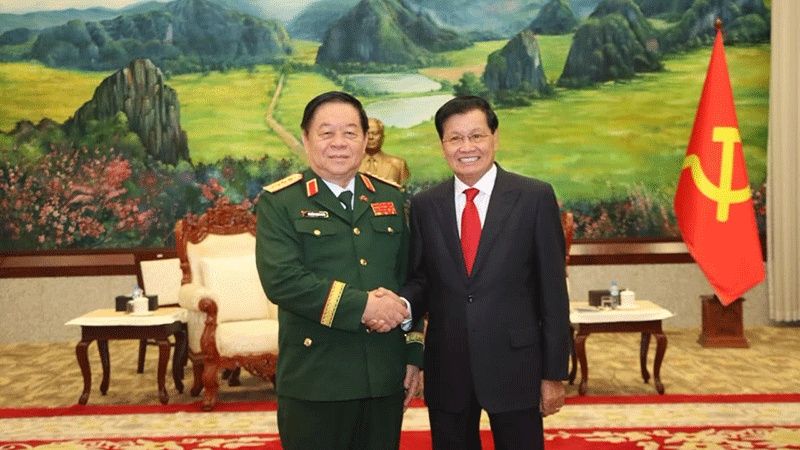
Laos and Vietnam have moved to deepen their long-standing defence alliance through high-level military engagements, with senior Vietnamese officers receiving warm receptions in Vientiane this week. On Thursday, August 6, Lao President Thongloun Sisoulith, who also serves as Secretary General of the Lao People's Revolutionary Party Central Committee, welcomed General Nguyen Trong Nghia, Chairman of the General Department of Politics of the Vietnam People's Army, during an official visit aimed at fortifying defence cooperation between the two neighbours. The encounter highlighted the strategic importance both nations place on their military relationship as a cornerstone of broader bilateral engagement.
General Nghia's visit to Laos, spanning August 5–7, represents part of a sustained diplomatic pattern whereby senior military and political figures routinely exchange visits to signal commitment to their partnership. During his courtesy call on President Thongloun, the Lao leader articulated the significance of the Vietnamese delegation's presence, framing it as a tangible manifestation of the deepening friendship and strategic alignment that binds the two countries. The President's emphasis on the "great friendship, special solidarity, comprehensive cooperation and strategic cohesion" reflects the carefully curated language used to describe ties rooted in decades of shared struggle and post-war reconstruction, distinguishing the Laos-Vietnam relationship from other regional partnerships.
The substantive military discussions between the General Departments of Politics of both armies produced what Lao officials characterised as fruitful outcomes. These talks centred on practical mechanisms for expanding cooperation across multiple domains, with particular attention paid to reinforcing institutional ties between the respective military institutions. For the Lao government, such engagement provides opportunities to modernise defence capabilities and institutional frameworks with support from a more militarily advanced neighbour. The discussions underscored how defence cooperation serves not merely as an end in itself but as a vehicle for consolidating political relationships at the highest levels.
Beyond the presidential audience, General Nguyen Trong Nghia conducted parallel discussions with Lao Deputy Prime Minister General Khamlieng Outhakaisone, the nation's Defence Minister, as well as with Lieutenant General Vongsone Inpanphim, Deputy Minister of National Defence and Director General of the Lao People's Army's General Department of Politics. This multi-layered engagement structure ensured that discussions permeated both political and operational echelons of the Lao defence establishment. The breadth of these interactions reflects a comprehensive approach to military cooperation that addresses strategic considerations, operational coordination, and institutional development simultaneously.
The specific areas of cooperation identified during the talks reveal the practical dimensions of the defence partnership. Both nations committed to expanding work related to Party and political education within military structures, a significant element given the role of communist parties in both countries' governance systems. Enhanced military-to-military exchanges, including personnel training and professional development initiatives, featured prominently in the agreed cooperation framework. Border management emerged as another priority, reflecting the shared frontier reality and the need for coordinated security arrangements along their common boundaries. For Southeast Asian observers, such border-focused cooperation holds particular relevance given regional concerns about cross-border challenges ranging from transnational crime to irregular migration.
The emphasis on educating younger generations about the historical bonds and enduring value of Laos-Vietnam friendship signals both nations' interest in institutionalising their relationship beyond the current leadership cadre. By inculcating awareness of historical connections and mutual interests among military personnel and civilians, both governments seek to create constituencies supportive of the partnership across generational lines. This reflects a sophisticated understanding that sustained bilateral cooperation requires deep societal foundations rather than relying solely on elite-level commitments.
From a Malaysian perspective, the Laos-Vietnam defence deepening merits attention as part of broader Southeast Asian security architecture evolution. As larger powers including China expand influence throughout the region, smaller nations like Laos and Vietnam navigate complex geopolitical terrain through careful alliance management. Vietnam's efforts to consolidate relationships with Laos, its closest neighbour and ideological partner, represent strategic hedge-building in an era of great power competition. Malaysia, similarly positioned as a mid-sized power navigating multiple regional interests, can observe how bilateral defence partnerships serve as stabilising mechanisms within the Association of Southeast Asian Nations framework.
The Laos-Vietnam comprehensive strategic partnership, repeatedly referenced in official statements, encompasses far more than military matters but views defence cooperation as fundamental to its architecture. This framing suggests that both nations see military alignment as prerequisite for pursuing broader economic, political, and social cooperation. General Nguyen Trong Nghia's affirmation of Vietnam's commitment to preserving and advancing the special relationship during his visit underscored Hanoi's assessment that investment in ties with Laos remains a priority despite Vietnam's expanding international engagement.
The visit also carries implications for regional stability considerations. By demonstrating active, multi-level engagement between their respective defence establishments, Laos and Vietnam signal continuity and consolidation rather than relationship drift. In Southeast Asia's volatile strategic environment, where countries' international alignments can shift considerably, such visible reinforcement of partnership provides reassurance to both nations and influences the calculations of other regional actors. For ASEAN as a collective, the strength of bilateral relationships among member states contributes to the stability that allows the grouping to maintain its centrality in regional affairs.
Looking forward, the patterns evident in this visit—regular high-level exchanges, institutionalised cooperation mechanisms, and deliberate effort to deepen ties across political, military, and societal domains—suggest that Laos and Vietnam will likely continue strengthening their defence partnership. Both nations face common security challenges and share ideological foundations that distinguish their relationship from purely transactional bilateral ties. As regional competition intensifies and smaller nations seek reliable partnerships, the Laos-Vietnam model demonstrates how sustained diplomatic investment can create resilient relationships capable of withstanding external pressures.

