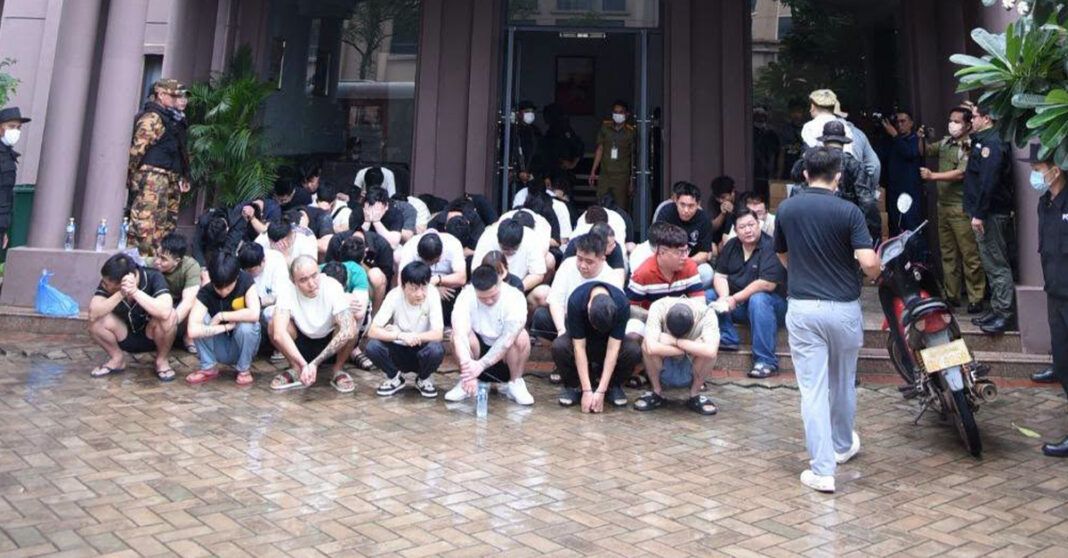
Laotian law enforcement has moved decisively against organized telecommunications fraud and online gambling operations in Vientiane, executing a major raid on August 8 at a facility within the Thatluang Lake Special Economic Zone. The operation resulted in the detention of 261 suspects representing a cross-section of Southeast and East Asian nationalities, underscoring the deeply international nature of these criminal networks that have flourished in the region.
The demographic breakdown of those detained reveals the collaborative structure typical of modern scam syndicates. Chinese nationals constituted the largest contingent with 153 individuals, reflecting their traditional dominance in orchestrating telecommunications fraud schemes across Southeast Asia. Vietnamese detainees numbered 61, followed by 36 Thai nationals. Smaller groups included five Taiwanese, and two each from Malaysia, South Korea, and Myanmar. This composition suggests a division of labour within the operation, with Chinese networks likely providing technological infrastructure and overall coordination, while neighbouring countries supplied both technical expertise and ground-level operatives.
The scale of seized equipment provides tangible evidence of the operation's sophistication and capacity. Police confiscated approximately 500 computing devices—a mix of desktop computers and laptops—alongside 2,355 mobile phones. Such quantities indicate the industrial scale at which these operations function, with each phone potentially used to contact hundreds of victims, and computers serving as command centres for coordinating fraud activities across multiple platforms. The devices constitute the digital backbone through which fraudsters maintained contact with victims, monitored schemes, and managed financial flows.
Authorities identified the building as the property of Lao Thatluang Investment Development Co., Ltd., raising questions about corporate structures that either wittingly accommodate illegal activities or are exploited through leasing arrangements by criminal syndicates. The involvement of registered companies in hosting scam operations illustrates how sophisticated networks embed themselves within legitimate business frameworks, complicating enforcement efforts and potentially implicating business owners in liability investigations. Laotian investigators have indicated their commitment to pursuing not merely the detained operatives but the masterminds and support network behind the operation.
The raid formed part of an accelerating enforcement campaign across Laos against scam networks operating with apparent impunity in recent years. Just two days after the Thatluang Lake operation, on August 10, authorities deported 41 Thai suspects through the 1st Lao-Thai Friendship Bridge to Thai counterparts. This deportation followed an earlier handover of 32 Thai nationals across the same crossing on August 6, bringing the total number of Thai nationals expelled within this enforcement period to at least 73. The rapid succession of deportations signals coordinated regional action and willingness by neighbouring governments to receive their nationals for prosecution at home.
These recent operations built upon an earlier major enforcement action conducted on July 18 at the ST Vegas complex in Dongphosy village, Hatsayfong district. That raid netted 589 suspected scammers, with Thai nationals predominating among the detainees, alongside significant numbers of Lao, Vietnamese, and Cambodian nationals. The scale of that operation—nearly 600 suspects in a single facility—demonstrated the staggering concentration of fraud operations within Laotian special economic zones and highlighted the urgency of the crackdown.
For Malaysian readers, these developments carry direct relevance given that Malaysian nationals appeared among detainees, albeit in small numbers. Malaysia has experienced persistent targeting by scam operations, with residents frequently victimized by telecommunications fraud and online gambling schemes. The international nature of these networks means that Malaysians are targeted by operations based thousands of kilometres away, making cross-border enforcement cooperation essential for victim protection and perpetrator accountability.
The clustering of scam operations within Laotian special economic zones reflects a pattern observed across Southeast Asia, where these zones—established to attract foreign investment and promote economic development—have become magnets for criminal enterprises exploiting permissive regulatory environments, relative isolation from national oversight mechanisms, and proximity to profitable neighbouring markets. The SEZs offer ideal operational bases because they typically feature less stringent scrutiny than major urban centres, yet maintain sophisticated telecommunications infrastructure necessary for international fraud operations.
Laos's intensifying crackdown represents a significant shift in enforcement posture. Authorities appear committed to disrupting the infrastructure supporting these networks rather than conducting isolated arrests. The sustained operations through July and August, combined with coordinated deportations, suggest sustained pressure intended to demonstrate that Laos will not function as a safe haven for international scam syndicates. This positioning matters for regional stability and legitimate business confidence in Laotian investment zones.
The regional dimensions of this crackdown highlight both challenges and opportunities for Southeast Asian cooperation. While individual countries can disrupt operations within their borders, the networks' transnational structure requires coordinated intelligence sharing, joint investigations, and reciprocal enforcement action. Thailand's willingness to receive deported nationals for prosecution and Laos's proactive deportation efforts indicate the type of bilateral cooperation necessary to address scam networks effectively. However, enforcement remains complicated by the mobility of operatives, the rapid reconstitution of networks, and the involvement of multiple nationalities necessitating coordination among numerous governments with varying enforcement capacities.
For victims across the region, including Malaysia, these enforcement actions provide modest reassurance that law enforcement agencies are mobilizing against the criminal infrastructure targeting them. However, the recurring discovery of new scam complexes housing hundreds of operatives suggests that enforcement has thus far managed containment rather than elimination of the underlying networks. The sophistication, funding, and international coordination evident in these operations indicate that dismantling them requires sustained, coordinated regional effort extending beyond discrete raids toward systematic disruption of the financial flows, recruiting networks, and technology supply chains sustaining these criminal enterprises.

