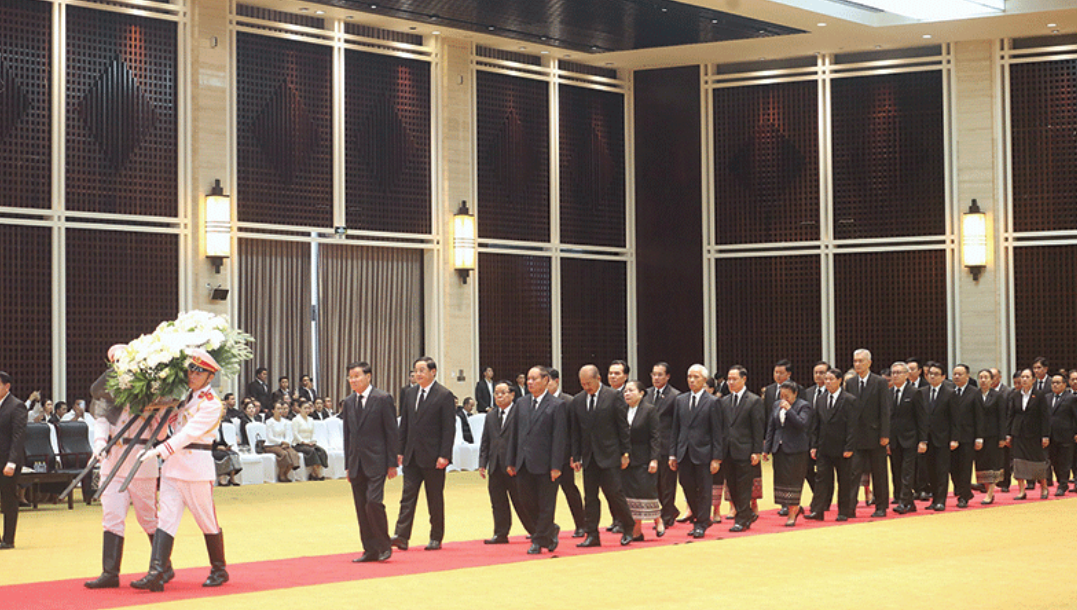
Laos came to a standstill on Sunday as the nation's top political leadership assembled to bid farewell to Xaysomphone Phomvihane, the National Assembly President who died on Saturday. Led by Party Secretary General and President Thongloun Sisoulith, senior figures from across the political establishment gathered at the National Convention Hall to place wreaths and pay final respects, marking the conclusion of a significant chapter in Laotian governance and revolutionary history.
The solemn state ceremony drew an expansive representation of the nation's political hierarchy. Members of the National Assembly, government ministers, representatives from key state organisations, and delegates from various sectors of society stood alongside family members of prominent party and state officials. The gathering underscored the scale of Xaysomphone's influence within Laotian politics—a reflection of his decades-long dedication to advancing the interests of the Lao People's Revolutionary Party and the broader nation.
Xaysomphone held one of the highest offices in Laos as a member of the Politburo of the Lao People's Revolutionary Party Central Committee and President of the National Assembly. His death represents a substantial loss to the country's legislative branch, where he had invested much of his professional career in strengthening institutional capacity and guiding the nation through complex policy decisions affecting defence, economic development, and social progress. Officials acknowledged that his contributions to the National Assembly's evolution and effectiveness would be difficult to replace.
The ceremonial tributes revealed the carefully structured nature of Lao state protocol. Party Secretary General and President Thongloun Sisoulith led the initial wreath-laying delegation on behalf of the Central Committee, followed by his own family. The National Assembly's Standing Committee, represented by Vice President Sounthone Xayachack, subsequently paid formal respects. Prime Minister Dr Sonexay Siphandone headed the government delegation, while Deputy Prime Minister and Finance Minister Santiphab Phomvihane represented the Phomvihane family. Each delegation's participation and ordering reflected the intricate hierarchy within Laotian political circles.
The presence of Vietnamese delegations at the wreath-laying ceremony underscored the deep interconnection between Laos and Vietnam at the highest levels of governance. Tran Thanh Man, a senior figure in the Communist Party of Vietnam and Chairman of Vietnam's National Assembly, attended to lay wreaths in tribute. Delegations from Vietnam's Ministry of Public Security and Ministry of National Defence also participated, demonstrating the symbolic importance placed on bilateral solidarity during this period of national mourning in Laos.
Beyond the immediate political establishment, the ceremony reflected broader representation across Laotian society. Delegations from the Lao Front for National Development, led by President Prof. Dr Kikeo Khaykhamphithoune, participated alongside the Prime Minister's Office, various line ministries, and government agencies. Representatives from the business community and foreign diplomatic missions in Vientiane also came to express condolences, signalling that Xaysomphone's passing resonated across multiple constituencies and international observers.
Xaysomphone's background positioned him at the intersection of Laotian revolutionary heritage and contemporary governance. Born on December 12, 1956, he was one of six sons of former President Kaysone Phomvihane, a founding figure of the Lao People's Revolutionary Party. His five brothers—Xaysongkham, Santiphab, Thongsavan, Sanyahak, and Ounkham Phomvihane—occupy or have occupied significant roles within the party and state apparatus, reflecting a pattern of political succession and family influence within the Laotian system.
The Laotian authorities declared five days of national mourning from August 8 to 12, during which wreath-laying ceremonies at the National Convention Hall continued to allow officials, organisations, foreign dignitaries, and members of the public to pay respects. Vietnam similarly declared two days of national mourning on August 10-11, acknowledging the significance of Xaysomphone's death within the broader framework of Indochinese communist solidarity and regional integration.
The official state funeral was scheduled for August 12, with full ceremonial honours to be observed at the That Luang esplanade, one of Laos's most significant national landmarks. The timing and venue of the cremation ceremony symbolised the stature accorded to Xaysomphone within the revolutionary hierarchy and national consciousness. The scale of mourning rituals and the participation of senior figures across multiple states indicated that his passing marked a transitional moment within Laotian political leadership.
Xaysomphone's death comes at a period when Laos faces ongoing challenges related to economic development, regional geopolitical shifts, and the need to strengthen institutional frameworks. His long association with the National Assembly meant that his absence would require the legislative body to navigate leadership succession during a time of significant regional and internal change. The tributes paid by both domestic and foreign officials acknowledged not merely a death, but the loss of institutional memory and political experience accumulated over decades of service to the revolutionary cause.
For regional observers, the conduct of Laos's mourning process and the visible integration of Vietnam into the ceremony offered insights into the practical depth of Laos-Vietnam relations. The presence of multiple Vietnamese state delegations, coupled with formal declarations of national mourning in Hanoi, demonstrated that bilateral relations extend beyond formal diplomatic protocols to include genuine acknowledgment of shared political heritage and ongoing alliance structures that remain fundamental to Southeast Asian geopolitics.

