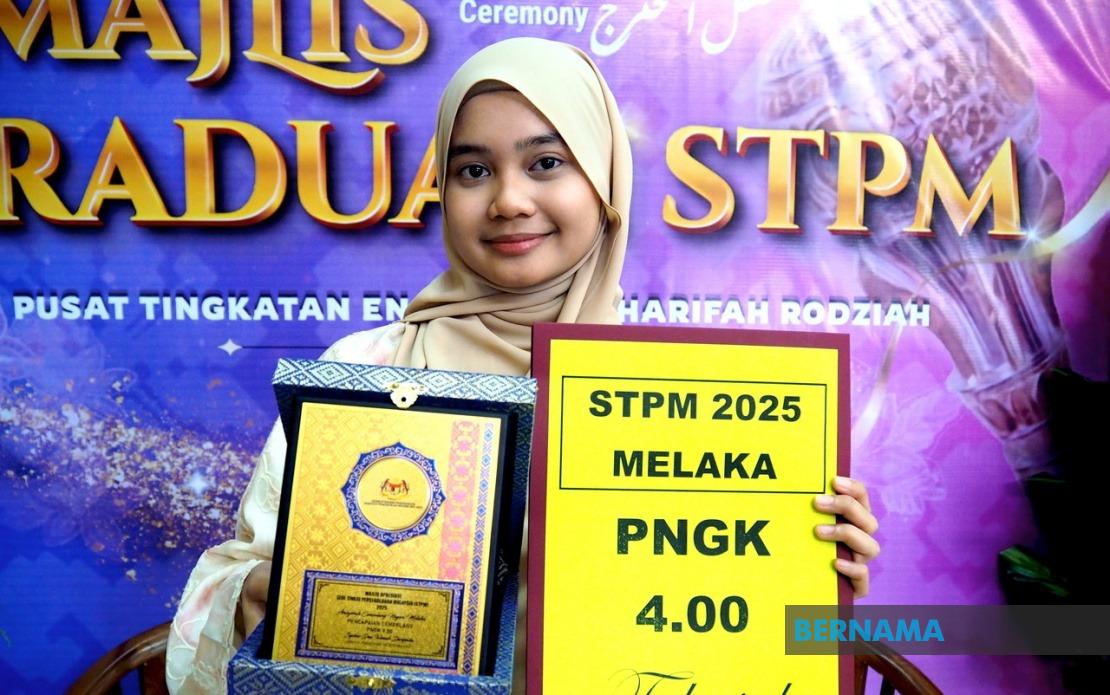
Nurfariesya Nasywa Hamedee has turned personal tragedy into academic triumph, securing a perfect 4.00 Cumulative Grade Point Average in the 2025 Sijil Tinggi Persekolahan Malaysia (STPM) examination announced yesterday. The 21-year-old from Sekolah Menengah Kebangsaan Agama (SMKA) Sharifah Rodziah in Melaka credits her achievement to the final words her father, Hamedee Asri, imparted before his death—a reminder to never squander her abilities, a message that proved powerful enough to sustain her through some of her darkest moments.
Hamedee Asri passed away at just 43 years old from a heart attack, striking a week before Nurfariesya was scheduled to sit for her Sijil Pelajaran Malaysia (SPM) trial examinations. The timing of his death could easily have derailed her educational journey entirely. Confronted with sudden loss and the emotional weight of grief, she found herself questioning whether continuing her studies made sense at all. The prospect of abandoning school to work and contribute financially to her family seemed not just reasonable but perhaps necessary, a practical response to the upheaval her household had experienced.
However, her late father's parting counsel, conveyed through her mother Yusnita Ruslan, offered an alternative path forward. Rather than allowing despair to dictate her next steps, Nurfariesya chose to interpret her father's words as a form of ongoing guidance from beyond. That singular piece of advice—to study hard and fulfill his wishes—became her anchor, transforming grief into determination. She resolved to channel her sorrow into academic excellence, treating each examination, each assignment, each study session as a way of honouring his memory and respecting the confidence he had placed in her.
When results were officially released during the Announcement of the 2025 Melaka State STPM Results ceremony, officiated by Datuk Rosli Abdullah, the State Deputy Exco for Education, Higher Education, and Religious Affairs, Nurfariesya's perfect score represented far more than numerical achievement. It embodied her refusal to yield to circumstance, her willingness to transform personal tragedy into fuel for success. Even she had not anticipated such a result; based on her trial examinations and preliminary calculations, she had conservatively estimated a CGPA of around 3.92, making her perfect 4.00 an unexpected and deeply meaningful outcome.
As the third of four siblings, Nurfariesya carried additional weight—the knowledge that her academic success or failure would influence her family's trajectory during a vulnerable period. That responsibility, rather than crushing her, seemed to crystallize her purpose. She had already demonstrated strong academic foundation, having secured seven A's during her SPM examination. But what sustained her through the STPM years was neither raw intellect alone nor simple ambition, but rather a profound sense of obligation to a father who had believed in her potential when circumstances threatened to extinguish it.
Beyond personal motivation, Nurfariesya's subject choices reflected genuine intellectual curiosity that complemented her emotional resilience. She pursued General Studies, Arabic, Usuluddin (Islamic Theology), History, and Shariah—a combination reflecting her long-standing interest in Islamic jurisprudence. This passion for Shariah law, cultivated since her earlier school years, provided additional intrinsic motivation beyond her filial devotion. She aspires to become a Shariah lawyer, a career path that demands both exceptional academic credentials and unwavering commitment to principle. Her choice of subjects demonstrated that her pursuit of excellence stemmed not merely from grief-driven determination but also from genuine intellectual engagement with her field of study.
When asked to reveal the secret behind her success, Nurfariesya offered no mystical formula, no revolutionary study technique, no privileged advantage. Instead, she articulated a philosophy as straightforward as it is demanding: consistent hard work, refusing to surrender when obstacles appear, and maintaining faith in a higher purpose. This directness reflects a maturity that extends beyond her 21 years. She neither dramatizes her achievement nor minimizes the effort required. For Malaysian students navigating the pressures of high-stakes examinations, her testimony carries particular weight—a reminder that sustained effort and resilience matter at least as much as innate ability.
Nurfariesya's decision to pursue STPM rather than other post-secondary pathways proved strategically sound. She viewed the two-year qualification as a more efficient route toward degree-level study compared to alternatives, while simultaneously recognizing its capacity to open doors to Malaysia's premier universities. Having recently completed interviews for Universiti Malaya's Bachelor's Degree programme, she stands poised to begin her university education—the culmination of years of sacrifice and determination. Her plan to study Shariah law at the nation's leading institution represents not just personal ambition but also potential contribution to Malaysia's legal and religious institutions.
Simultaneously, another exceptional student has emerged from Melaka's 2025 STPM cohort, bringing national recognition to the state. Ng Zhen Hong, 20, a student from Kolej Tingkatan Enam Tun Fatimah, has been named the National-Level Best Student Award recipient for the Science Stream. His achievement underscores the calibre of Melaka's secondary education system and the dedication of its students. Ng credited his success to unwavering parental support, dedicated teachers, and his genuine passion for science—particularly subjects involving calculation and problem-solving. Unlike Nurfariesya's journey through personal adversity, Ng's path reflects the power of consistent encouragement and alignment between personal interest and academic pursuit.
Ng's daily commitment of one to two hours reviewing lessons demonstrates the disciplinary foundation required for excellence in quantitative disciplines. His ten A's in SPM examination and ten A's in STPM showcase sustained academic achievement across his secondary education. His aspirations toward Chemical Engineering or Electrical Engineering at Universiti Malaya position him within Malaysia's critical shortage areas for engineering talent. Both students—Nurfariesya and Ng—exemplify the calibre of Malaysian youth increasingly gaining admission to top-tier universities, suggesting growing alignment between secondary education outcomes and tertiary institutional standards.
For Malaysian parents and students, these two narratives offer complementary lessons. Nurfariesya demonstrates that extraordinary circumstances and personal tragedy need not derail educational aspiration; rather, properly channelled, they can intensify commitment and resilience. Ng illustrates that sustained passion for one's field, combined with consistent effort and strong familial support, naturally produces excellent results. Together, they reflect Malaysia's educational ecosystem at its most promising—young people who combine personal determination with intellectual engagement, working within systems that ultimately recognize and reward excellence.
The broader context matters as well. STPM continues to serve as a demanding qualification, with perfect 4.00 CGPAs remaining genuinely rare achievements. That two such outstanding students emerged in Melaka during the same examination cycle suggests healthy competition and quality institutional support across the state's secondary system. As Malaysia continues developing its human capital and competing regionally in knowledge-based sectors, students like Nurfariesya and Ng represent the foundation upon which future innovation, professional excellence, and national competitiveness ultimately rest.