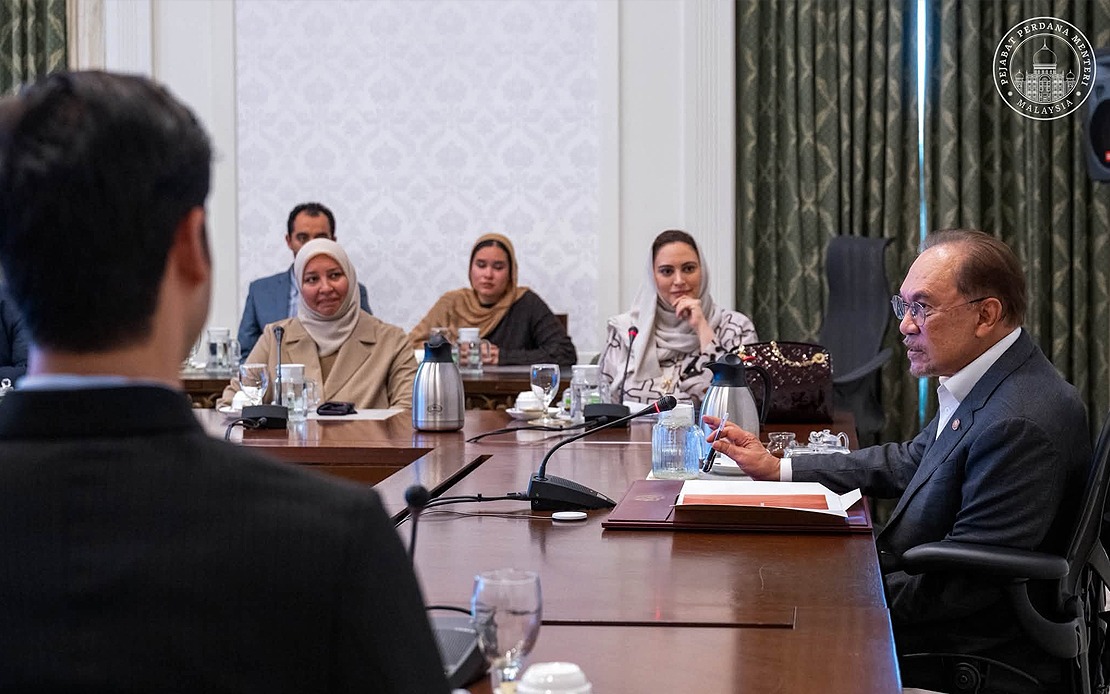
Prime Minister Datuk Seri Anwar Ibrahim has stressed the importance of leaders cultivating a mindset that embraces continuous learning and contemporary thinking without surrendering the foundational principles that define ethical governance. Speaking at the AZM Global Leaders Kuala Lumpur Summit 2026 in Putrajaya, Anwar articulated a vision of leadership that navigates the complexities of modern challenges through the dual lens of intellectual flexibility and unwavering moral foundation.
The gathering brought together 22 emerging leaders representing 12 nations, providing a platform for cross-cultural dialogue on leadership philosophies in an increasingly interconnected world. Anwar's intervention at this summit reflects Malaysia's positioning as a convener of regional and global discourse on governance and ethical leadership. His remarks, shared via Facebook, underscore the Malaysian government's interest in shaping the next generation of decision-makers who will influence regional and international affairs.
Anwar's central thesis addresses a persistent tension in modern governance: the need to remain responsive to evolving circumstances and novel methodologies while resisting the erosion of foundational values. In many developing economies, including Malaysia, this balance proves particularly acute as nations pursue economic modernisation and technological advancement. Leaders frequently face pressure to adopt pragmatic short-term solutions that may compromise long-term ethical standing or institutional credibility. Anwar's framing suggests that false choices between adaptation and principle represent a fundamental misunderstanding of effective leadership.
The Prime Minister highlighted that navigating leadership within culturally diverse contexts demands more than technical competence or strategic acumen. Rather, he argued that wisdom, sound judgment, and patience serve as essential counterweights to the rapid pace of change. These attributes—often cultivated through experience and reflection rather than formal training—enable leaders to discern which innovations align with enduring values and which represent genuine threats to institutional or societal integrity. For Malaysian policymakers and administrators grappling with issues from economic reform to digital governance, this perspective offers a useful framework for evaluating proposed changes.
The AZM Global Leaders initiative, founded by Muna AbuSulayman, represents an investment in developing networks of principled leaders capable of addressing transnational challenges. Anwar's participation and endorsement signal government recognition of such initiatives' potential to strengthen regional cooperation on governance issues. The summit's focus on cross-border networks acknowledges that contemporary challenges—from climate adaptation to cybersecurity—increasingly require coordinated responses transcending national boundaries.
For Malaysia specifically, the summit reflects broader strategic ambitions to position the country as a thought leader on governance within the Global South. As the nation pursues its Vision 2050 agenda and navigates geopolitical complexities, developing young leaders who combine innovation with ethical grounding becomes increasingly important. Anwar's remarks implicitly endorse the view that Malaysia's competitive advantage rests not merely on economic or technological metrics but on its capacity to model responsible, values-driven leadership.
The emphasis on trust as a foundational principle carries particular resonance in Southeast Asia, where institutional credibility and social cohesion remain essential preconditions for effective governance. Trust operates as both a public good and a practical necessity; without it, even technically sound policies struggle to gain public acceptance and implementation buy-in. Leaders who maintain moral integrity across administrations and political transitions build the institutional capital that enables difficult decisions and long-term strategic commitments.
Anwar's invocation of patience as a leadership attribute warrants specific attention within the Malaysian context. In an era of instant communication and pressure for immediate results, patience can appear antiquated or ineffectual. However, in complex governance challenges—whether institutional reform, communal reconciliation, or economic restructuring—hasty action frequently generates unintended consequences. Leaders who demonstrate patience in gathering information, consulting stakeholders, and allowing for gradual implementation often achieve more durable outcomes than those pursuing rapid transformation.
The summit's timing in mid-2026 positions it within Malaysia's medium-term development cycle, suggesting that the government views the cultivation of global leader networks as integral to its international engagement strategy. By hosting such forums, Malaysia demonstrates commitment to dialogue-based approaches to regional challenges and positions itself as a convener rather than merely a participant in global governance discussions.
Anwar's message ultimately articulates a sophisticated understanding of leadership as requiring simultaneous commitment to two sometimes-competing imperatives: responsiveness and integrity. This perspective suggests that the most effective leaders are not those who adapt values to circumstances or who rigidly resist change, but rather those who maintain clear principles while intelligently adjusting tactics and strategies. For the young leaders gathered in Putrajaya from across the globe, this framework offers both moral clarity and practical permission to engage dynamically with complex problems.

