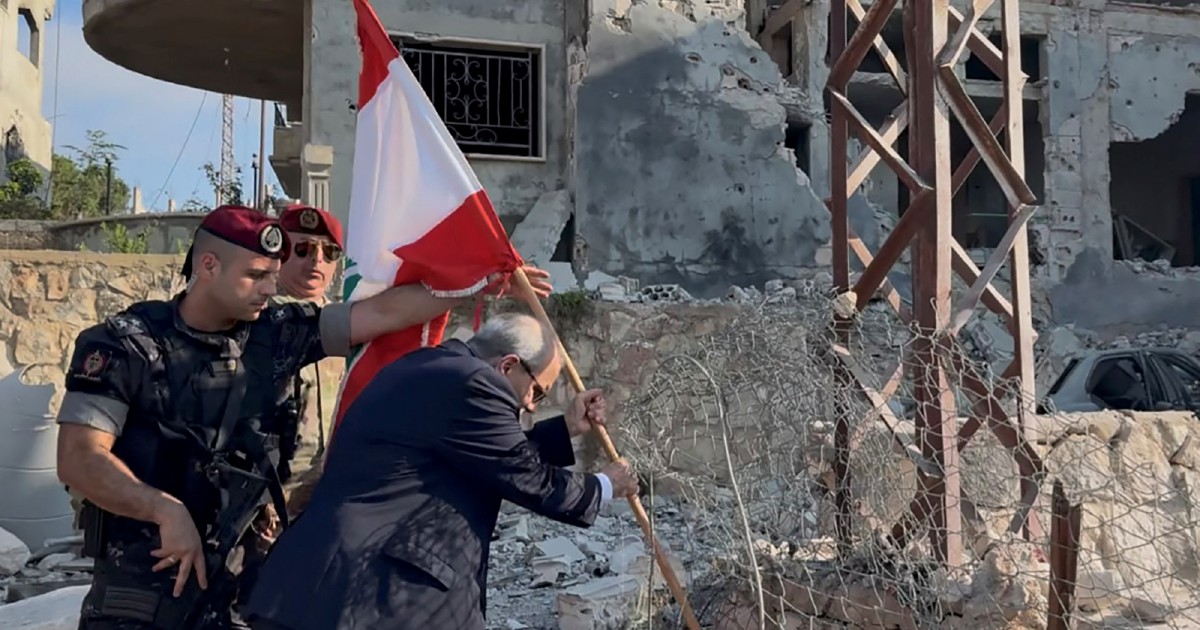
Lebanese Prime Minister Nawaf Salam has reinforced his government's commitment to achieving a comprehensive Israeli withdrawal from occupied Lebanese territory, signalling this goal remains central to Beirut's strategy even as new military deployments reshape the country's security posture. Speaking in Zawtar al-Gharbiyah during a visit to inspect recent army movements, Salam underscored that negotiations and diplomatic efforts continue to focus on ending the military occupation that has remained a flashpoint in the region.
The village visit carries considerable symbolic weight, as it represents one of the southernmost communities where Lebanese armed forces have begun reasserting a presence following recent military developments. The deployment signals an attempt by the Lebanese state to restore governmental authority in areas that have been contested or subject to limited civilian control. For residents and observers, the arrival of uniformed troops represents a potential turning point in Lebanon's long-standing territorial dispute with Israel, though the ultimate success of such initiatives remains uncertain given the region's complex geopolitical dynamics.
Salam's remarks reflect a broader shift in how Lebanon is approaching its border security challenges. Rather than relying solely on other non-state actors or diplomatic back-channels, the government appears to be positioning its own military as the primary instrument for territorial recovery. This represents a notable evolution in Lebanese security strategy, one that carries implications for the balance of power between state institutions and other armed groups operating within the country. The emphasis on state military capability suggests Beirut is attempting to consolidate control over its own security apparatus as a prerequisite for successful negotiations.
The question of Israeli occupation has long been a defining issue in Lebanese politics and national identity. For decades, various armed groups and civilian populations have sought to end what they view as an unlawful military presence. Salam's public statements keep this objective at the forefront of national discourse, ensuring that any future diplomatic arrangements will be measured against the standard of complete withdrawal. This rhetorical positioning helps maintain domestic political consensus around territorial sovereignty, even as the practical mechanisms for achieving such withdrawal remain contested and uncertain.
For regional observers and international stakeholders, Salam's declarations signal that Beirut intends to maintain this demand throughout any negotiation process. Whether through bilateral talks, international mediation, or multilateral frameworks, Lebanon's stated position is clear: partial arrangements or compromises on the occupation question are not acceptable long-term solutions. This uncompromising stance reflects both nationalist sentiment within Lebanon and the political costs any leader would face if seen as abandoning territorial claims.
The timing of Salam's visit to a recently deployed military position carries tactical significance. By physically appearing among troops in a sensitive border area, he demonstrates governmental engagement with security matters and sends a message that the state is active in addressing territorial concerns. Such visits often precede policy announcements or signal shifting priorities within the government's security establishment. The visual message—of a civilian leader standing alongside deployed soldiers—reinforces the narrative that Lebanon's recovery of occupied land is a state project, not a matter to be resolved through non-state channels.
For Malaysia and Southeast Asia, Lebanon's situation offers instructive parallels regarding border disputes and the challenges of military occupation in densely populated regions. The Lebanese experience demonstrates how territorial conflicts can persist for generations, creating cycles of tension and periodic escalation. Malaysian policymakers monitoring developments in the Middle East may note how Lebanon's emphasis on military deployment as a confidence-building measure reflects broader regional trends toward reasserting state authority in contested zones. This approach carries risks and benefits that transcend Lebanon's borders.
International observers note that Salam's statements exist within a constrained diplomatic environment. Multiple stakeholders hold interests in Lebanese territory, and any withdrawal by Israeli forces would need to account for security concerns from various quarters. Lebanon's assertion of governmental control through military deployment represents one variable in an equation that includes Israeli security priorities, interests of regional powers, and the UN presence in the south. The practical pathway to achieving Salam's stated objective remains obscure despite rhetorical clarity.
The deployment itself addresses a long-standing governance challenge in southern Lebanon. Weak state presence in border areas has historically created vacuums filled by other security actors. By moving troops into villages like Zawtar al-Gharbiyah, Beirut seeks to establish that the Lebanese state, not external actors, bears primary responsibility for security and civilian protection. This reassertion of state capacity has implications beyond the Israeli dispute, touching on Lebanon's internal stability and the legitimacy of its governing institutions.
Salam's emphasis on complete rather than partial withdrawal suggests Lebanon rejects frameworks that would leave any Israeli military presence in place, whether openly or through informal arrangements. This maximalist position may reflect genuine nationalist conviction or may represent a necessary political stance given domestic sensitivities. The gap between stated objectives and realistic outcomes will likely define Lebanon's negotiating experience in whatever diplomatic process unfolds. For now, Beirut's position is unambiguous, and Prime Minister Salam has made clear that accepting anything less than full withdrawal would constitute a failure of state purpose.

