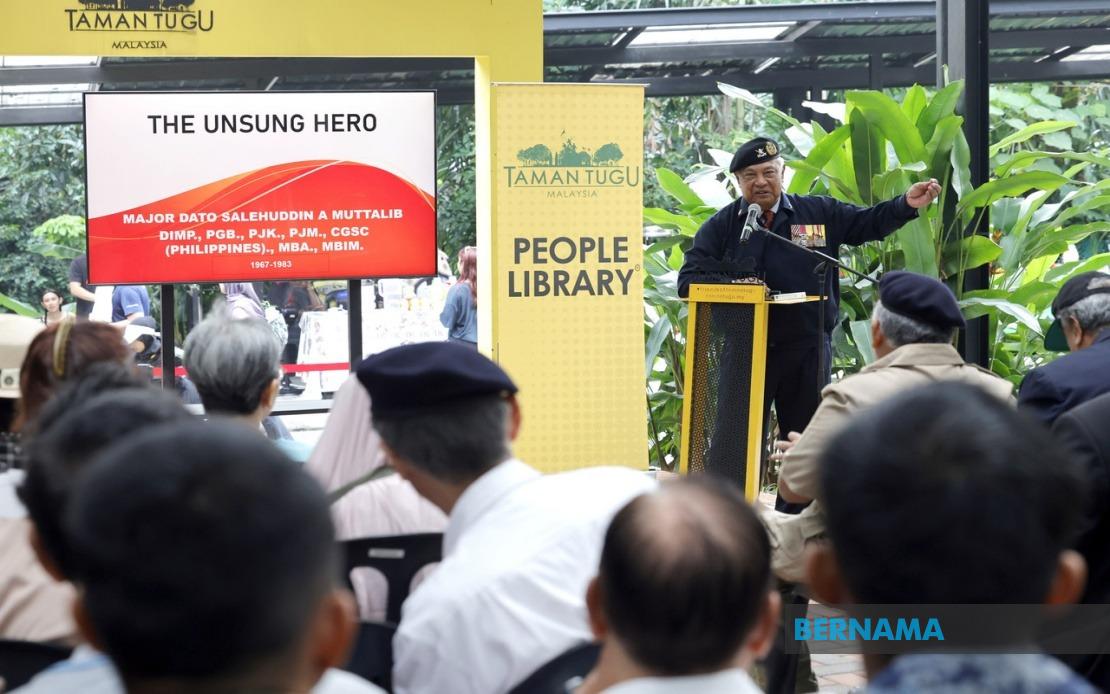
Retired security personnel in Malaysia gathered recently to commemorate Warriors' Day by recounting their experiences from some of the nation's most dangerous operational periods, offering contemporary audiences a window into the hidden struggles that shaped the country's stability. The testimonies revealed the constant life-or-death calculations that undercover operatives faced while infiltrating communist organisations, decisions made in fractions of seconds that determined whether they lived to see their families again.
Superintendent (R) Paul Kiong Sing Chu, now 82 years old, recalled a mission from the early 1980s that exemplified the razor-thin margins between success and tragedy in clandestine work. Tasked with driving three Communist Party of Malaya (CPM) members through a police checkpoint near Chemor in Ipoh, Kiong faced a scenario where exposure could have triggered a firefight that would almost certainly have cost him his life. His location at the vehicle's helm meant he would be caught between two opposing forces—the communist passengers and the police officers manning the roadblock—with nowhere to escape. Recognising the danger as he spotted the checkpoint ahead, Kiong made an instantaneous decision to divert onto a smaller road, circumventing the checkpoint entirely and preventing what could have become a violent confrontation. Such split-second judgements, he reflected, represented some of the most harrowing moments of his three-decade police career.
The ability to navigate these situations successfully required more than tactical awareness. Deep cover work demanded that operatives maintain psychological resilience while living dual identities, constantly suppressing their true allegiances while convincing hardened operatives of their commitment to revolutionary causes. For Kiong and his peers, the stakes extended beyond personal survival—any failure could compromise ongoing investigations and jeopardise the broader counter-insurgency effort. The weight of this responsibility, combined with the constant knowledge that a single misstep could be fatal, created a form of stress that many security professionals from that era carry with them decades later.
Major (R) Datuk Salehuddin Abd Muttalib brought a different perspective from his experiences during covert military operations in Sarawak directed against members of the Indonesian Communist Party (PKI). Unlike police undercover work that emphasised intelligence gathering and infiltration, military operations against armed communist elements often involved direct confrontation. Salehuddin recounted a particularly traumatic engagement where a PKI operative he had shot managed to greet his unit even as he lay dying, a moment that forced him to confront the human cost of counter-insurgency warfare. The subsequent realisation that his target was a Muslim believer gave him profound pause—he found himself wrestling with religious and moral dimensions of his actions, wondering whether the victim's family could ever forgive him for taking a life.
The emotional aftershocks of such encounters proved remarkably durable. A decade later, an unexpected visitor arrived at Salehuddin's home who revealed himself to be the uncle of the man killed in that operation. Rather than confrontation, the meeting proceeded with a gravity and solemnity appropriate to the gravity of past events, but the encounter itself shocked Salehuddin. That a family member of his victim would seek him out, and that he would eventually accept such a meeting, spoke to the complex ways in which communities in post-conflict environments process historical violence. The incident remained vivid in his memory long after retirement, testament to the psychological footprint that frontline operations leave on those who conduct them.
The public sharing of these experiences took place during a formal commemoration of Warriors' Day, an annual observance held on July 31 that honours the sacrifices of Malaysia's security forces. The Malaysia Military History Tourism Association (MMHTA) and Taman Tugu organised the event, bringing together approximately 200 participants to hear testimonies from five veteran speakers representing both police and military backgrounds. This curated approach to historical remembrance served multiple purposes simultaneously—it provided therapeutic value for veterans processing their experiences publicly, it created educational opportunities for younger Malaysians to understand their nation's security history, and it reinforced broader narratives about national sacrifice and institutional heroism.
For Kiong, who received the Seri Pahlawan Gagah Perkasa (SP) medal in recognition of his extraordinary courage during his service tenure, public recognition came late but represented formal acknowledgement of contributions that often remained classified or obscure during active service. The decision to dedicate 31 years to the police force, with all its attendant risks and demands, reflected a commitment that modern Malaysians, living in a period of comparative stability, might struggle to fully appreciate. Yet the recognition that such individuals gave up normal lives—stable social relationships, predictable career trajectories, freedom from constant danger—underscores the often-invisible infrastructure upon which national security rests.
The pedagogical dimension of these public recollections carried particular importance. Younger visitors to the Warriors' Day programme, many of whom had only encountered anti-communist history through school textbooks or official ceremonies, encountered veteran testimony that added emotional and human dimensions absent from formal historical records. By presenting the subjective experiences of those who lived through dangerous operations, the programme helped younger Malaysians internalise not merely the factual chronology of Malaysia's security struggles but the existential weight they carried for those involved. Understanding that real individuals made agonising choices under extreme pressure, and that these choices shaped the nation's trajectory, provides richer historical consciousness than abstract accounts of military operations or casualty figures.
The broader significance of these recollections extends beyond individual memorialisation. Malaysia's anti-communist campaigns—both the conventional Emergency from 1948 to 1960 and the subsequent counter-insurgency operations that continued into the 1980s—represented defining episodes in the nation's early decades of independence. The operations undertaken by operatives like Kiong and Salehuddin, though often conducted in obscurity, contributed materially to eliminating threats that could have fundamentally altered Malaysia's political trajectory. By the early 1980s, when Kiong conducted his dangerous mission, the CPM was substantially weakened but remained active, necessitating ongoing security operations. Salehuddin's operations against the PKI reflected Malaysia's integration into regional Cold War dynamics, where communist movements sponsored by major powers posed perceived existential threats.
The decision to establish formal platforms for veteran testimony, rather than allowing these experiences to fade into personal memory or classified archives, represents a maturation in how Malaysia approaches its security history. Rather than treating counter-insurgency operations as embarrassing episodes best left unexamined, or conversely as unambiguous triumphs requiring no critical reflection, the Warriors' Day programmes allow for more nuanced engagement with complex historical events. Veterans can acknowledge moral ambiguities—the difficulty of killing a fellow Muslim, the pressure of impossible situations, the lasting trauma of operations—while simultaneously asserting the legitimacy of their service and its necessity for national survival.
For contemporary Malaysia, these narratives offer subtle lessons about the price of stability and the human dimensions of state security. In an era where terrorism and cross-border insurgency threats persist, understanding how previous generations navigated comparable dangers provides practical and psychological resources. More broadly, societies that fail to commemorate and understand their security history risk repeating past errors or undervaluing current defenders. The Warriors' Day programmes, by providing structured occasions for veteran testimony, help ensure that the sacrifices made during Malaysia's Cold War struggles remain within collective memory and continue to inform national consciousness about security challenges and the character of those tasked with meeting them.

