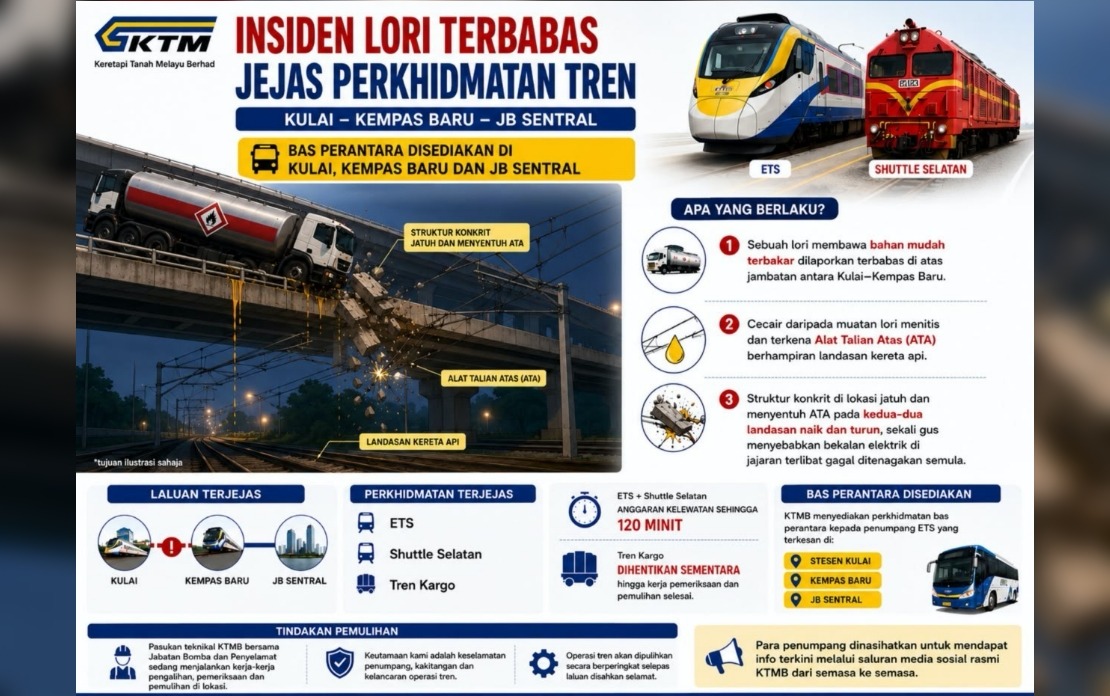
A transportation incident in Johor Bahru on August 5 created significant disruption for thousands of commuters when a commercial vehicle carrying flammable cargo lost control near critical railway infrastructure. The accident triggered an electrical power failure that cascaded through train operations on the Kulai–Kempas corridor, affecting both the Shuttle Selatan service and the Electric Train Service (ETS), two of Peninsular Malaysia's most heavily travelled rail routes in the southern region.
Keretapi Tanah Melayu Berhad (KTMB), the state-owned railway operator, announced the disruption through social media, confirming that the lorry incident had directly caused the power supply outage. The company's response prioritised restoring electrical systems and clearing the accident site, with recovery crews mobilised immediately to perform both cleanup operations and repairs to infrastructure. The incident underscores the vulnerability of rail networks to road transport accidents, particularly when vehicles carrying hazardous materials operate in proximity to electrified rail corridors.
To mitigate the impact on passengers, KTMB activated contingency protocols by deploying alternative shuttle bus services across three major stations: Kulai, Kempas Baru, and JB Sentral. This move reflected the operator's established procedure for managing capacity during service interruptions, allowing ETS passengers to reach their destinations through substitute transport rather than face complete service loss. The shuttle bus response was critical given that the Kulai–Kempas route serves a dense commuter belt with significant daily passenger volumes.
Passengers using the Shuttle Selatan service, however, faced a different situation. Rather than receiving substitute transport immediately, KTMB advised them to seek alternative modes of transportation independently during the disruption period. This distinction highlighted operational constraints—while ETS infrastructure permitted rapid deployment of replacement buses, the Shuttle Selatan system operated under different parameters that made immediate substitution less feasible. The advisory effectively shifted responsibility to individual commuters to find their own solutions, whether through private vehicles, ride-sharing services, or other public transport modes.
Fare compensation emerged as a key component of KTMB's response to passenger inconvenience. The operator committed to providing fare adjustments to those affected by the delays and service cancellations, though specific details regarding the calculation methodology or claim procedures were not immediately disclosed. Such compensation frameworks have become standard practice across Malaysian rail operators, recognising that extended disruptions impose genuine costs on commuters through lost time and alternative transport expenditures.
By late evening, residual delays persisted despite ongoing repair efforts. The ETS9449 service was running approximately thirty-two minutes behind schedule, while the subsequent ETS9533 experienced a fifty-five minute delay as of 10:37 pm. KTMB's acknowledgment that these figures remained subject to change based on evolving operational conditions reflected the complexity of restoring power systems after significant electrical incidents. The cascading nature of such disruptions means that even as primary repairs conclude, secondary effects ripple through subsequent service rotations, affecting passengers hours after the initial incident.
The incident raises broader questions about infrastructure resilience in Malaysia's transport sector. While road and rail networks increasingly intertwine geographically, the proximity of heavy vehicle routes to electrified railway corridors creates inherent risk points. Johor's development corridors, which have witnessed rapid expansion of both road and rail capacity, exemplify this challenge. Unlike dedicated grade-separated infrastructure in more mature transport systems, Malaysian networks often feature adjacent rather than separated pathways, creating potential for such incidents.
Road safety around railway installations has emerged as a growing concern, particularly as lorry traffic intensifies along key commercial corridors. The use of flammable cargo compounds the risk profile, as evidenced by this incident. Regulatory frameworks governing heavy vehicle operations near critical rail infrastructure may warrant review, with consideration given to enhanced barriers, signage, or route management protocols to reduce accident frequency and severity.
For the broader commuting public in Johor Bahru and surrounding districts, such incidents reveal the interdependence of transport systems. When rail services fail, the burden often shifts to road infrastructure and private transport alternatives, temporarily degrading overall network efficiency. The incident underscores the importance of infrastructure redundancy and contingency planning, particularly in regions where rail services provide essential mobility for working populations.
KTMB's public communication regarding the disruption demonstrated established crisis response procedures, with timely updates through social media and clear passenger guidance. However, the distinction in treatment between ETS and Shuttle Selatan passengers—with the former receiving substitute transport and the latter left to independent solutions—may reflect resource constraints or different operational structures that warrant examination. Moving forward, standardised response protocols across all services could enhance passenger experience during future incidents.
The incident occurred during evening peak hours, magnifying its impact on daily commuters. The timing likely affected significant numbers of workers returning home, students commuting between campuses and residences, and others for whom the Kulai–Kempas corridor represents a critical transport artery. Such peak-hour disruptions carry disproportionate social costs, as alternatives become congested and travel times spike across dependent networks.

