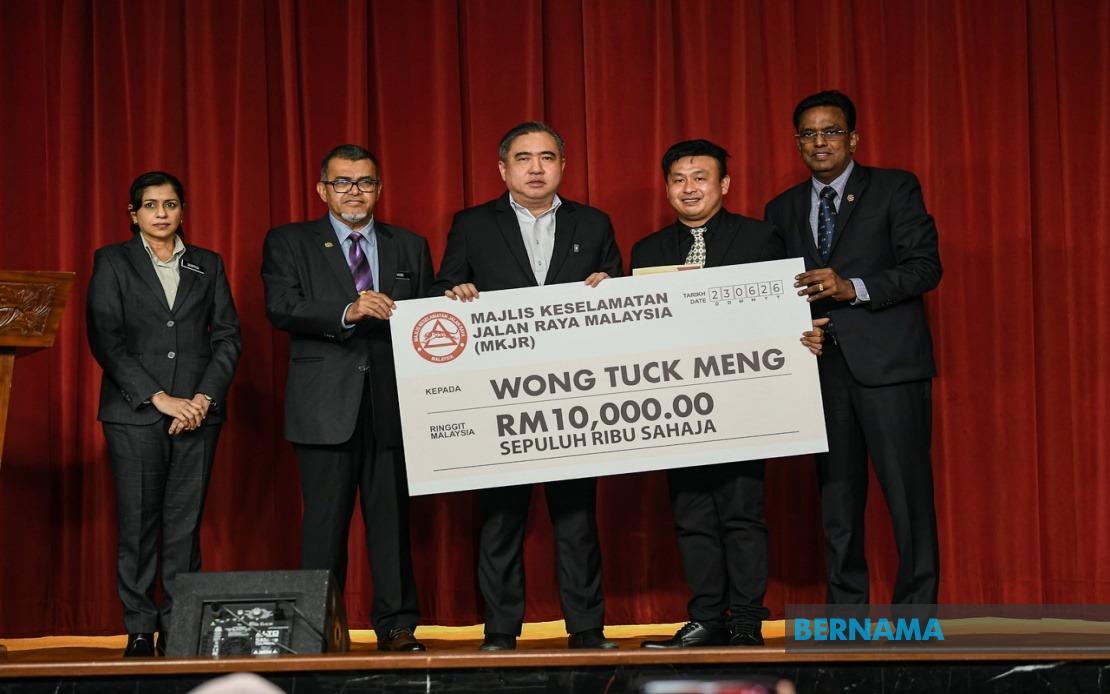
Wong Tak Ming, the lorry driver whose split-second decision prevented what could have been a deadly motorway disaster, was formally honoured at Parliament today with a Special Certificate of Appreciation and RM10,000 in recognition of his lifesaving actions. The award, funded by the Malaysian Road Safety Council, acknowledges Wong's extraordinary presence of mind during an incident on June 15 near the Menora Tunnel in Perak that threatened the lives of 21 bus passengers.
Transport Minister Anthony Loke presented the recognition at a special ceremony held at the Parliament building, describing Wong's intervention as nothing short of heroic. Loke emphasised that Wong's actions, carried out without thought for his own safety, prevented a potential tragedy by stopping an express bus that had suddenly lost control while travelling downhill toward Kuala Lumpur from Kedah. The minister noted that such examples of civic responsibility and quick thinking are increasingly rare, and Wong's willingness to put himself at risk to protect strangers deserves the highest commendation from Malaysian society.
The incident unfolded when the express bus encountered a mechanical failure that caused it to lose control on the downhill section of the Menora Tunnel approach. Faced with an out-of-control vehicle bearing down on his lorry, Wong made a series of calculated decisions that ultimately saved multiple lives. Rather than panicking or attempting to evade the bus completely, Wong remained composed and allowed the bus to make contact with his vehicle. He then used his lorry as a braking mechanism, gradually slowing the runaway bus while simultaneously steering both vehicles closer to the guardrail to bring them to a controlled stop away from the path of oncoming traffic.
Wong's tactical thinking extended beyond simply stopping the vehicles. Understanding that the danger was not contained to his immediate vicinity, he acted to warn other drivers in the vicinity of the hazard. By sounding his horn forcefully, Wong alerted motorists ahead to the emergency situation developing behind them, giving them precious seconds to move clear of potential harm. This additional action demonstrated that Wong's heroism was not limited to a single split-second decision but rather a sustained chain of rational, life-preserving choices made under extreme pressure.
When asked about his remarkable composure during the crisis, Wong deflected much of the praise, attributing his actions to basic human instinct and concern for preserving life. He explained that from his vantage point, there remained sufficient distance between his vehicle and the bus to allow for intervention. This distance, which another driver might not have noticed or might have used to simply escape the situation, Wong recognised as an opportunity to act. His willingness to sacrifice his own safety by allowing the bus to collide with his lorry rather than swerving away demonstrates a form of moral courage that transcends professional duty.
The recognition extended beyond the executive branch, as the Dewan Rakyat formally expressed its gratitude for Wong's actions. Deputy Speaker Datuk Dr Ramli Mohd Nor conveyed Parliament's collective appreciation following Transport Minister Loke's tabling of the Road Transport (Amendment) Bill 2025 for its second reading. This parliamentary acknowledgement elevates Wong's actions from an isolated incident to a matter of national significance, signalling that Malaysia's legislative body recognises the importance of celebrating and encouraging such conduct among the general public.
The viral spread of video footage capturing the incident across social media platforms played a crucial role in bringing Wong's actions to the attention of government authorities and the broader public. The documentary evidence of his calm decision-making under pressure sparked widespread discussion online, with many Malaysians expressing their gratitude for his intervention and their admiration for his character. This organic public recognition, following the official government award, underscores the deep resonance his actions have had with ordinary Malaysians who depend on the roads daily.
The significance of Wong's actions extends beyond the immediate lives saved to raise important questions about road safety culture in Malaysia. Incidents involving express buses losing control remain a persistent concern on Malaysian highways, particularly on routes through hilly terrain such as the Perak corridor. Wong's intervention highlights both the vulnerability of passengers in such vehicles and the potential for civilian intervention to prevent catastrophe when emergency systems fail. His award serves as a reminder that road safety is not solely the responsibility of authorities and vehicle operators but also depends on the vigilance and moral responsibility of individual road users.
For the transport sector and safety officials, Wong's example provides a powerful case study in emergency response and crisis management. His actions suggest that passengers and other motorists need not be passive victims of mechanical failure or human error on the roads. The deliberate, measured nature of his response to an emergency—avoiding panic while making rapid, life-saving decisions—offers insights into how drivers can be better trained to respond to unexpected hazards. The award for Wong therefore carries implications for broader road safety education and awareness campaigns across Malaysia.