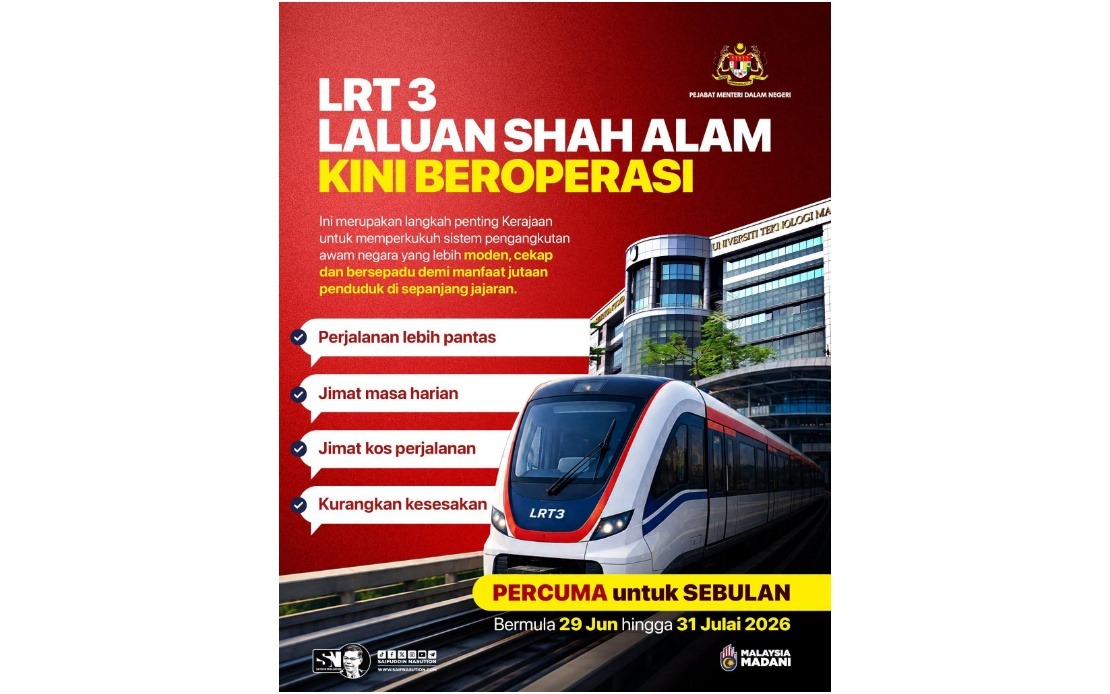
The inauguration of the Shah Alam Line LRT3 represents a significant milestone in the MADANI Government's broader strategy to modernise Malaysia's public transport landscape, according to Home Minister Datuk Seri Saifuddin Nasution Ismail. Speaking through a social media statement, Saifuddin positioned the new rail corridor as tangible proof of the administration's commitment to delivering efficient, integrated transit solutions that directly benefit ordinary Malaysians navigating their daily routines.
The new line addresses a persistent challenge facing the Klang Valley region, where congestion along key transport corridors has long strained commuter schedules and driving habits. By introducing this additional rail option, the government aims to redistribute passenger demand away from roads increasingly saturated during peak hours. The corridor served by LRT3 encompasses Shah Alam, Klang, Subang and surrounding municipalities—areas home to hundreds of thousands of workers, students and residents whose commuting decisions shape traffic patterns across the region.
Beyond simply adding a third line to the existing Light Rail Transit network, the service promises measurable improvements to daily life quality. Shorter travel times translate directly into reclaimed hours for commuters, while reduced reliance on private vehicles lowers fuel expenditure and associated vehicle maintenance costs. For households already burdened by rising living expenses, these savings accumulate meaningfully over months and years. The environmental dimension, though not explicitly highlighted, offers additional community benefits through reduced emissions across one of the country's most populated corridors.
Prime Minister Datuk Seri Anwar Ibrahim launched the line's operations by announcing a promotional free-fare period extending from June 29 through July 31. This two-month window covers both the main LRT3 service and feeder bus networks operated by Prasarana Malaysia Bhd, creating a comprehensive trial opportunity for potential users. The strategy reflects calculated government thinking: by eliminating cost barriers temporarily, officials can demonstrate service convenience to sceptical motorists who might otherwise dismiss rail travel without experiencing it firsthand.
Saifuddin's public messaging strategy emphasised accessibility and inclusivity, specifically targeting residents, workers and students along the route. Rather than framing LRT3 merely as infrastructure, he positioned it as an invitation—a chance for people to temporarily abandon personal vehicles and discover whether public transit meets their daily needs. This approach acknowledges a critical behavioural challenge: many Malaysian commuters, particularly in suburban areas like Shah Alam and Klang, have become accustomed to driving and require genuine incentive to reconsider transportation choices.
The free-travel initiative also serves a political function within the broader MADANI development narrative. By making the service accessible at zero cost, the government demonstrates direct commitment to improving living standards for ordinary Malaysians. This approach gains particular resonance in constituencies where transport costs burden working-class commuters disproportionately. The symbolic gesture of inviting people to "leave your car behind" resonates with younger voters and environmentally conscious demographics who view public transport expansion as essential to urban livability.
Investment in rail infrastructure like LRT3 reflects strategic prioritisation of what the Home Minister termed "the government's strategic investments." Behind this language lies significant capital expenditure, project management complexity and multi-year planning. The successful delivery of LRT3 signals administrative competence and forward-thinking governance—qualities governments emphasise when building public confidence. For Malaysian voters evaluating MADANI's performance, tangible transport improvements offer concrete evidence supporting claims of improved governance.
The geographic scope of the new line carries particular significance for the Klang Valley, Malaysia's industrial and commercial heartland. Efficient public transport in this region influences broader economic productivity, since congestion directly impairs business operations and worker punctuality. By easing movement through this crucial zone, LRT3 contributes to economic efficiency in ways that ripple beyond individual commuter convenience. Companies benefit when employees arrive reliably; logistics networks function more smoothly when traffic flows predictably.
Saifuddin's emphasis on feeder bus services alongside rail suggests the government recognises that rail-only solutions prove insufficient without comprehensive first-mile and last-mile connectivity. Many commuters cannot walk directly to LRT stations, so bus networks become essential for system utility. This integrated thinking demonstrates policy sophistication—the willingness to coordinate across different transport modes rather than treating them in isolation. For Malaysian readers evaluating public transport quality, this holistic approach offers hope that the system might actually function as seamlessly as government rhetoric suggests.
The free-fare period carries implicit risk alongside its promotional benefits. Some commuters will try LRT3, find it convenient and become long-term users; others will revert to private vehicles once charges resume. Government planners clearly hope that positive first experiences overcome ingrained transportation habits, but the transition from free trials to paid operations often proves psychologically challenging for users. How commuters respond when fares commence in August will reveal whether this promotional strategy succeeded in genuinely converting motorists to transit-dependent patterns.
For the broader Southeast Asian context, Malaysia's LRT3 expansion exemplifies middle-income countries' growing investment in metro systems as cities expand beyond road-based solutions. Regional cities from Bangkok to Jakarta face similar congestion challenges, and Malaysia's approach—combining infrastructure expansion with temporary incentive schemes—offers instructive lessons. The success or struggles of LRT3's operational phase may influence transport planning decisions across the region.
The MADANI Government's positioning of LRT3 as a flagship initiative suggests transport modernisation will feature prominently in its political narrative moving forward. Continued investment in rail expansion, proper maintenance, fare policy and ridership growth will become barometers by which voters judge governmental performance. In this sense, every commuter boarding LRT3 between now and August represents a small political wager—a test of whether government promises translate into functional improvements to Malaysian urban life.

