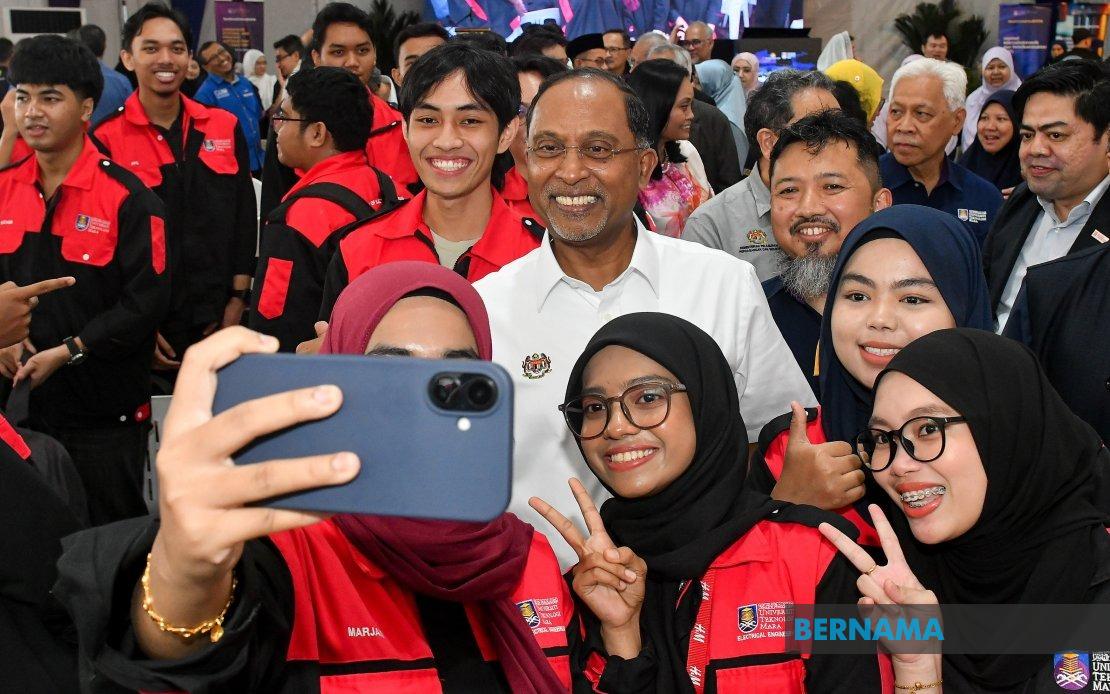
The launch of the Light Rail Transit 3 Shah Alam Line has emerged as a timely infrastructure development for Universiti Teknologi MARA Shah Alam, where the new transit service is already demonstrating tangible benefits for student mobility and regional connectivity across the Klang Valley. Higher Education Minister Datuk Seri Dr Zambry Abd Kadir underscored these advantages during a recent visit to campus, noting the evident enthusiasm among the student population who previously faced mounting frustrations with daily traffic congestion around the university precinct.
Prime Minister Datuk Seri Anwar Ibrahim catalysed adoption of the new line by announcing complimentary fares for all passengers throughout June 29 to July 31, a promotional period designed to familiarise commuters with the service and encourage shift away from private vehicle dependency. This temporal incentive arrives at a critical juncture as the Shah Alam area experiences accelerating development, making reliable public transport increasingly essential for managing vehicular pressure on local roads. The UiTM Shah Alam Station itself forms part of a comprehensive 20-station network spanning from Bandar Utama through to Johan Setia, with intermediate stops including Kayu Ara, Damansara Idaman, Subang, Glenmarie 2, Stadium Shah Alam, and multiple Shah Alam municipal stations.
Beyond immediate commuting convenience, the transit infrastructure reduction in transportation expenses represents a meaningful economic benefit for students whose household budgets often face strain. The Klang Valley connectivity dimension proves particularly significant given the economic integration of this metropolitan region, where employment, educational, and commercial opportunities increasingly cluster across multiple urban nodes rather than concentrated in single locations. For UiTM Shah Alam learners undertaking internships, campus visits, or extracurricular activities across the broader conurbation, the LRT3 service materially expands accessibility without proportional cost escalation.
Concurrently, Zambry articulated a broader institutional mandate during his campus visit, unveiling the Semiconductor@UiTM initiative as evidence of UiTM's repositioning within Malaysia's evolving technological economy. This strategic programme directly operationalises the RM20 million government allocation into tangible infrastructure development, curriculum enhancement, and expertise cultivation aligned with international semiconductor industry benchmarks. The initiative explicitly targets the National Semiconductor Strategy objectives, ensuring Malaysia's educational pipeline produces technical professionals equipped to sustain the country's position within global semiconductor manufacturing and design ecosystems.
The timing of this educational investment reflects strategic recognition that Malaysia's semiconductor sector, currently commanding 13 per cent of the global market and generating over RM300 billion in annual economic value, faces mounting talent acquisition challenges as production becomes increasingly sophisticated and competitive. UiTM's enhanced Electrical and Electronics Engineering programmes, supported by upgraded teaching facilities and industry-embedded curriculum development, position the university as a credible contributor to workforce development in this strategically critical sector. This approach extends beyond traditional classroom pedagogy to incorporate direct engagement with industry practitioners and exposure to contemporary technological systems operating within global semiconductor supply chains.
The cross-pollination between academic institutions and commercial semiconductor enterprises constitutes an underappreciated dimension of this initiative. By facilitating student interaction with actual industry participants, UiTM students gain pragmatic exposure to technological challenges, problem-solving methodologies, and professional expectations that classroom environments cannot replicate. This experiential learning pathway proves particularly valuable in engineering disciplines where hands-on familiarity with cutting-edge equipment and methodologies directly influences graduate employability and contribution trajectories within the sector.
Zambry contextualised the Semiconductor@UiTM development as emblematic of broader government resource conversion into sustainable human capital accumulation rather than ephemeral spending. The framing emphasises long-term economic sustainability through workforce development that extends Malaysia's technological competitive advantage beyond manufacturing cost advantages, which face erosion from higher-wage competitors in neighbouring economies. By establishing UiTM as a recognised excellence centre for semiconductor engineering talent production, the initiative implicitly signals to multinational semiconductor corporations that Malaysia maintains a credible domestic talent pipeline, thereby supporting investment decisions in favour of local operations.
The ministerial visitation sequence itself—commencing with an LRT3 demonstration journey from Stadium Shah Alam Station to UiTM Shah Alam Station followed by formal programme inauguration—carried symbolic weight beyond ceremonial convention. This progression physically illustrated the infrastructural ecosystem supporting educational excellence, implicitly communicating to students and industry observers that government simultaneously invests in complementary transportation and human capital development. The accessibility dimension gains particular resonance within the semiconductor sector, where talent recruitment increasingly transcends geographic boundaries, making reliable commuting infrastructure a genuine competitive factor in attracting and retaining specialised personnel.
Looking forward, UiTM's achievement framework potentially establishes replicable benchmarks for other Malaysian universities seeking enhanced semiconductor sector integration. The Semiconductor@UiTM model combines facility modernisation, curriculum internationalisation, and industry partnership systematisation—elements transferable to alternative institutions and potentially applicable beyond semiconductor engineering to adjacent high-technology disciplines. If other universities successfully adopt comparable approaches, Malaysia's aggregate human capital production in semiconductor-related fields would scale accordingly, providing the sectoral workforce stability that global industry participants consider when evaluating regional investment locations.
The convergence of improved student mobility through LRT3 accessibility and strategic educational repositioning through Semiconductor@UiTM reflects coherent government policy recognising that economic competitiveness in high-technology sectors demands both workforce preparation and liveable urban infrastructure. Students attracted to UiTM's enhanced semiconductor programmes gain not merely superior technical instruction but also reduced commuting frictions and expanded metropolitan connectivity—cumulative advantages that influence talent development outcomes. This integrated approach contrasts with narrower infrastructure-only or education-only interventions, suggesting Malaysian policymakers increasingly appreciate how complementary investments across multiple domains compound effectiveness in addressing sectoral development objectives.

