The Islamic calendar's new year has become a moment for reflection and renewal across Malaysia, with Maal Hijrah 1448H/2026 celebrations held nationwide emphasising the spiritual and practical dimensions of hijrah—the concept of positive migration and transformation. The observances, which took place on June 17, positioned hijrah not merely as a historical event but as an ongoing principle for personal and collective progress, stronger governance, and deeper unity within the Muslim community. This year's theme, "MADANI Dihayati, Ummah Diberkati" (MADANI Lived, Ummah Blessed), reflected efforts to connect Islamic values with Malaysia's governance framework and national aspirations.
The nationwide festivities comprised a range of spiritual and educational activities designed to engage both religious scholars and the general public. Quran recitations, thematic religious talks, and formal award presentations structured the celebrations as occasions for acknowledging exemplary Islamic leadership and community service. The emphasis on quality leadership resonated throughout the ceremonies, with organisers framing the hijrah concept as directly relevant to building stronger institutions, promoting public welfare, and establishing a more robust civilisation rooted in Islamic principles. This framing suggests growing efforts to integrate religious observance with national development priorities, a pattern increasingly common in Malaysia's approach to Islamic affairs.
Among the highest-ranking attendees were Deputy Prime Minister Datuk Seri Fadillah Yusof and Minister in the Prime Minister's Department (Religious Affairs) Dr Zulkifli Hasan, whose presence underscored the government's formal recognition of Maal Hijrah's significance to Malaysia's multicultural society. The main ceremony, which drew approximately 5,000 participants, operated as a platform for honouring individuals whose contributions have shaped Islamic thought, education, and community development. The attendance of senior government figures alongside religious leaders symbolises the alignment between state institutions and the Islamic religious establishment, a relationship that remains central to Malaysia's constitutional framework.
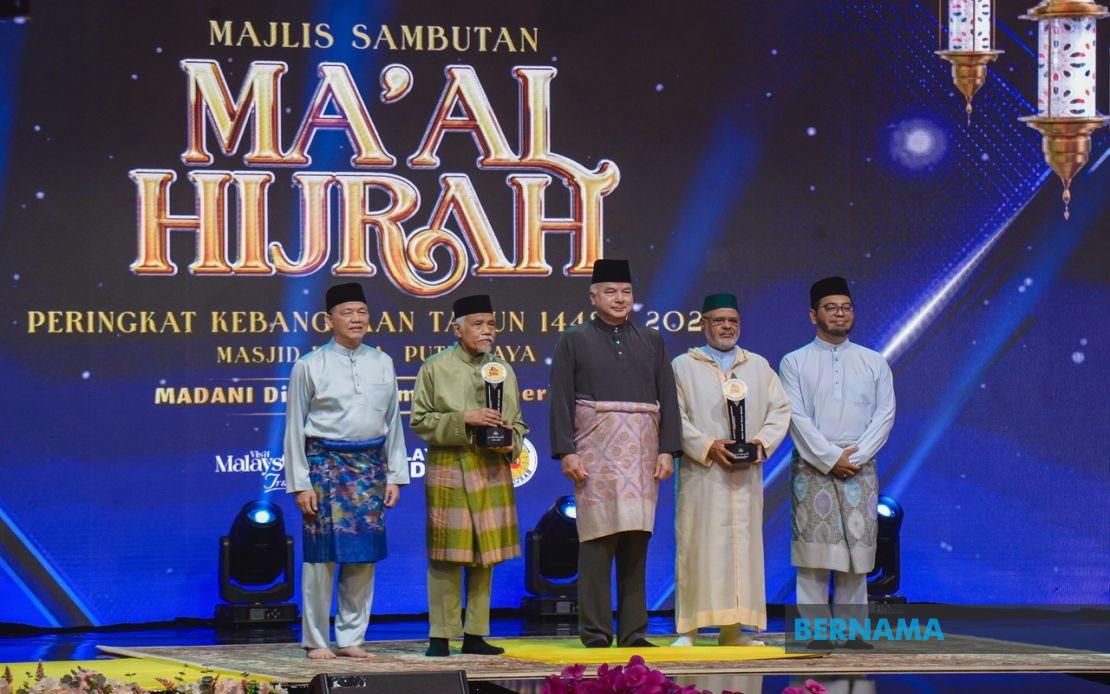
The National Tokoh Maal Hijrah Award, presented by Sultan Nazrin Shah, Sultan of Perak, recognises outstanding Islamic scholarship and leadership at the national level. This year's recipient, Prof Emeritus Datuk Dr Osman Bakar, rector of the International Islamic University Malaysia (IIUM), represents the category of institutional leaders who have shaped Islamic higher education in the region. IIUM's role as a pioneering Islamic university in Southeast Asia has positioned it as a key player in developing Islamic thought relevant to contemporary challenges, making Osman Bakar's recognition particularly significant for Malaysia's educational sector and its aspirations in religious scholarship.
The International Tokoh Maal Hijrah Award went to Dr Ahmad Al-Raysuni, a prominent Moroccan Islamic jurisprudence scholar, reflecting Malaysia's engagement with leading Islamic intellectuals from beyond Southeast Asia. This choice indicates an intentional effort to position Malaysian Maal Hijrah celebrations within a broader Islamic world context, acknowledging that contemporary Islamic leadership extends across continents and theological traditions. Such recognition also suggests Malaysia's interest in learning from and engaging with diverse Islamic scholarly perspectives, particularly in fields like jurisprudence that inform governance and religious administration.
Parallel ceremonies in other states demonstrated how Maal Hijrah observances have become decentralised yet coordinated expressions of Islamic identity across Malaysia's federal system. In Sabah, celebrations attended by approximately 1,000 participants featured state-level dignitaries, including Chief Minister Datuk Seri Hajiji Noor and organising committee chairman Datuk Dr Mohd Arifin Mohd Arif, who holds the portfolio of Local Government and Housing Minister. The presence of Tun Musa and Toh Puan Faridah Tussin added ceremonial weight to the state-level observance, reflecting the integration of these celebrations into official state functions.
The Tokoh Maal Hijrah Award categories recognising individual achievement across gender lines demonstrated a structured approach to honouring diverse contributions to Islamic community life. Community activist Datuk Ag Sharin Alimin, former director of the Sabah Islamic Religious Affairs Department, received recognition in the male category, while former Sabah deputy state secretary Datuk Masnah Matsalleh was honoured in the female category. These appointments reflect efforts to acknowledge women's roles in religious administration and community leadership, an area where Malaysian institutions have gradually expanded recognition.
One of the most poignant moments involved the presentation of the Tokoh Maal Hijrah Award to 95-year-old Quran teacher Jusoh @ Muda Ismail, identified as the adopted son and student of the late Tuan Guru Haji Mat Lintar, a renowned Quranic scholar. This recognition bridges generations of Islamic learning and preserves continuity with Malaysia's pre-modern Islamic educational traditions. Jusoh's longevity and continued dedication to Quranic teaching exemplifies the lived practice of Islamic commitment that complemented the institutional and scholarly recognitions awarded elsewhere in the ceremonies.
The nationwide character of Maal Hijrah celebrations reflects how Islamic observances have evolved from purely religious occasions into events integrating government participation, award ceremonies, and public engagement strategies. For Malaysian readers, these celebrations represent moments when Islamic values are formally positioned as foundational to national identity and governance, even in a constitutionally secular federal system. The emphasis on hijrah as a principle of continuous improvement and transformation carries implications for how Islamic concepts are mobilised to address contemporary challenges in education, leadership, and community cohesion.
For Southeast Asian observers more broadly, Malaysia's approach to Maal Hijrah illustrates how Muslim-majority nations balance religious observance with state functions and international engagement. The inclusion of international Islamic scholars alongside domestic award recipients signals Malaysia's positioning within global Islamic networks while maintaining specific national and regional contexts. These celebrations ultimately function as occasions for reaffirming commitments to Islamic principles while demonstrating their perceived compatibility with modern governance, institutional development, and cross-cultural dialogue in an increasingly complex regional landscape.