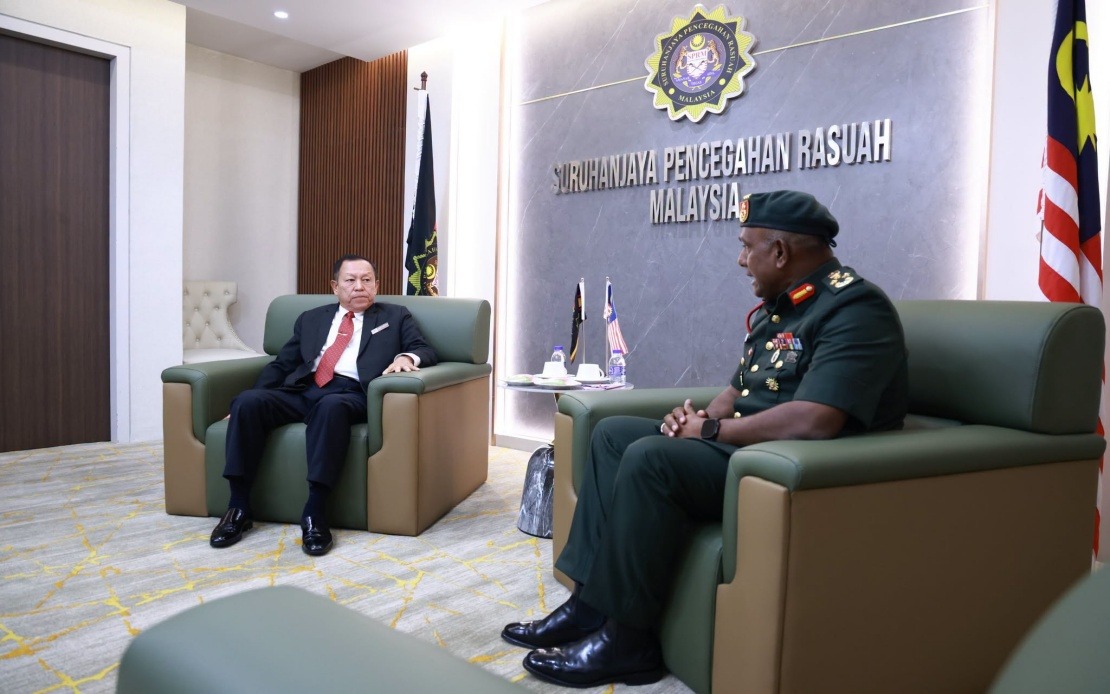
The Malaysian Anti-Corruption Commission and the Malaysian Armed Forces have reaffirmed their determination to deepen institutional cooperation in the ongoing campaign against graft and misconduct. The commitment was solidified during a formal engagement at MACC headquarters in Putrajaya on July 7, marking an important convergence between two of the country's most crucial oversight bodies tasked with protecting national interests and upholding public accountability.
MACC Chief Commissioner Datuk Seri Abd Halim Aman underscored the critical importance of the existing partnership, characterising the relationship as longstanding and mutually beneficial. He expressed optimism that collaborative momentum would gather strength, positioning the two institutions as complementary forces in the national anti-corruption architecture. The commissioner's remarks reflected an understanding that combating corruption effectively requires coordinated action across multiple government agencies, particularly those with distinct mandates and access to different intelligence streams.
Central to the expanded cooperation framework are three strategic pillars: intelligence sharing, information exchange, and governance enhancement. These areas represent recognised gaps where a fragmented approach has historically weakened enforcement effectiveness. By establishing clearer channels for intelligence dissemination between the MACC's investigative capacity and the Armed Forces' security apparatus, both organisations can identify patterns of misconduct that might otherwise escape detection. Information exchange protocols are similarly critical, enabling rapid cross-referencing of suspicious transactions, procurement irregularities, and personnel conduct issues that span both civilian and military spheres.
The governance enhancement component carries particular significance for Southeast Asia's security environment. Military institutions across the region have increasingly become targets for corruption investigations, with procurement scandals, equipment misappropriation, and defence contractor bribery featuring prominently in recent years. By proactively strengthening internal governance mechanisms and ethical standards, the Malaysian Armed Forces signals a commitment to institutional integrity that resonates beyond its ranks. This approach contrasts with defensive postures adopted elsewhere, positioning Malaysia as a regional exemplar of military accountability.
Lieutenant General Datuk Fazal Abdul Rahman, who recently assumed his role as director-general of the Malaysian Defence Intelligence Organisation, articulated the Armed Forces' perspective during the engagement. His remarks emphasised that military commitment to anti-corruption extends beyond passive compliance with external oversight. Instead, the service branches are adopting proactive internal discipline mechanisms and prioritising professional standards across all operational domains. This framing reflects a modernised understanding of military governance, where institutional reputation and public trust constitute strategic assets comparable to hardware and personnel capacity.
The timing of this high-level coordination is noteworthy given Malaysia's broader anti-corruption trajectory. Over the past decade, the MACC has expanded its investigative reach and prosecutorial success rates, pursuing cases involving defence procurement irregularities and high-ranking military officials. Formalising intelligence-sharing protocols with the Armed Forces potentially accelerates case development and strengthens evidentiary chains. Conversely, military leadership gains assurance that corruption investigations proceed through legitimate institutional channels rather than through ad-hoc political pressure or selective enforcement.
For Malaysian citizens and businesses, the strengthened cooperation carries practical implications. Legitimate defence contractors can expect more transparent and consistent procurement processes, reducing opportunities for well-connected competitors to win contracts through illicit means. Military personnel facing misconduct allegations gain procedural safeguards through coordinated investigation protocols that reduce the risk of arbitrary action. The broader business community benefits from demonstrated state capacity to identify and prosecute corruption schemes that undermine fair competition and inflate government costs.
The presence of senior officials from both the MACC Intelligence Division and the Armed Forces Security and Counter Intelligence Directorate at the formal engagement indicates that implementation machinery is already being activated. These technical-level personnel will likely develop detailed memoranda of understanding specifying information-sharing procedures, classification protocols, and operational boundaries. Such groundwork transforms rhetorical commitment into functional cooperation, distinguishing genuine institutional reform from ceremonial announcements that populate government public relations calendars.
Regionally, Malaysia's approach to military-civilian anti-corruption coordination offers lessons for neighbouring countries wrestling with similar challenges. Thailand, Indonesia, and the Philippines have all grappled with defence sector corruption; explicit institutional mechanisms for intelligence sharing between military and civilian oversight bodies could strengthen enforcement in those contexts. Malaysia's willingness to publicly announce such cooperation also sends diplomatic signals about institutional maturity and resistance to corruption as a governance principle.
The sustainability of this partnership will ultimately depend on several factors beyond initial commitment statements. Political stability in Malaysia must persist to prevent anti-corruption priorities from shifting with administration changes. Budget allocations to both agencies need to sustain specialised units dedicated to intelligence analysis and coordination. Career incentives must favour officers who build inter-institutional relationships over those who jealously guard agency turf. These structural requirements remain invisible in formal announcements but determine whether cooperation deepens or diminishes over subsequent years.
Looking ahead, the MACC and Armed Forces face an opportunity to establish themselves as a model inter-institutional partnership within Malaysia's governance ecosystem. Success in this domain could catalyse similar coordination arrangements with other enforcement bodies including the police, customs authorities, and financial intelligence units. A genuinely integrated anti-corruption framework would represent meaningful institutional evolution in a region where corruption remains a persistent challenge to effective governance and economic development.

