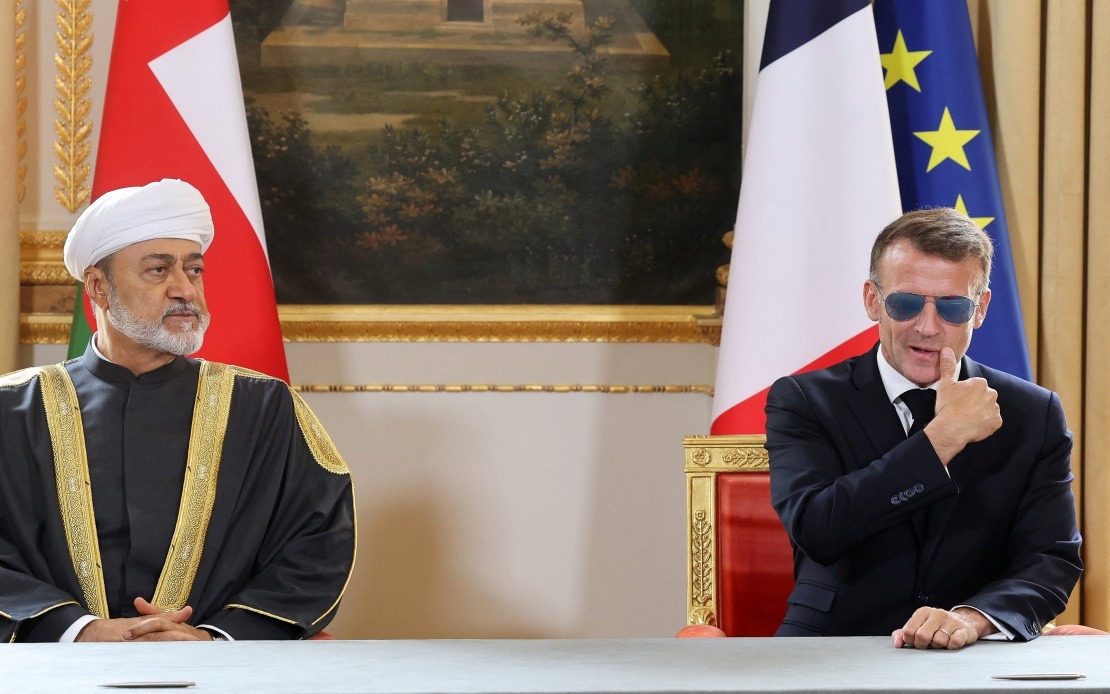
French President Emmanuel Macron donned his now-famous aviator sunglasses during a Monday meeting with the Sultan of Oman, reigniting discussion about the accessory that has become an unlikely focal point of international attention. Macron wore the shades while greeting Sultan Haitham bin Tariq at the Élysée Palace and maintained them throughout their subsequent discussions, prompting French media outlets to revisit the story behind the distinctive eyewear.
According to sources close to the French president, Macron's decision to wear the sunglasses was purely medical in nature. French officials confirmed that the president has been managing an eye inflammation condition, the same ailment that prompted him to wear protective eyewear for approximately two weeks beginning in January. The recurrence of the issue explains his appearance at the Oman meeting, though the timing meant the sunglasses once again captured public attention in an age of instant social media scrutiny.
The sunglasses first achieved global prominence when Macron wore them at the World Economic Forum in Davos in January, an event attended by world leaders and influential figures from business and politics. That appearance sparked considerable international commentary, with US President Donald Trump notably mocking the French leader's choice of eyewear. The incident highlighted how even practical medical decisions by major political figures can become subjects of widespread public discourse and humor across different countries and cultures.
French commentators and social media users drew comparisons between Macron's appearance and Hollywood actor Tom Cruise's iconic look in the Mission Impossible film franchise, reflecting how fashion choices by world leaders often invite cultural references and lighthearted criticism. The mockery extended across national boundaries, demonstrating the amplified scrutiny that accompanies every aspect of prominent political figures' public appearances in our interconnected world. What might have been a minor health accommodation in an earlier era became a topic of international jest.
The unexpected celebrity status of Macron's sunglasses has had tangible commercial consequences for the eyewear industry. Henry Jullien, a prestigious French luxury eyewear manufacturer, reported receiving a substantial increase in customer inquiries following Macron's high-profile wearing of their product. The company capitalized on this unexpected publicity by continuing to market the specific model, utilizing photographs of Macron himself in their promotional materials—a form of inadvertent celebrity endorsement that money cannot typically buy.
This phenomenon illustrates how even ostensibly trivial aspects of political life can influence consumer behavior and market trends. The surge in interest from Henry Jullien demonstrates that fashion and lifestyle choices by world leaders carry commercial weight beyond the realm of politics. For a luxury goods manufacturer, association with a national leader provides credibility and aspirational appeal that resonates with consumers seeking products connected to power and prestige.
For Malaysian and Southeast Asian observers, the Macron sunglasses saga offers insights into the nature of modern political communication and the blurred boundaries between governance and celebrity culture. Regional leaders increasingly operate in a global media environment where their public appearances are instantly dissected, analyzed, and often transformed into humorous internet content. The incident underscores how geographically distant political figures can become subjects of regional discussion and commentary.
The medical explanation for Macron's eyewear choice also reflects broader patterns in how political figures communicate health information to the public. By having officials clarify the medical reasoning behind his appearance, Macron's administration sought to contextualize what might otherwise appear as an unusual fashion choice. This demonstrates a calculated approach to managing political imagery and public perception, where transparency about health matters can preempt speculation and criticism.
The recurring nature of Macron's eye condition suggests that French officials may face similar situations in future international engagements. The question of how political figures present themselves to domestic and international audiences remains relevant, particularly for nations seeking to project strength and stability on the global stage. The Oman meeting thus represents not an isolated incident but potentially a recurring element of Macron's public profile.
Meanwhile, the Oman-France meeting itself held diplomatic significance independent of Macron's eyewear choices. Sultan Haitham bin Tariq has been strengthening Oman's international partnerships, and France maintains substantial interests in the Gulf region. The talks likely covered trade, security cooperation, and regional matters, though media coverage inevitably focused on the visual spectacle of the sunglasses rather than substantive policy discussions.
The international response to Macron's appearance reflects evolving standards in political discourse, where visual elements often overshadow policy substance in news cycles. Leaders from smaller nations and emerging markets increasingly find their international visibility dependent on factors beyond traditional diplomatic channels, as media attention gravitates toward memorable images and personality-driven narratives. The Macron sunglasses phenomenon exemplifies how modern politics intersects with entertainment and consumer culture in ways that previous generations of political leaders rarely experienced.
Looking forward, the incident serves as a reminder that even leaders of major European powers cannot fully control their public image in an age of ubiquitous digital media and social commentary. The next time Macron appears at an international forum wearing sunglasses, observers across Asia, Europe, and beyond will likely recall this moment, demonstrating how a single image can achieve remarkable staying power in global consciousness.

