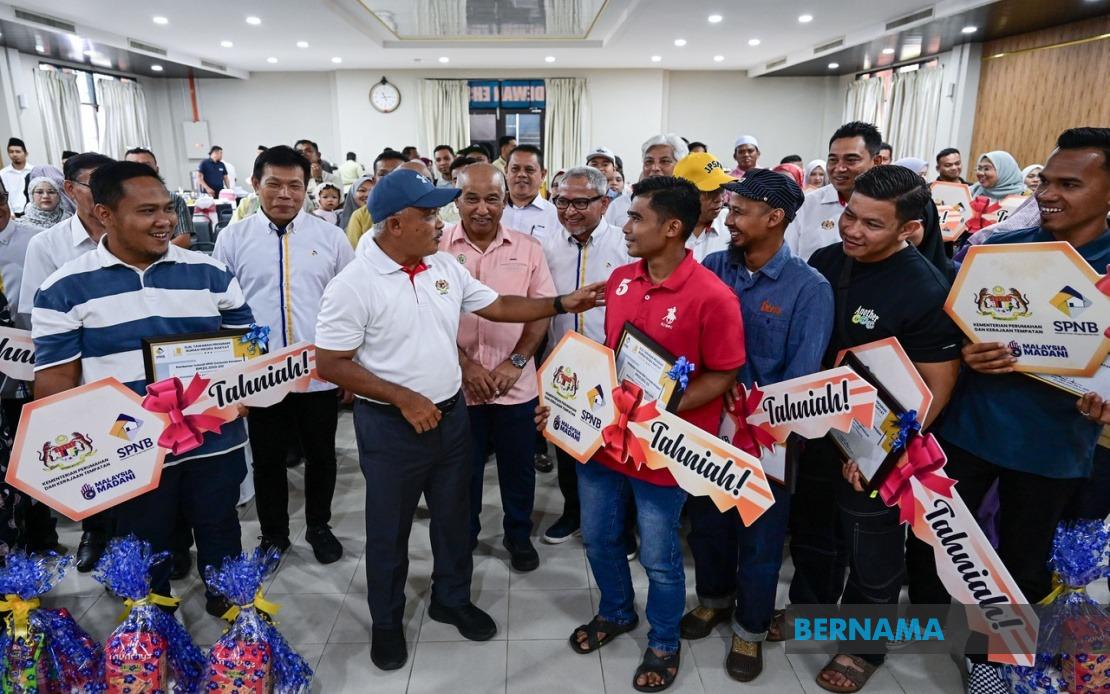
Fifty families in the Kuala Terengganu and Kuala Nerus parliamentary constituencies have become homeowners through the Rumah Mesra Rakyat (RMR) programme, receiving either completed dwellings or construction contracts in a ceremony held at Dewan Ehsan, Felda Wilayah Timur. The initiative, managed by Syarikat Perumahan Negara Berhad under the Housing and Local Government Ministry, represents a significant milestone in the MADANI Government's approach to housing policy, which prioritises enabling lower-income families who already possess land to transition into safe, dignified accommodation.
The programme addresses a distinctive challenge within Malaysia's housing landscape: the gap between land ownership and actual home construction. Many lower-income households, particularly in rural and semi-urban areas, hold land titles but lack the financial capacity to build quality structures. Rather than constructing homes on government-owned plots, the RMR approach leverages existing private land ownership, allowing families to benefit from government-supported construction while maintaining their property assets. This model proves particularly relevant for Terengganu and other East Coast states where land ownership among lower-income groups is comparatively widespread.
According to Datuk Dr M. Noor Azman Taib, the ministry's secretary-general, the programme reflects a holistic vision of homeownership that transcends mere shelter provision. Officials characterise the initiative as a catalyst for comprehensive quality-of-life improvements, recognising that secure, comfortable housing creates foundations for family stability, educational outcomes, and economic participation. The framing shifts focus from viewing homeownership simply as addressing a basic need toward acknowledging its role as a long-term family investment and community-building tool.
Terengganu has emerged as a significant implementation hub for the RMR programme, with 680 units currently in various stages of development across the state, supported by a combined allocation of RM46.67 million. The distribution reflects geographic spread across parliamentary constituencies, with Kuala Terengganu accommodating 34 units and Kuala Nerus hosting 32 units. Progress metrics indicate robust execution: by May of the previous year, 246 units statewide had been completed and transferred to eligible recipients, while 154 additional units remained under active construction. This pipeline suggests sustained momentum, with approximately one unit in three still progressing through the building phase.
Nationally, the programme demonstrates considerable scale and longevity. Since its inception in 2002, RMR has distributed housing assistance to more than 80,000 families across Malaysia, establishing it as one of the nation's enduring affordability initiatives. Current nationwide implementation encompasses 3,900 units, of which 2,478 have been completed and handed over while 1,422 remain in construction phases. The budget allocation for 2026 targets an additional 6,545 units, signalling the government's commitment to accelerating delivery despite economic constraints and competing budgetary pressures.
The timing of this expansion carries particular significance given Malaysia's persistent housing affordability crisis. Urban centres continue experiencing rapid price escalation, while rural areas struggle with inadequate infrastructure and financing constraints. The RMR programme's emphasis on leveraging existing landholdings offers a practical pathway that avoids the astronomical costs associated with acquiring urban real estate. For East Coast states like Terengganu, where urbanisation pressures remain less acute than in Selangor or Kuala Lumpur, such initiatives can meaningfully shift homeownership accessibility for blue-collar workers, agricultural labourers, and informal-sector employees.
The recipients selected for assistance today represent diverse occupational and demographic backgrounds, though eligibility criteria typically prioritise households earning below specified income thresholds. The mix of completed homes and construction offers reflects different implementation stages within the programme's pipeline, enabling simultaneous delivery of immediate housing solutions alongside future expansion. Recipients of offer letters will transition through construction phases, typically spanning twelve to eighteen months, after which they receive completed homes with transferred titles.
Financing mechanisms underpinning the RMR programme typically involve government-subsidised construction costs, with beneficiaries paying contributions proportional to their income capacity. This sliding-scale approach distinguishes the initiative from purely market-driven housing schemes, embedding affordability protection into programme design. The subsidy structure recognises that lower-income households, even when owning land, lack capital reserves necessary for quality construction, thus government intervention addresses a market failure rather than enabling dependency.
For Southeast Asian policymakers observing Malaysia's housing strategies, the RMR model presents replicable elements worth considering. The focus on landholding rather than land acquisition reduces acquisition costs substantially, while government involvement in construction quality assurance protects beneficiaries from substandard development. Countries experiencing similar housing-ownership-without-shelter dynamics might adapt comparable approaches, particularly in contexts where land distribution patterns favour lower-income populations but construction finance remains inaccessible.
Terengganu's implementation progress suggests effective coordination between federal ministry oversight, state administrative machinery, and implementing agencies. The ceremony's location in Felda Wilayah Timur carries additional significance, recognising federal land development authority areas where beneficiary families often worked as smallholders or labourers. Housing assistance for such populations acknowledges long-standing employment relationships and community ties.
Moving forward, sustaining programme momentum requires addressing potential implementation bottlenecks. Construction material price volatility, skilled labour availability in smaller towns, and land title verification processes represent ongoing challenges. The 2026 target of 6,545 additional units demands efficient project management and possibly enhanced contractor capacity-building initiatives. Monitoring completion timelines and beneficiary satisfaction will prove crucial for maintaining programme credibility and public confidence.
The RMR programme's expansion reflects broader MADANI administration priorities emphasising inclusive economic participation and basic needs fulfillment. Homeownership traditionally represents a significant wealth-building pathway for lower-income households, and programmes enabling such access address inequality dimensions beyond immediate shelter concerns. As Malaysia navigates post-pandemic economic adjustment and employment restructuring, ensuring housing security for vulnerable populations takes on heightened importance for social cohesion and economic resilience.

