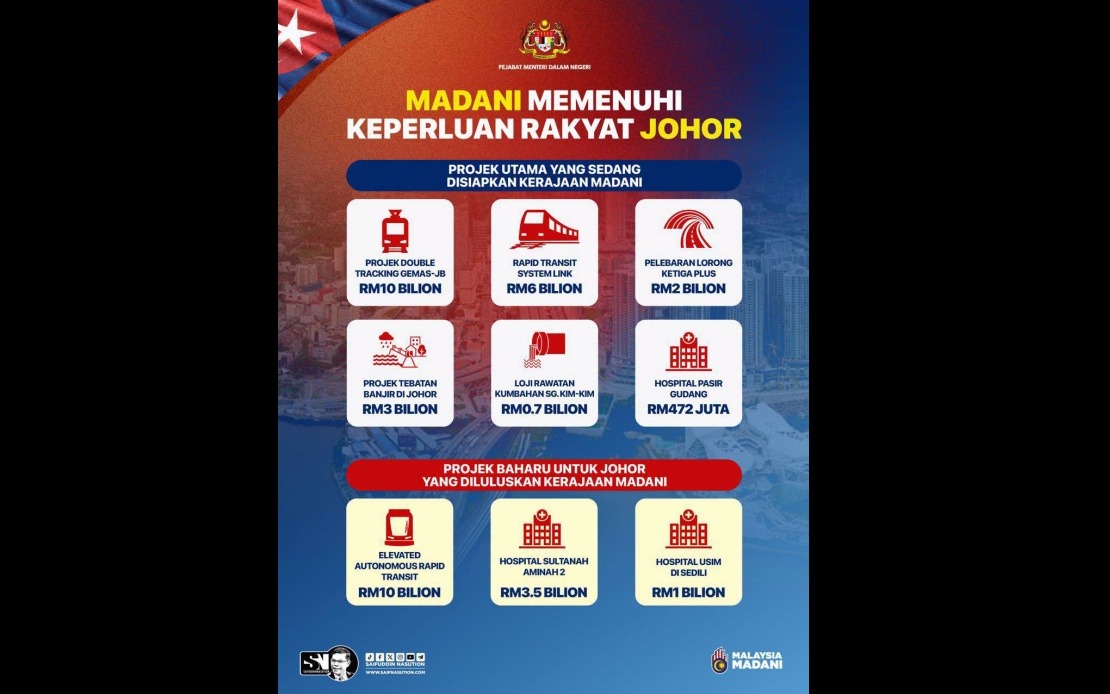
The federal government under Prime Minister Datuk Seri Anwar Ibrahim has renewed its commitment to steering equitable and sustainable development across Malaysia's states, with Johor emerging as a key showcase for this broader agenda. Speaking in Johor Bahru on June 29, Pakatan Harapan secretary-general Datuk Seri Saifuddin Nasution Ismail outlined how the MADANI framework intends to weave together infrastructure, healthcare, mobility, and environmental resilience into a cohesive development model that reaches ordinary Malaysians rather than serving abstract economic targets.
The Home Minister's remarks reflect a strategic pivot by the federal administration towards demonstrating tangible governance impact at the state level, particularly in a southern corridor state where development expectations remain high following recent political shifts. By positioning Johor as emblematic of nationwide development philosophy, the government signals that its approach transcends urban centres and concentrates on distributing growth benefits throughout the federation. This framing carries significance for regional readers given Johor's economic weight and its role as a bellwether for broader Southeast Asian development trends.
Among the cornerstone projects advancing in Johor are several that address longstanding infrastructure gaps and public welfare needs. The Gemas-Johor Bahru Electrified Double Tracking Project represents a major investment in rail connectivity, enhancing passenger and freight movement between the state and peninsular networks. Simultaneously, the Rapid Transit System Link and third lane widening of the PLUS Highway tackle congestion and commuter efficiency—issues affecting daily economic productivity and quality of life. These transport-focused initiatives underscore recognition that mobility infrastructure underpins broader development outcomes, from job accessibility to business competitiveness.
Flood mitigation emerges as another critical pillar of the government's Johor strategy, reflecting both climate change realities and historical vulnerability patterns in the state. The dedicated Johor flood mitigation project, alongside specific installations such as the Sungai Kim Kim Sewage Treatment Plant, address environmental management and public safety simultaneously. For Malaysian policymakers and regional observers, this integrated approach signals acknowledgement that modern sustainable development cannot isolate environmental stewardship from economic growth. Johor's experience with monsoon flooding has demonstrated that infrastructure investment without climate adaptation remains incomplete.
Healthcare expansion forms the third major component of the development blueprint. The Pasir Gudang Hospital, Sultanah Aminah Hospital 2, and USIM Hospital in Sedili collectively represent substantial investment in medical infrastructure across different zones of the state. These facilities address access gaps in secondary and tertiary care, particularly for populations in industrial and suburban areas. For regional analysis, this healthcare focus reflects evolving development priorities across Southeast Asia, where emerging economies increasingly recognise that human capital and health outcomes directly influence productivity and social stability.
The Elevated Autonomous Rapid Transit initiative warrants particular attention as a forward-looking infrastructure choice. E-ART technology represents adoption of innovative urban mobility solutions, positioning Johor as a testing ground for smart city principles at the Malaysian level. While such projects carry both promise and execution risks, their approval signals governmental intent to modernise transport systems beyond conventional approaches. For readers across the region, this technological dimension reflects broader trends wherein Southeast Asian states compete to position themselves as innovation hubs rather than merely adopting infrastructure models from developed economies.
Saifuddin Nasution's emphasis that development must be measured through citizen benefit rather than mere financial aggregates suggests an attempt to reframe how progress is communicated and evaluated. This framing acknowledges public criticism of past development initiatives that generated impressive statistics while delivering limited tangible improvement to ordinary people. By explicitly linking infrastructure investment to job creation, transportation efficiency, healthcare access, and living standards, the government articulates a theory of change that prioritises welfare outcomes. Such messaging carries weight in Malaysian political discourse, where citizen scepticism towards development promises remains elevated.
The concentration of major projects in Johor reflects both strategic logic and political calculation. As a major economic centre with significant manufacturing, port, and tourism sectors, Johor's development trajectory influences broader national economic performance. Investment here generates employment and tax revenue while serving as proof of concept for MADANI policies. Simultaneously, visible infrastructure development in Johor addresses electoral considerations given the state's political significance in national coalition building.
For Malaysia's regional position, these development commitments carry implications extending beyond state borders. Johor's connectivity to Singapore, Indonesia, and broader ASEAN trade networks means that transport, healthcare, and environmental improvements enhance not only local welfare but also regional integration capacity. The PLUS Highway widening and rail electrification projects facilitate cross-border commerce and movement, underpinning ASEAN Economic Community objectives. Similarly, environmental management addressing Sungai Kim Kim and flood resilience contributes to transnational resource management in the Strait of Malacca region.
The government's articulation of coordinated state-level development under a federal framework also signals institutional coordination between national and subnational governance tiers. Effective implementation of these diverse projects requires synchronisation among federal ministry agencies, state governments, and local authorities. Successfully delivering this portfolio would demonstrate that Malaysia's political system, despite occasional tensions between federal and state governments, can mobilise resources around shared development objectives.
However, delivering on this expanded agenda requires sustained funding, administrative capacity, and protection against scope creep and project delays that have historically plagued major infrastructure initiatives in Malaysia. Public scepticism regarding project completion timelines and cost overruns suggests that execution quality will determine whether these commitments translate into the citizen welfare improvements that officials emphasise. The next phase involves demonstrating that announcement of projects translates into genuine developmental outcomes that reshape how ordinary Johoreans experience daily life and economic opportunity.

