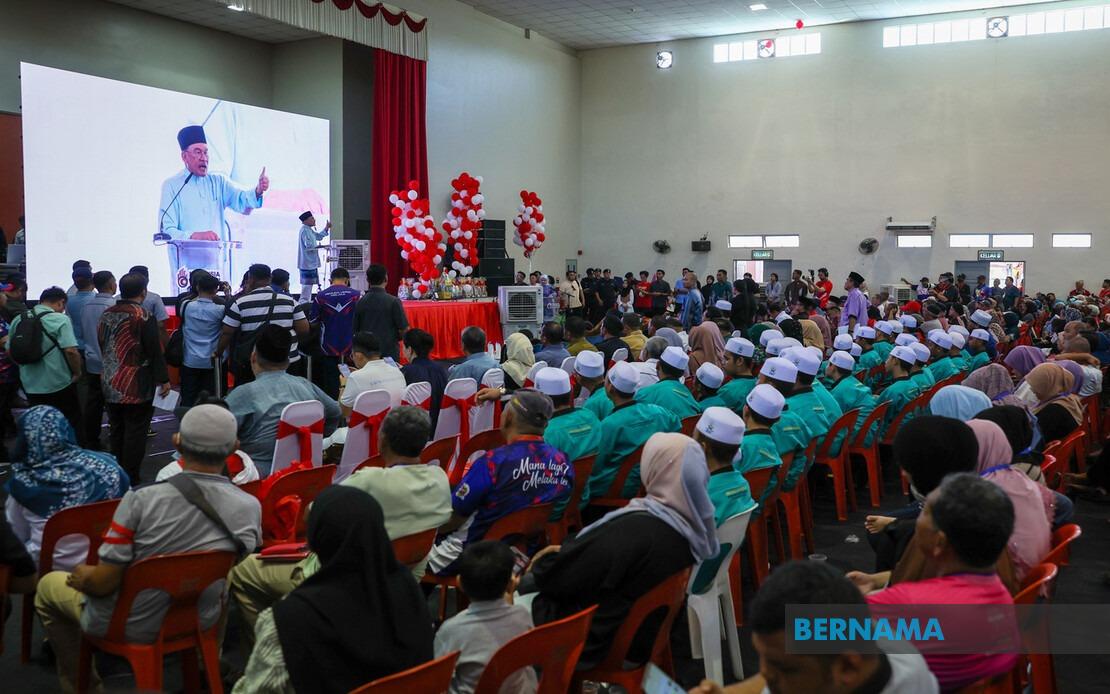
Prime Minister Datuk Seri Anwar Ibrahim has underscored the MADANI Government's dedication to providing equitable support across Malaysia's diverse education landscape, seeking to dispel concerns that backing Islamic institutions comes at the expense of vernacular schools. Speaking at the Gelombang MADANI Carnival in Alor Gajah, Melaka, on August 7, Anwar stressed that resources directed towards pondok schools and tahfiz institutions—which had suffered years of neglect—do not signal reduced commitment to Chinese and Tamil educational establishments. The Prime Minister's remarks reflect ongoing sensitivities around education policy in Malaysia's plural society, where resource allocation decisions carry symbolic weight beyond their immediate budgetary implications.
Anwar disclosed that funding packages for Chinese and Tamil schools have already been finalized and would be announced within two weeks in Kuala Lumpur, effectively providing a timeline for what some stakeholders have viewed as delayed action. This sequential announcement strategy appears designed to demonstrate governmental intent to maintain balanced support while acknowledging the historical backlog affecting Islamic educational institutions. The timing of these pronouncements matters considerably for community confidence, particularly among minority groups whose education systems have sometimes felt deprioritized in national development agendas. By committing to a specific announcement date, the Prime Minister has set a measurable benchmark against which the government's multicultural credentials will be evaluated.
The government's approach to education funding reflects broader philosophical commitments embedded in the MADANI framework, which emphasizes shared prosperity and inclusive governance. Anwar articulated this vision by highlighting that Malaysia's success as a multiethnic, multireligious nation depends fundamentally on demonstrating that no community faces systematic disadvantage. He referenced the peaceful coexistence evident at the carnival itself—where participants encompassed Malays, Chinese, Indians, and adherents of various faiths—as practical evidence that equitable treatment strengthens rather than threatens social cohesion. This framing positions education funding not merely as a technical budget allocation but as a cornerstone of the nation's social contract and internal stability.
Crucially, Anwar addressed the historical trajectory of Islamic educational institutions, noting that support had been discontinued prior to his 2022 assumption of office. The resumption and expansion of funding beginning in 2023, with further increases in 2024, represent deliberate corrections of what the government characterizes as past neglect. This framing proves significant for understanding why additional allocations to religious schools are presented not as preferential treatment but as remedial action addressing accumulated deficits. For Malaysian readers, this historical context helps explain why government messaging emphasizes restoration rather than expansion, a distinction that carries political implications in debates over resource distribution.
The modernization agenda for Islamic educational institutions addresses competitiveness concerns that have informed policy discussions for years. By integrating artificial intelligence and computer training into pondok school curricula, the government attempts to ensure that graduates from religious institutions possess marketable skills comparable to those from other educational streams. Anwar explicitly framed this modernization as preventing religious schools from falling behind their better-resourced counterparts, recognizing that parity in opportunity requires not merely equivalent funding but equivalent infrastructure and technological access. This approach acknowledges that historical underfunding has created capability gaps that simple budget equalization cannot immediately redress.
On August 7, the Prime Minister announced RM1.29 million in allocations targeting thirteen Islamic educational institutions across Melaka, with disbursements ranging from RM100,000 to RM250,000 per institution. Recipients included Madrasah Tahfiz Al-Quran Wal Qiraat Kota Melaka, which received the largest single allocation, alongside various government Islamic schools serving rural and urban populations. These distributions, while modest in national budgetary terms, signal tangible commitment to infrastructure improvement at the local level. For Melaka specifically, these announcements demonstrate that developmental benefits from the MADANI agenda extend beyond state capitals to regional centers, a consideration relevant for voters assessing government performance across different constituencies.
Anwar's invocation of the Islamic concept of 'ummatan wasatan'—referenced in Surah Al-Baqarah, verse 143—anchors his education policy rhetoric within theological rather than purely pragmatic frameworks. By defining balanced community in terms encompassing faith, knowledge, character, and environmental stewardship alongside human relations, the Prime Minister presents education funding as serving spiritual and moral objectives alongside economic ones. This theological grounding proves significant for religious constituencies whose support depends partly on seeing government policies as aligned with Islamic principles rather than merely secular development targets. The emphasis on integrity, the absence of corruption, and efficient governance as manifestations of this balanced approach directly addresses concerns about how Islamic educational funding is administered and whether such resources genuinely benefit intended communities.
The contextual importance of these announcements extends beyond Malaysia's domestic education debates. Southeast Asian nations watching Malaysia's approach to managing plural societies—including Thailand, Indonesia, and the Philippines—view the MADANI Government's education policy as a test case for whether developmental states can simultaneously modernize religious institutions and maintain support for minority education systems. Malaysia's perceived success or failure in this balance carries regional implications for how other governments calibrate their own multicultural policies. For Malaysian readers engaged with regional affairs, understanding that domestic education policy carries external significance helps contextualize why these seemingly routine funding announcements generate considerable political attention.
The announcement sequence itself—with Islamic institution funding revealed immediately and vernacular school funding deferred by approximately two weeks—inevitably shapes public perception despite government intentions. This ordering risks inadvertently suggesting that religious institution support represents priority policy, even if the delayed announcement reflects logistical rather than prioritarian considerations. The gap between announcement timing and the political messaging becomes navigable only if the subsequent vernacular school announcements prove substantial and comparable in scope. For stakeholders monitoring government equity commitments, the quantum of funding, the timeline for implementation, and the relative generosity of provisions across different education streams will collectively determine whether the MADANI Government's multicultural rhetoric translates into substantive policy outcomes.
As Malaysia's education system continues evolving amid technological change and global competitiveness pressures, the government's capacity to fund improvements across all streams becomes increasingly constrained. This reality renders Anwar's assurances about balanced support inherently fragile—budget limitations mean that genuinely equitable expansion across Islamic, Chinese, Tamil, and secular schools requires sustained fiscal growth or difficult reallocation choices. The Prime Minister's emphasis on avoiding marginalization, while politically essential, confronts economic realities that may ultimately force difficult prioritization decisions. Understanding these tensions helps Malaysian readers assess whether current policy announcements represent sustainable commitments or aspirational statements that future budgetary pressures may ultimately constrain.

