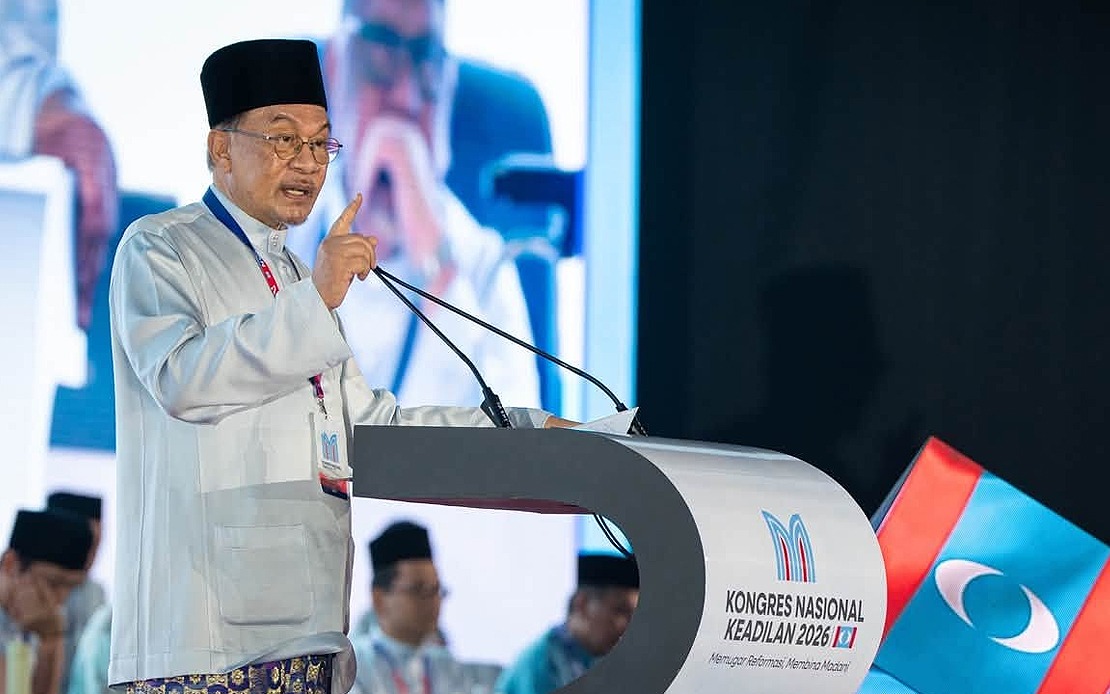
The MADANI Government's reform agenda will only succeed if ordinary Malaysians can see and experience concrete improvements in their daily lives, according to Prime Minister's Senior Political Advisor Tengku Datuk Seri Zafrul Tengku Abdul Aziz. Speaking at the 2026 PKR National Congress in Melaka, he emphasised that policy announcements and economic figures alone are insufficient to build public confidence in the administration's direction. Instead, the government must ensure that its various initiatives produce measurable outcomes that reach every segment of society, from low-income families to middle-class professionals.
Tengku Zafrul pointed to Malaysia's recent six percent economic growth as an example of the gap between headline achievements and felt experience. While this performance exceeds international forecasts and represents a positive macroeconomic indicator, he cautioned that such statistics mean little to citizens if they do not translate into higher wages, better employment prospects, or improved services in their communities. The challenge facing the government, he suggested, is not merely implementing programmes but ensuring that the spillover effects of economic success genuinely permeate through Malaysian society.
The PKR leader's remarks came during the two-day congress at the Melaka International Trade Centre, themed "Reviving Reform, Building MADANI", where party delegates discussed policy directions aligned with President Datuk Seri Anwar Ibrahim's keynote address. The congress provided a platform for internal party dialogue on how effectively the coalition government has communicated its agenda to voters and stakeholders. Debate sessions reflected broad agreement on the government's strategic direction, though underlying concerns about public perception appear to have prompted leadership to recalibrate messaging approaches.
A critical weakness identified by Tengku Zafrul is the government's communication machinery. He argued that the MADANI administration has compiled an impressive roster of initiatives and achievements, yet many Malaysians remain unaware of these efforts. This awareness gap, he contended, represents a fundamental failure of government communication rather than public apathy. If citizens do not know about programmes designed to benefit them, the responsibility lies with officials and politicians to improve how they convey this information, not to blame the electorate for inattention.
Among the major policy achievements highlighted at the congress were the abolition of the Universities and University Colleges Act (AUKU), a longstanding demand from student activists and civil libertarians who argued the legislation unduly restricted academic freedom and student political participation. The government has also initiated efforts to rehabilitate the Federal Land Development Authority (FELDA), a crucial institution whose performance has deteriorated over decades and whose fate affects hundreds of thousands of smallholder farmers and their families across the peninsula. These initiatives, alongside upcoming budget provisions focused on economic stimulus, demonstrate the MADANI Government's commitment to addressing systemic institutional challenges rather than merely implementing cosmetic reforms.
For Malaysian citizens, particularly those who voted for change in recent elections, the question of implementation becomes increasingly urgent. Economic growth statistics and policy announcements can only sustain political goodwill for a limited period. Voters expect to see improvements in their purchasing power, employment security, education quality, and healthcare access. The MADANI Government's challenge is to narrow the distance between policy intention and lived reality, a task that requires not only sound policy design but also effective delivery mechanisms and transparent progress reporting.
Tengku Zafrul's emphasis on party solidarity and improved working mechanisms suggests internal recognition that political effectiveness depends on organisational discipline and coordination across government agencies. PKR, as the coalition's largest party, bears particular responsibility for demonstrating that reform delivers results. Failure to do so risks eroding public trust and potentially undermining the coalition's electoral prospects in future contests. The party's strength, he argued, depends on its willingness to listen to public concerns and continuously adapt its approach based on feedback from communities.
The broader context of this message reflects regional and international pressures on Malaysian governance. Southeast Asian democracies face increasing competition for legitimacy, with voters comparing their government's performance against regional peers. Malaysia's economic growth rate, while respectable, must be accompanied by inclusive distribution of benefits to remain politically sustainable. The government's commitment to institutional reform, evidenced by AUKU abolition and FELDA rehabilitation, suggests awareness that systemic change is necessary to restore public confidence in institutions.
Looking forward, the MADANI Government appears to be entering a critical phase where rhetoric must yield to results. The upcoming budget will be closely scrutinised for concrete measures addressing cost-of-living pressures, job creation, and wage growth. Political analysts suggest that the next 12 to 18 months will be decisive in determining whether the coalition retains sufficient public support to govern beyond the current parliamentary term. Tengku Zafrul's calls for enhanced communication and tangible delivery acknowledge this reality implicitly, signalling that party leadership understands the narrow window available to demonstrate effective governance.
For Malaysian voters and civil society observers, this statement from a senior government figure provides useful insight into internal coalition thinking. It suggests that leaders recognise existing implementation gaps and are attempting to address them through organisational and communication improvements. Whether these efforts prove sufficient to translate reform ambitions into widespread citizen benefit remains an open question that will be answered over the coming years through concrete policy outcomes and observable changes in Malaysians' economic and social circumstances.

