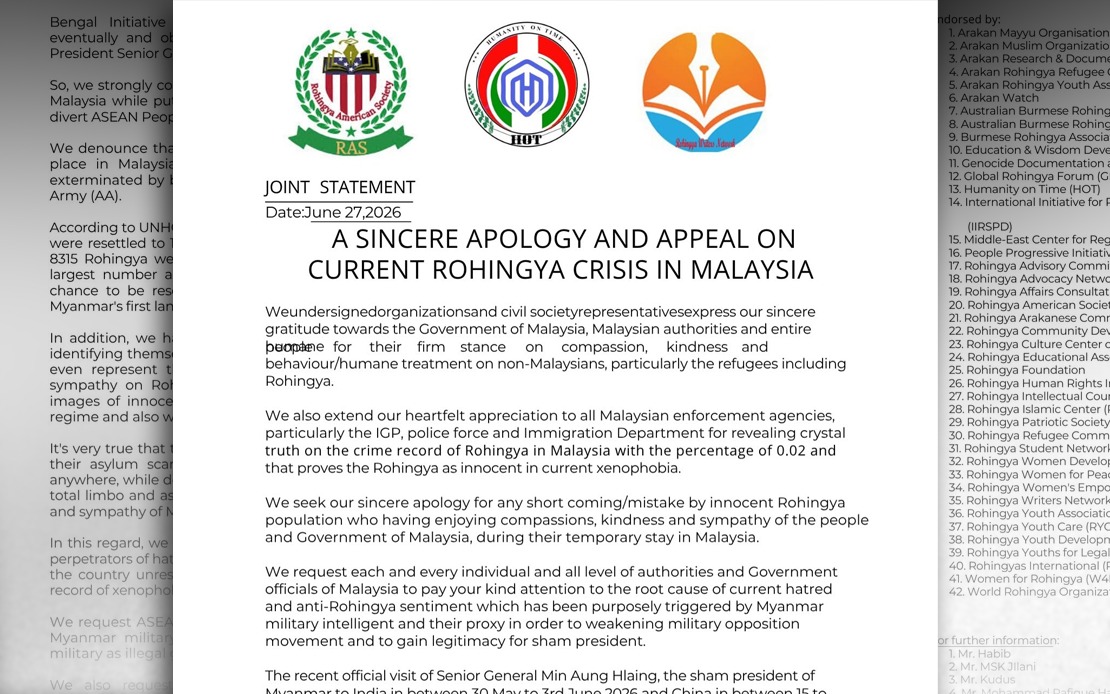
Malaysian Humanitarian Aid and Relief (MAHAR) has expressed approval over an apology tendered by 40 Rohingya non-governmental organisations, characterising the gesture as evidence of accountability. The organisation, however, is pressing these groups to expand the scope and depth of their humanitarian activities beyond the conventional model of delivering food assistance and temporary shelter.
The nature of humanitarian work in Malaysia's refugee context requires a fundamental shift in perspective, according to MAHAR's assessment. Rather than treating aid distribution as the entirety of support services, the organisation contends that NGOs should simultaneously undertake educational initiatives that help Rohingya populations understand their civic obligations and proper conduct while residing in the country. This represents a more holistic approach that balances meeting immediate survival needs with preparing refugees to be responsible members of their host society.
MAHAR has specifically identified the role Rohingya NGOs should play in cultivating an environment of legal and cultural compliance. The organisations ought to invest resources in programmes designed to communicate Malaysian laws, explain local customs, and present the values underpinning Malaysian society. Such efforts, MAHAR suggests, would contribute meaningfully to bridging divides between refugee populations and ordinary Malaysians, potentially reducing tensions that occasionally arise from cultural misunderstandings or perceived violations of social norms.
Equally important to MAHAR's vision is the strengthening of international advocacy mechanisms. The organisation has urged the 40 NGOs to intensify their efforts in drawing global attention to the persecution of Rohingya people within Myanmar, where the humanitarian crisis originated. Rather than accepting the displacement as permanent, MAHAR posits that genuine humanitarian work must confront the underlying causes of mass migration, working towards conditions in Myanmar that would permit Rohingya populations to return voluntarily and with dignity.
The dual-track approach reflects recognition that long-term solutions require both immediate support for displaced persons and simultaneous pressure on root-cause factors. By neglecting international advocacy whilst focusing solely on local service provision, NGOs risk perpetuating a cycle of dependency rather than advancing towards sustainable resolutions. MAHAR's position suggests that moral obligation extends beyond Malaysia's borders to the broader Myanmar situation.
Jismi Johari, MAHAR's president, has underscored the necessity of balancing refugee welfare with host community safety. He acknowledged that certain segments of the Malaysian population harbour legitimate concerns regarding security and public order, particularly individuals who have directly experienced incidents allegedly involving members of refugee communities. Such apprehensions, MAHAR indicates, merit serious consideration rather than dismissal as xenophobia or prejudice.
However, Jismi has cautioned against the conflation of individual misconduct with communal characteristics. He highlighted that antisocial behaviour, criminal activity, and rule-breaking occur across all demographic groups within any society, whether among citizens or migrants. Attributing the actions of isolated individuals to an entire refugee population would represent a logical and moral failing that compounds existing tensions. This distinction between individual accountability and collective responsibility forms a cornerstone of MAHAR's analytical framework.
Addressing the concerns that have surfaced requires what Jismi termed a foundation of empathy, mutual respect, and active dialogue among all stakeholders. The burden falls not solely on NGOs or refugee communities but extends to Malaysian authorities, media organisations, and civil society actors. Constructive engagement implies willingness to listen to grievances, investigate incidents thoroughly, and implement transparent responses that demonstrate fairness to all parties involved.
MAHAR has recommitted itself to humanitarian operations that integrate justice, safety, and human dignity as core principles. This formulation attempts to synthesise what might otherwise appear as competing interests: the welfare of displaced persons seeking refuge and the legitimate security concerns of Malaysian residents. Rather than treating these as opposed values, MAHAR's framework presents them as complementary elements of a comprehensive humanitarian vision that respects the rights and needs of both populations.
The acceptance of the 40 NGOs' apology signals a willingness to move forward constructively, yet MAHAR's subsequent calls for expanded engagement suggest this represents a beginning rather than a conclusion. The organisation's messaging indicates that Rohingya NGOs must evolve beyond their current operational models to encompass education, integration support, and international advocacy. Malaysia's long-term stability regarding refugee populations may well depend on whether these recommendations gain traction within the humanitarian sector and among community leadership.
For Malaysian readers and policymakers, MAHAR's position offers a middle path between opposing tendencies: neither uncritical acceptance of all refugee-related activities nor blanket rejection of humanitarian assistance. The emphasis on rule-of-law education, cultural integration programming, and sustained international pressure on Myanmar reflects sophisticated thinking about how host societies can accommodate displaced populations whilst maintaining social cohesion and addressing legitimate public concerns.

