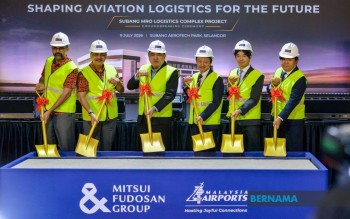
Malaysia Airports Holdings Bhd (MAHB) and Mitsui Fudosan Group have joined forces on an RM80 million venture to construct an air cargo logistics complex at Subang Airport, marking a significant expansion of the facility's cargo-handling capabilities. The partnership reflects a strategic effort by MAHB to monetise its valuable airport land holdings while tapping into the operational know-how of an internationally experienced logistics developer. Under the arrangement, MAHB retains a 30 per cent ownership stake while Mitsui Fudosan assumes majority control with 70 per cent equity, allowing the Japanese conglomerate to lead development and day-to-day management of the facility.
Transport Minister Anthony Loke Siew Fook outlined the rationale behind the partnership at a groundbreaking ceremony on Thursday, emphasising that the collaboration exemplifies MAHB's broader strategy to unlock value from its airport real estate by collaborating with specialised partners possessing proven expertise in logistics infrastructure. The minister noted that Mitsui Fudosan brings substantial operational credentials, having developed and successfully operated similar complexes at Tokyo's Haneda Airport—one of Asia's busiest aviation hubs. By importing Japanese technical knowledge and operational best practices to Malaysia, the partnership aims to mitigate execution risks and ensure the facility meets international standards from inception.
The new complex will be constructed within Subang Aerotech Park and housed under MFMA Industrial Sdn Bhd, a newly established joint venture between Mitsui Fudosan (Asia) Malaysia Sdn Bhd and Malaysia Airports (Subang) Sdn Bhd. This corporate structure allows both parties to formalise their respective roles and responsibilities while maintaining clear governance. The facility is positioned as a strategic asset to stimulate growth among aviation and aerospace companies operating in and around Subang Airport, one of Malaysia's established aviation clusters.
Subang Airport has long served as a secondary hub for Malaysia's aviation sector, housing numerous maintenance, repair and overhaul (MRO) operators, aircraft leasing firms, and related service providers. The new air cargo logistics complex represents an extension of this ecosystem, providing dedicated infrastructure for temperature-controlled storage, consolidation, and handling of time-sensitive cargo—capabilities increasingly demanded by regional e-commerce operators, pharmaceutical shippers, and perishable goods exporters. The facility's strategic positioning within Subang's existing aerospace industrial park creates natural synergies with established tenants and neighbouring operations.
For MAHB, the arrangement reflects a pragmatic approach to capital deployment in an era of constrained public investment. Rather than funding the entire RM80 million facility through its own balance sheet, the partnership transfers development risk and operational responsibility to an entity with demonstrable expertise and financial resources. This model allows MAHB to generate ongoing revenue through land leasing, utility provision, and equity returns while preserving capital for investments at other Malaysian airports facing capacity constraints and infrastructure gaps. The 30 per cent stake ensures MAHB benefits from the facility's profitability without bearing the majority of upfront capital risk.
Mitsui Fudosan's decision to establish a Malaysian presence in airport logistics suggests confidence in the region's long-term cargo growth prospects. The Japanese developer's entry into the market also signals potential appetite for similar opportunities at other Malaysian airports, particularly Kuala Lumpur International Airport, which handles the majority of Malaysia's international cargo. The company's Haneda experience is particularly relevant, as Haneda has become a model for efficient cargo operations post-pandemic, with sophisticated systems for handling high-volume, time-sensitive shipments. The transfer of such capabilities to Subang may position the facility as an attractive alternative for regional shippers seeking backup capacity to Kuala Lumpur or seeking specialised handling for particular cargo types.
From a regional perspective, the Subang complex complements Malaysia's stated ambitions to position itself as a Southeast Asian logistics hub. With similar facilities being developed across the region—including in Thailand, Singapore, and Vietnam—Malaysia faces competitive pressure to offer world-class infrastructure. The introduction of Japanese operational standards and management practices at Subang may help differentiate Malaysian facilities and attract multinational logistics operators reluctant to invest in markets lacking international best practices. The partnership thus represents more than a transactional real estate deal; it reflects Malaysia's willingness to absorb and deploy global expertise to strengthen competitive positioning.
The timing of the project carries additional significance, coming as global supply chains remain in flux following pandemic-induced disruptions. Shippers increasingly seek geographic diversification and redundancy in their logistics networks, making Southeast Asian cargo hubs increasingly attractive. A modern, professionally managed facility at Subang—combining Japanese operational rigour with Malaysia's geographic advantages—could capture a portion of this shifting demand. The complex's focus on supporting MRO, aerospace, and aviation-adjacent businesses further aligns with Malaysia's efforts to develop higher-value logistics services rather than competing purely on cost with larger regional players.
Minister Loke's emphasis on risk mitigation through partnership resonates with broader Malaysian economic policy themes. Rather than attempting to build world-class logistics infrastructure entirely through government-owned enterprises, the government increasingly recognises that collaboration with private sector partners—particularly those with international track records—accelerates capability development while improving outcomes. This philosophy extends beyond airports to port operations, rail logistics, and specialised manufacturing sectors where Malaysian firms may lack either scale or technological depth to compete globally. The Subang partnership illustrates this pragmatic approach in action.

