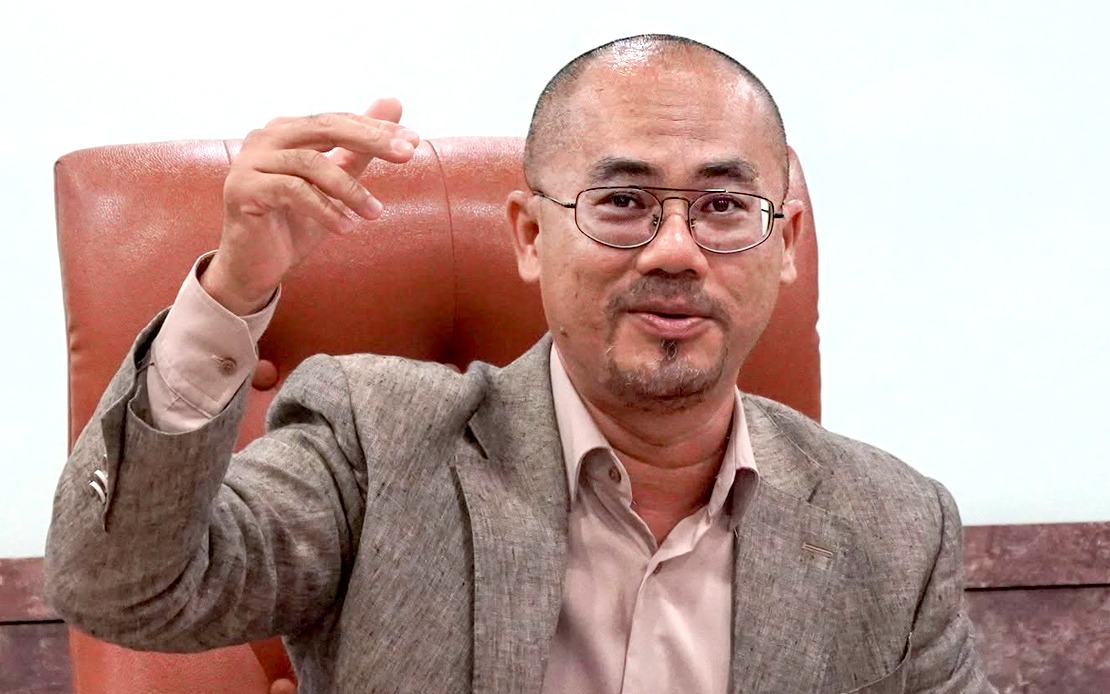
The Perak Islamic Religious and Malay Customs Council (MAIPk) moved swiftly to counter allegations circulating on social media that it had forced traders to abandon their businesses at a commercial site along Jalan Panglima Bukit Gantang Wahab in Ipoh, dismissing the claims as a misunderstanding of the actual situation confronting the institution. Speaking at the Casuarina Convention Centre following the 2026 Perak State Mosque Committee Convention, chief executive officer Syamsul Hazeman Md Salleh provided a detailed account of the circumstances that prompted MAIPk to issue notices to the affected traders, emphasising that no eviction order had been issued and that the council's communications were designed solely to manage expectations and protect its institutional reputation from unfounded allegations.
The core issue precipitating the dispute involves infrastructure inherited when MAIPk assumed ownership of the land in 2024, a transition that revealed substantial pre-existing complications. Upon taking control, the council discovered that a primary water pipeline supplying the premises had developed a significant leak, a fault that had persisted long before the current operator took responsibility for the site. Compounding this structural problem was an accumulation of water utility arrears exceeding RM100,000, an outstanding debt that had accumulated over years of operation under previous management arrangements. Syamsul Hazeman was explicit in clarifying that this financial burden did not originate from excessive consumption by the traders themselves, who remit payments consistent with their individual metering and usage patterns.
Rather, he explained that the debt arose from systemic problems inherent to the main distribution pipeline serving the entire location, a technical and financial responsibility that devolved to MAIPk upon acquisition of the property. The council's issued notices, therefore, were crafted to provide traders with transparent explanation of MAIPk's institutional position and to forestall potential accusations that the body was either negligent in its obligations or complicit in allowing utilities to accumulate unpaid balances. This defensive posture underscores the complexity faced by Malaysian religious institutions when acquiring properties laden with liabilities and infrastructure deficiencies that predate their stewardship, challenges that governmental and quasi-governmental bodies frequently encounter but which generate public controversy when misunderstood.
During an engagement session conducted on July 14, MAIPk representatives outlined to traders the necessity of temporarily severing water connections to permit repairs to the leaking main pipeline, a disclosure that apparently triggered the subsequent social media dispute when details became distorted in online discourse. The temporary disconnection, according to Syamsul Hazeman, was presented as a prerequisite step rather than a punitive measure, yet the communication evidently failed to prevent misinterpretation and the emergence of claims alleging systematic expulsion of business operators. This incident illustrates the vulnerability of institutional stakeholders to reputational damage when operational announcements, regardless of how carefully framed, encounter a public predisposed to interpret such communications through a lens of institutional malfeasance.
The financial dimension of this crisis presents particular difficulty for MAIPk's resolution pathways. Religious organisations in Malaysia typically operate within constrained funding architectures, relying substantially on zakat contributions, waqf endowments, and voluntary donations rather than commercial revenue streams. As Syamsul Hazeman underscored, neither zakat nor waqf funds—designated for religious purposes and charitable distribution—can permissibly be redirected toward settlement of utilitarian arrears such as water bills, creating an apparent impasse. The outstanding RM100,000 obligation cannot be absorbed within conventional religious financing mechanisms, necessitating either extraordinary institutional fundraising, intervention from governmental bodies, or negotiated settlement with the Perak Water Board, processes that inherently consume extended timeframes.
MAIPk is presently engaged in substantive discussions with the Perak Water Board aimed at identifying viable solutions to the dual problem of arrears settlement and pipeline repairs. Syamsul Hazeman acknowledged the complexity of these negotiations while projecting cautious optimism that resolution remains achievable, though he candidly admitted that the trajectory and timeline remain uncertain. The council is simultaneously pursuing engagement with the Perak state government, recognising that regulatory and potentially financial support from the governmental sphere may prove essential to navigating the crisis, an approach consistent with how Malaysian institutional actors typically mobilise state apparatus when confronting difficulties exceeding their autonomous capacity.
The longer-term operational prospects for traders occupying the site remain contingent upon resolution of the immediate water crisis but also subject to broader developmental intentions affecting the property. MAIPk has indicated that once outstanding balances are addressed and repairs completed, the council intends to establish new contractual arrangements with incumbent traders, implying that existing informal or legacy tenure arrangements will be formalised into explicit rental agreements. However, this administrative reconfiguration operates against a backdrop of planned institutional development; the Perak Islamic Religious Department Complex has been proposed for construction at the site, a project that would necessitate comprehensive redesign of the premises and displacement of current commercial occupants.
Syamsul Hazeman cautioned that whilst he remains uncertain regarding implementation timelines for the departmental complex—characterising the project as residing within the state government's discretionary purview—traders should anticipate eventual relocation requirements should the development proceed. This uncertainty reflects the reality that whilst MAIPk now legally controls the property, strategic decisions regarding its ultimate utilisation remain subject to governmental planning processes and budgetary allocations beyond the council's authority. The traders currently occupying the premises thus face a complex temporal horizon wherein near-term survival depends upon resolution of utility crises whilst longer-term viability remains hostage to government-level determinations regarding infrastructure deployment.
The incident itself encapsulates broader tensions within Malaysia's institutional landscape regarding property stewardship, infrastructure maintenance, and the particular vulnerabilities of religious organisations navigating commercial real estate operations. For traders established at the Jalan Panglima Bukit Gantang Wahab location, the episode has generated understandable anxiety about tenure security and operational continuity, concerns that circulate more broadly across Malaysian commercial ecosystems wherein properties change hands and institutional stewardship transitions frequently generate disruption. MAIPk's initial miscommunication—inadvertently generating fears of eviction when addressing technical and financial problems—demonstrates how institutional actors must calibrate public messaging with exceptional care to forestall misinterpretation and the reputational consequences that ensue when stakeholder anxieties metastasise into social media narratives.

