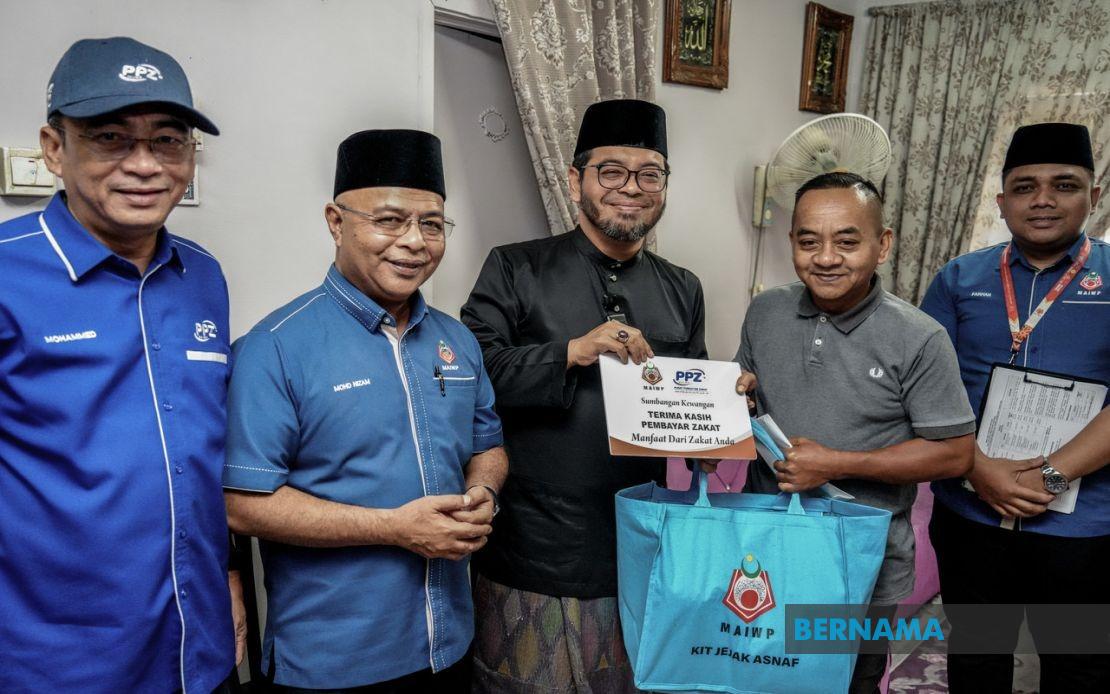
The Federal Territories Islamic Religious Council (MAIWP) has activated a comprehensive assistance programme to support a widow who assumed sole responsibility for five children following her husband's death early this month. The intervention package addresses immediate family needs including monthly living expenses, rental accommodation, and educational costs for children aged between six and 15, reflecting a structured approach to welfare provision that extends beyond simple cash transfers.
Minister in the Prime Minister's Department (Religious Affairs) Senator Datuk Dr Zulkifli Hasan highlighted the importance of ground-level engagement when administering social support. According to him, direct visits and community assessments enable MAIWP to calibrate its responses to the actual circumstances facing recipients, rather than applying blanket solutions that may not address specific household vulnerabilities. This personalised methodology aims to translate government resources into tangible improvements in beneficiaries' daily lives.
The widow's household had previously benefited from MAIWP's General Schooling Aid programme. The recent enhancement to her support package signals an institutional recognition that the loss of an income earner fundamentally alters a family's financial architecture and creates cascading pressures across housing, nutrition, and educational spheres. By combining multiple assistance streams, MAIWP attempts to stabilise the household during its transition to single-income dependence.
Beyond this individual case, MAIWP's recent outreach encompassed other vulnerable family configurations requiring institutional support. One household comprised a married couple raising eight school-age children, where the father is employed as a Kuala Lumpur City Hall driver and the mother manages the household full-time. This family receives monthly medical assistance covering essential items such as diapers and diabetic supplies, alongside wheelchair provision and school-related expenses. The package acknowledges that formal employment income alone often proves insufficient when family size and medical requirements create compounding expenditures.
A third family visited during this outreach period included a divorced single mother who has independently supported three school-going children since 2018. Her assistance encompasses regular cost-of-living payments, basic necessities procurement, and dedicated schooling support. These cases collectively illustrate MAIWP's engagement with the structural vulnerabilities that affect Malaysian households across different family compositions—bereavement, disability, single parenthood, and large dependent populations.
The institutional rationale underpinning MAIWP's interventions extends to recognition that informal sector workers and lower-wage formal employees frequently lack adequate safety nets when confronted with catastrophic life events or chronic dependency needs. By calibrating assistance to family-specific circumstances rather than applying uniform criteria, the council attempts to maximise the poverty-reduction impact of its annual budget allocation. This targeted methodology contrasts with universal basic assistance approaches and reflects a conviction that careful needs assessment produces more efficient welfare outcomes.
As of 12 August 2026, MAIWP has distributed RM699.57 million in cumulative assistance across its portfolio of programmes. This substantial allocation underscores the council's positioning as a significant welfare provider within the Federal Territories' social protection infrastructure. The funds flow through multiple channels—medical assistance, educational support, emergency aid, and regular living allowances—addressing different dimensions of household vulnerability simultaneously.
For Malaysian policymakers and welfare administrators observing MAIWP's operational model, several implications emerge relevant to broader discussion of safety-net design and implementation capacity. The council's emphasis on personalised assessment and multi-component support packages reflects lessons learned from welfare systems globally regarding the limited effectiveness of single-issue interventions in households facing multiple simultaneous pressures. A widow managing five children confronts not only reduced household income but potential increases in emotional support needs, school attendance disruptions, and psychological adjustment challenges that extend beyond financial compensation.
The visibility that Senator Datuk Dr Zulkifli Hasan has afforded these family visits, including direct reporting to media, signals political investment in demonstrating welfare responsiveness during transitions of household structure and capacity. In contexts where public perception of social safety-net adequacy influences both electoral confidence and institutional legitimacy, high-profile engagement with individual beneficiaries serves communicative functions alongside its direct assistance purposes. Malaysian media coverage of such initiatives shapes public understanding of institutional competence and government commitment to vulnerable populations.
Regionally, MAIWP's approach offers a contrasting model to some neighbouring welfare systems that emphasise centralised disbursement and standardised criteria. The council's commitment to ground-level verification and contextual assessment requires institutional investment in community-level social workers, local administrative capacity, and coordination mechanisms that some developing welfare systems struggle to maintain. Sustainability of such personalised approaches depends on adequate funding, staff retention, and protection from political interference in case-selection processes.
Looking forward, the expansion of assistance packages to households including the bereaved widow illustrates MAIWP's recognition that static welfare formulas inadequately respond to dynamic household circumstances. As Malaysian society experiences demographic shifts including ageing populations, changing family structures, and labour market disruptions, welfare councils will face intensifying pressure to expand both the scope and sophistication of their interventions. The institutional learning embedded in cases like this widow's family assistance will inform policy discussions regarding appropriate scale, design, and targeting of social protection across Malaysia's federal structure.

