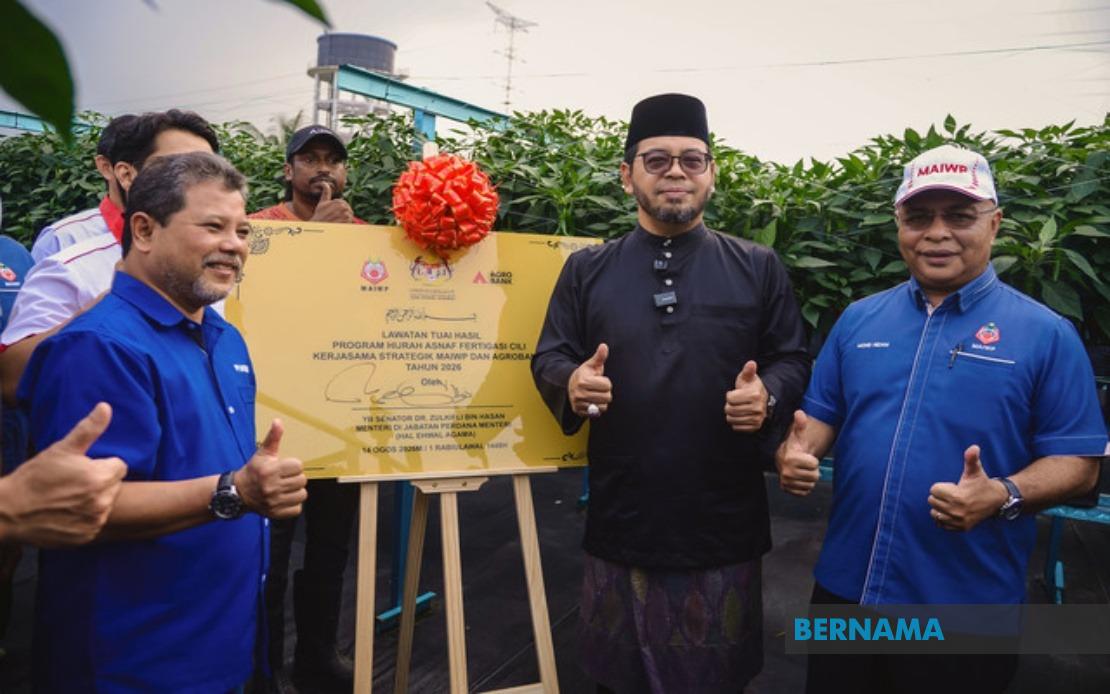
The Ministry in the Prime Minister's Department (Religious Affairs) has given its backing to an expanded agricultural initiative aimed at empowering asnaf communities through modern farming techniques. The chilli fertigation project, now being scaled to five acres, represents a strategic pivot toward sustainable livelihoods within the Islamic welfare ecosystem in the Klang Valley region.
Dr Zulkifli Hasan, overseeing religious affairs at the federal level, praised the outcomes of the initial phase, describing the undertaking as a genuine success story in skills development and economic empowerment. The first growing cycle alone demonstrated the commercial viability of the approach, with participants harvesting more than 16.7 tonnes of chillies. This volume translated directly into financial gain, with total revenue surpassing RM207,000 during the inaugural season, providing tangible evidence that modern agricultural methods can deliver quick returns to low-income farming communities.
The initiative reflects a broader recognition within government circles that asnaf populations—those eligible to receive zakat assistance—require more than temporary welfare handouts. By introducing controlled-environment farming technologies such as fertigation, which delivers nutrients directly through irrigation systems, the programme addresses both immediate income needs and long-term skill accumulation. Participants gain practical knowledge that can be deployed across multiple growing seasons and potentially adapted to other crops, building resilience into their economic strategies.
Beyond the primary harvest stage, the expansion plan incorporates downstream value-addition opportunities. Programme leaders have identified potential for participants to establish small-scale processing operations, manufacturing chilli-based products such as sauces, pastes, and dried preparations. These value-added offerings command higher retail margins than fresh produce and open pathways into retail and online distribution channels, effectively multiplying the commercial potential of each kilogramme of raw material.
Alinda Rosely, a 49-year-old single mother enrolled in the programme, offers a compelling narrative of personal recovery. Her participation has proven transformative, equipping her with technical competencies that directly reversed her financial trajectory. During a particularly favourable market period last year, she generated RM40,000 in income within a six-month window—a sum that would have been unattainable through conventional wage employment given her circumstances and skill level. Her experience underscores how targeted technical training, when coupled with market access, can deliver life-changing results for vulnerable demographic groups.
The Majlis Amanah Ikhtiar Wilayah Persekutuan (MAIWP), the implementing agency, positions this expansion within its broader mandate to develop economically self-sufficient and internationally competitive asnaf communities. The organisation operates within the Islamic finance and welfare architecture of the federal territories, leveraging zakat revenues and related funds to drive programme implementation. This institutional positioning ensures that agricultural initiatives remain anchored within the religious framework of Islamic charitable obligation, while simultaneously pursuing commercial sustainability and market viability.
The scale of MAIWP's financial commitment to community welfare demonstrates the scale of institutional resources mobilised in this sector. As of mid-August 2026, the organisation had channelled RM699.57 million through 38 distinct welfare assistance schemes targeting vulnerable populations across Kuala Lumpur, Labuan, and Putrajaya. This funding landscape reveals that chilli farming represents merely one component of a substantially larger ecosystem of support programmes, ranging from direct cash assistance to skills training initiatives.
From a policy perspective, the expansion to five acres signals confidence in the replicability of the model across larger geographical areas. If yields and profitability metrics remain consistent as production scales upward, MAIWP could feasibly expand the programme further, potentially creating a network of small-scale commercial chilli producers within the federal territories. Such horizontal scaling would distribute income-generating opportunities more broadly while building supply capacity for potential institutional buyers or integrated value chains.
The timing of this expansion also reflects broader Malaysian agricultural policy priorities. The nation faces persistent challenges in achieving food security across a range of staple and high-value crops. By developing home-grown chilli production capacity through the asnaf community, the initiative simultaneously addresses poverty alleviation and contributes modestly toward domestic supply augmentation. Chillies represent a major ingredient in Malaysian cuisines and food processing, making local production expansion strategically relevant.
Market dynamics have clearly favoured the initiative's financial performance. When chilli prices peak—as they periodically do due to seasonal fluctuations and supply disruptions—participating farmers like Alinda Rosely experience windfall returns. However, programme designers must also consider price volatility risk management. Introducing storage technologies, cooperative marketing arrangements, or forward contracting mechanisms could stabilise farmer incomes during price-soft periods, ensuring that the initiative remains financially viable across seasonal cycles.
Looking forward, the expansion trajectory suggests that MAIWP intends to deepen rather than merely broaden its agricultural interventions. Moving from demonstration-scale operations on smaller plots to five-acre commercial zones represents a qualitative shift toward genuine enterprise development. Success at this scale would likely attract policy interest from other state-level Islamic councils and welfare authorities, potentially catalysing replication across Malaysia and inspiring similar initiatives in other Southeast Asian nations with comparable asnaf populations and zakat frameworks.

