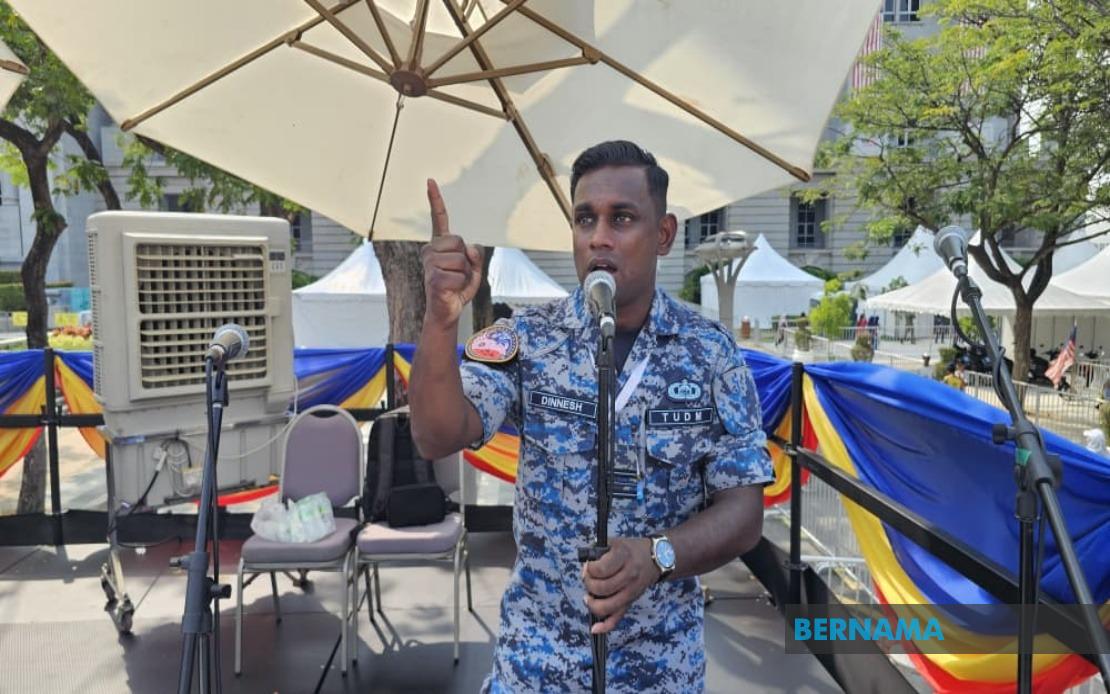
When thousands of Malaysians gathered at Dataran Putrajaya on National Day to witness the thunderous passage of fighter jets overhead, one voice became the crucial thread connecting the aerial drama unfolding above to the spectators gazing skyward. Major Dinnesh Nicolas Rene, a 34-year-old Royal Malaysian Air Force (RMAF) officer, served as one of three air commentators orchestrating the live narration of that high-flying display, transforming complex military manoeuvres into comprehensible, thrilling moments for the assembled crowds below.
The position of air show commentator within Malaysia's military aviation community represents far more than a ceremonial speaking role. Major Dinnesh emphasises that the work demands encyclopaedic knowledge spanning aircraft specifications, individual pilot capabilities, formation flying techniques, and the precise sequence of every planned manoeuvre. This specialised expertise cannot be improvised; it must be meticulously researched and internalised before a single word reaches the microphone.
Major Dinnesh's journey into this distinctive field began in 2019 when he was selected to commentate at the Langkawi International Maritime and Aerospace Exhibition (LIMA 2019). That initial assignment opened a new professional pathway, leading to subsequent roles during RMAF anniversary celebrations and eventually culminating in his selection alongside Major Neny Suhaida Ab Suki and Captain Muhammad Iqbal Nasrudin for the 2026 National Day aerial displays. His background as an air defence officer has provided institutional advantages, offering him operational insights that inform how complex aerial activities are explained to civilians, yet these advantages do not diminish the preparatory demands.
The preparation process for major state events demands rigorous coordination extending well beyond the commentator's booth. Major Dinnesh describes an intricate web of pre-event meetings with ground controllers and pilots to establish absolute clarity regarding every element of the display. The commentator team must acquire comprehensive knowledge of aircraft types involved, precise pilot identities, squadron affiliations and mottos, and exact timing sequences for each manoeuvre. This coordination necessarily extends beyond aviation personnel to encompass security agencies and other stakeholders, creating a complex operational framework where the commentator functions as one component within a much larger ceremonial apparatus.
Protocol observance emerges as a particularly significant consideration when events involve the highest levels of Malaysian state ceremonialism. National Day celebrations attended by the King and Prime Minister impose heightened sensitivities regarding what constitutes appropriate commentary content. Commentators must navigate these constraints skillfully, understanding precisely which topics warrant discussion and which require circumspection. The timing of information delivery becomes equally critical; remarks must synchronise with corresponding aerial events while respecting the gravity and formality inherent in state occasions.
Beyond these procedural and diplomatic challenges lies a physical reality that distinguishes air show commentary from other public speaking disciplines. The commentator's voice becomes an endurance asset subjected to considerable strain. Unlike a master of ceremonies working within controlled acoustic environments, an air commentator must project voice sufficiently powerful to penetrate the overwhelming ambient noise generated by passing fighter jets. This demands exceptional vocal projection sustained across multiple rehearsals and the actual performance day. Voice preservation thus represents one of the profession's most persistent technical challenges, requiring deliberate strategies to prevent vocal deterioration across extended periods of intense public speaking.
Major Dinnesh's approach to maintaining performance energy throughout these demanding assignments reflects a fundamental principle: the commentator must genuinely internalise and embody the excitement and patriotic spirit they seek to convey to audiences. This emotional authenticity cannot be simulated convincingly; it must emerge from genuine enthusiasm that audiences instinctively recognise and reciprocate. Despite years spent observing fighter jet operations in professional capacities, Major Dinnesh retains an undiminished sense of wonder regarding aerial displays, a perspective that translates into commentary distinguished by authentic passion rather than mechanical recitation.
The role assumes particular significance within Malaysia's broader cultural and civic context. National Day celebrations represent occasions when civilian populations engage directly with military aviation capabilities normally confined to operational contexts. The air commentator serves as an educational intermediary, translating technical military activities into narratives accessible and meaningful for diverse audiences spanning various age groups and educational backgrounds. Through skilled commentary, routine operational manoeuvres transform into compelling national spectacles that reinforce collective identity and appreciation for military service.
For Malaysia's armed forces, cultivating commentators with Major Dinnesh's combination of technical expertise, professional military background, and communication skills represents an investment in institutional capacity. The RMAF's ability to present its aviation capabilities through engaging public displays depends substantially on individuals who bridge military and civilian audiences effectively. As Malaysia continues hosting major international aerospace exhibitions and elevated state ceremonies, the demand for professionally trained commentators who can articulate complex aviation concepts whilst maintaining dramatic momentum will likely expand.
Major Dinnesh's experience also highlights how military professional development increasingly encompasses skills traditionally associated with media and communications sectors. Contemporary armed forces require personnel capable of functioning across multiple domains, from operational competency to public engagement and diplomatic sensitivity. His trajectory from air defence specialisation to public commentary reflects this evolving professional landscape, where technical expertise alone proves insufficient without complementary capabilities in communication and stakeholder management.

