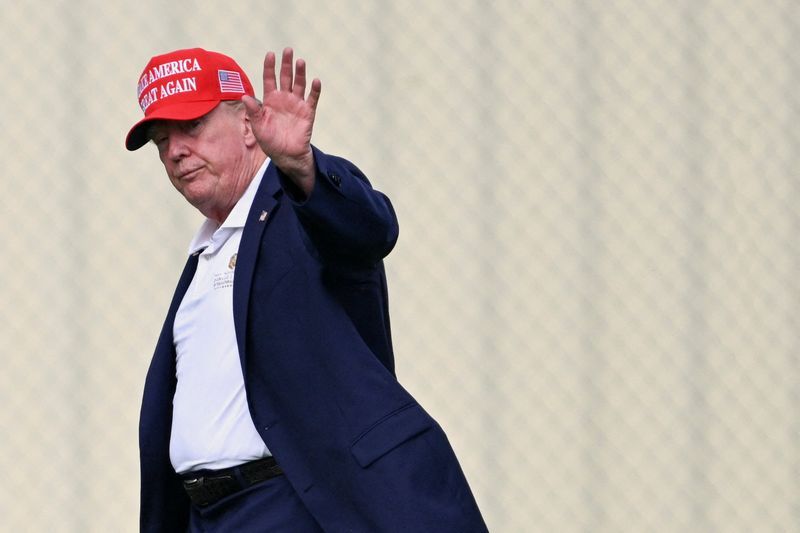
A substantial majority of Americans harbour doubts about President Donald Trump's financial activities since his return to power, with particular concern centring on cryptocurrency ventures that have generated over $1.4 billion in revenues. The latest Reuters/Ipsos polling data, completed in mid-August, reveals that public scepticism extends beyond mere business success to encompass fundamental questions about the appropriate boundaries between private enterprise and executive authority in the United States. This perception gap underscores a persistent tension in American politics regarding presidential ethics and the mixing of commercial interests with governance responsibilities.
The polling exercise, which surveyed 1,166 Americans over four days, found that roughly two-thirds of respondents deemed it improper for the Trump family to have accumulated substantial profits through digital asset ventures while the president holds office. These cryptocurrency enterprises include World Liberty Financial and a self-branded meme coin that the president actively promoted on social media earlier this year, describing it in characteristically superlative terms. The financial scale of these operations—exceeding $1.4 billion in annual revenue—distinguishes this situation from typical post-electoral business concerns and places it squarely in the public consciousness as a governance issue rather than a peripheral matter.
The partisan dimensions of public opinion on this question reveal nuanced fault lines within the American electorate. While Democratic voters and independents overwhelmingly view the cryptocurrency earnings as inappropriate, even within Trump's own Republican base roughly three in ten respondents expressed disapproval of these ventures. This fracture in Republican consensus speaks to lingering unease among some conservative voters regarding the optics and substance of presidential financial entanglement with private business operations, despite their broader support for the administration.
Beyond the immediate question of cryptocurrency profits, Americans harbour deeper anxieties about potential conflicts of interest embedded in presidential decision-making. Approximately seven in ten survey respondents indicated they believe Trump's policy choices are influenced by considerations related to his personal business interests. This perception permeates across demographic boundaries, with two-thirds of independents and nine in ten Democrats expressing this concern. The breadth of this conviction suggests that public wariness transcends typical partisan polarisation and touches upon something more fundamental—a widespread belief that concentrated business holdings can create competing incentives for policymakers.
The Trump administration has consistently maintained that no impropriety exists in these arrangements, contending that the president maintains no day-to-day involvement in family business operations and that investments are managed through independent financial institutions. White House spokesperson Anna Kelly issued a formal statement asserting that the president acts solely in the interests of the American public and that no conflicts of interest are present. This position reflects the administration's confidence in the legal and ethical frameworks surrounding presidential business ownership, though it has done little to assuage public concern as reflected in the polling.
Experts in presidential ethics have characterised the current situation as unprecedented in scope and complexity. Richard Painter, who served as chief ethics lawyer for President George W. Bush, noted that the second Trump administration operates with substantially more intricate business entanglements than even the first Trump administration possessed. This professional assessment carries considerable weight in ongoing debates about whether existing ethical guidelines and legal frameworks adequately address contemporary scenarios involving globally recognised brands, digital assets, and complex corporate structures under presidential control. The consensus among ethics specialists suggests that the present arrangements stretch beyond historical precedent in ways that may require fresh examination.
The cryptocurrency dimension of these holdings introduces particular complications absent from traditional real estate or manufacturing investments. Digital assets operate across jurisdictions, exist in rapidly evolving regulatory frameworks, and benefit directly from government policy decisions affecting their status and taxation. Trump's well-documented championing of cryptocurrency interests during his campaign and his subsequent pursuit of crypto-friendly policies in office have reinforced public perceptions that his personal financial interests align with his executive decisions. This convergence of commercial enthusiasm and policy implementation appears to trouble voters across demographic categories.
Public anxiety about presidential profiteering exists within a broader context of frustration with corruption in American governance generally. Americans perceive graft as widespread across all government levels, though partisan disagreement persists regarding which party bears greater responsibility. When presented with a direct choice, 49% of survey respondents pointed to the Republican Party as more corrupt, compared with 41% identifying the Democratic Party. These figures suggest that Trump's personal enrichment concerns have measurable impacts on broader party brand perceptions, particularly relevant given midterm elections that will determine congressional control during the final two years of the presidential term.
The political stakes of these perceptions extend beyond abstract concerns about ethics. Democrats have consistently emphasised alleged corruption within the current administration as a central campaign message ahead of congressional elections, while Trump's team has countered with investigations into alleged corruption in Democratic-led states. In this polarised environment, the polling data becomes a political asset for opposition messaging, suggesting that concerns about inappropriate profiteering resonate sufficiently with voters to potentially influence electoral outcomes. The administration's legislative priorities and ability to govern effectively during its final two years could be circumscribed if public trust in its integrity continues eroding.
Individual voters express genuine ambivalence about these issues, reflecting the complicated terrain upon which this debate unfolds. Thomas Schmidt, a semi-retired Wisconsin crossing guard who supported Trump in 2024 but has grown disappointed with the administration, articulated a sentiment combining scepticism about Trump's focus with cynical resignation about systemic corruption. Schmidt expressed particular concern that the president prioritises business considerations over governance challenges, yet simultaneously dismissed the Trump administration as uniquely problematic, suggesting that presidential business entanglement represents a persistent feature of American governance rather than an aberration.
The evolution of Trump's own positioning on corruption and ethics adds another layer of complexity to current public perception. His 2016 campaign centred on pledges to eliminate corruption from Washington through rhetoric about "draining the swamp" and establishing higher ethical standards for government officials. The apparent contradiction between these campaign promises and current circumstances involving substantial presidential family wealth accumulation from cryptocurrency operations has not escaped voter notice. This disconnect between campaign commitments and governing reality particularly troubles former supporters who believed the anti-corruption messaging represented genuine conviction rather than rhetorical strategy.
Looking ahead, these polling results suggest that ethical concerns around presidential business interests will remain salient throughout the remainder of Trump's second term and potentially influence public reception of his policy agenda. The margin of error of three percentage points for national samples and five points for partisan subgroups lends credibility to these findings, indicating genuine, measurable public sentiment rather than statistical noise. Whether the administration can effectively counter these perceptions through policy achievement, ethical clarifications, or alternative messaging remains to be seen, but the current data suggests that public scepticism regarding presidential financial propriety represents a significant political liability entering the final phase of the presidential term.

