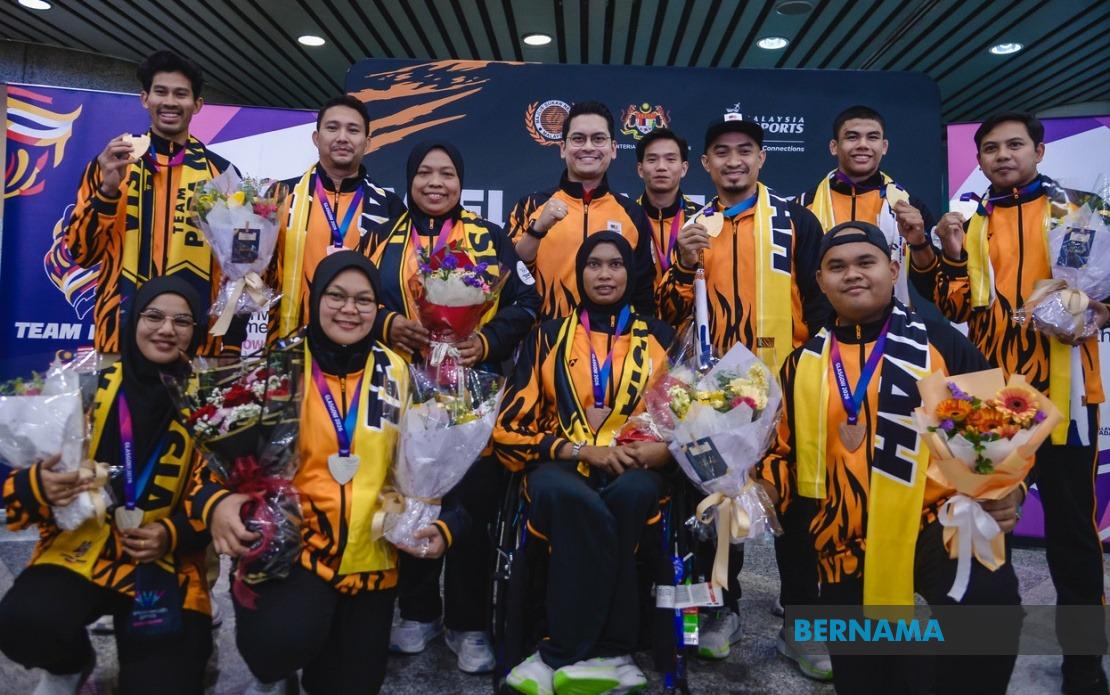
Malaysia will distribute RM1.1 million in prize money to athletes who captured medals at the 2026 Glasgow Commonwealth Games, Youth and Sports Minister Dr. Mohammed Taufiq Johari announced during a reception ceremony for medal-winning competitors at Kuala Lumpur International Airport. The incentive scheme, known as SHAKAM (Skim Galakan Sukan Kebangsaan), represents the government's formal recognition of the dedication and national pride generated by the athletes' achievements on the international stage.
Under the structured incentive framework, gold medalists will receive RM80,000 each, a figure that underscores the government's prioritization of top-finishes in competitive sport. Athletes who set new Commonwealth Games records will qualify for an additional RM10,000 bonus, creating a financial ladder that rewards not only medallists but those who establish benchmarks for future competitors. Silver medalists will pocket RM40,000 while bronze medalists receive RM20,000, establishing a clear tier system that reflects competitive achievement levels.
Dr. Mohammed Taufiq indicated that discussions are underway between the National Sports Council and corporate partners to expand the prize pool through private sector funding, suggesting that the published figures may represent a minimum baseline rather than the final distribution totals. This approach aligns with global sporting trends where corporations increasingly underwrite athlete incentive schemes as part of their corporate social responsibility and brand alignment strategies. For Malaysian athletes competing in a regional context, supplementary corporate funding could position the country's reward structure more competitively against wealthier nations.
Malaysia's Glasgow contingent delivered what officials characterized as a breakthrough performance, securing eight gold medals, three silver, and five bronze—a haul that exceeded the government's revised targeting methodology and represented one of the strongest Commonwealth Games showings in nearly two decades. The eight-gold result surpassed the ministry's minimum target of five gold medals, validating a strategic shift introduced across sports associations and coaching bodies. This outcome becomes particularly significant when considering that Malaysia competed with a smaller overall delegation than in previous Commonwealth Games cycles, suggesting that targeted investment and focused athlete development yielded disproportionate results.
The philosophical underpinning of this achievement rested on introducing colour-based medal targets rather than aggregate medal tallies, a departure from traditional planning approaches. Dr. Mohammed Taufiq emphasized that focusing specifically on gold medal acquisition created psychological momentum for athletes rather than inducing counterproductive pressure. The minister acknowledged initial concerns that such explicit gold-focused targets might overwhelm competitors, but the Glasgow results demonstrated instead that clarity of purpose strengthened rather than hindered athletic performance. This approach carries implications for Malaysian sporting culture, potentially influencing how future Commonwealth Games teams, Southeast Asian Games squads, and Olympic hopefuls structure their competitive objectives.
The emphasis on gold-medal targeting reflects broader Malaysian Olympic aspirations. Dr. Mohammed Taufiq framed the Glasgow success as a foundational stepping stone toward securing Malaysia's maiden Olympic gold medal, a strategic gap that has long frustrated national sporting administrators. By institutionalizing colour-based medal targets across the sports system, the ministry seeks to embed a gold-focused mindset into athlete development pipelines, coaching methodologies, and performance measurement frameworks. For Southeast Asian context, this represents a tonal shift in how Malaysia positions itself within regional sporting hierarchies, particularly against neighbours who have accumulated Olympic gold medals.
The development of this strategy involved extensive consultation with sports associations, coaches, and athletes themselves, ensuring that target-setting reflected practical competitive realities rather than bureaucratic wishful thinking. This consultative approach distinguishes the colour-based system from top-down mandates that sometimes characterize government sports initiatives in the region. By grounding targets in expert opinion and athlete feedback, the National Sports Council enhanced buy-in and created shared ownership across the sporting ecosystem. For Malaysian readers, this collaborative methodology suggests a maturing approach to sports administration that increasingly recognizes athletes as stakeholders rather than mere executors of government directives.
Chef de Mission Datuk Awalan Abdul Aziz, who leads the Malaysian Lawn Bowls Federation, provided insight into how gold-medal aspirations operated differently across sports. The lawn bowls contingent harboured internal gold-medal ambitions without designating them as official targets, reflecting the reality that different sports face varying competitive landscapes and athlete readiness profiles. Their Glasgow performance—two silver and two bronze medals—represented substantial improvement over the Birmingham 2022 Commonwealth Games, which yielded only one silver and one bronze. This incremental progression demonstrates how even sports operating under less aggressive targeting frameworks can improve when integrated into a national system prioritizing structured development and competitive excellence.
The allocation of RM1.1 million carries broader economic implications for Malaysian sports. Athlete prize money influences career decisions, training dedication, and retention of talent within competitive pipelines. Younger athletes observing older competitors receive substantial monetary rewards for medal achievement become more likely to pursue sporting careers despite regional competition from wealthier nations offering larger incentive schemes. For Malaysian women and men athletes balancing training with economic sustainability, SHAKAM payments provide tangible recognition that national investment translates to personal financial security. This matters particularly in developing-nation contexts where athletes often train while managing secondary employment or financial instability.
The Glasgow Games performance offers Malaysian sporting administrators a template for Olympic preparation, with the Commonwealth platform serving as a testing ground for targeting methodologies and athlete-development approaches that will be refined for Los Angeles 2028 and subsequent Olympic cycles. The success demonstrated that focused resource allocation to medal-viable sports and competitors, combined with explicit gold-focused objectives, generates superior returns compared to traditional all-encompassing medal-chasing approaches. As Malaysia continues calibrating its sports strategy in an increasingly competitive Southeast Asian and global landscape, the Glasgow 2026 results provide quantifiable evidence that strategic narrowing and qualitative targeting can outperform broader initiatives.

