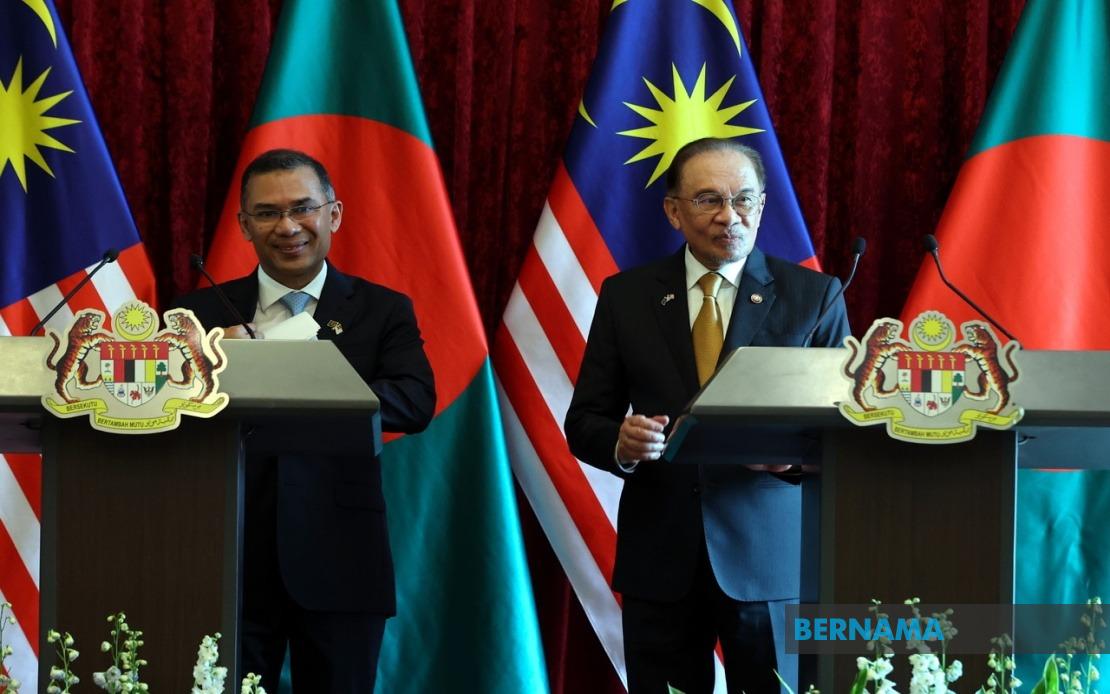
Malaysia and Bangladesh have reaffirmed their shared commitment to addressing some of the world's most pressing geopolitical challenges, with Prime Minister Datuk Seri Anwar Ibrahim stressing the importance of coordinated international engagement on Palestine, Gaza, regional stability in the Gulf and relations with Iran. The alignment emerged during a joint press conference at Putrajaya on Monday as Bangladesh Prime Minister Tarique Rahman concluded the opening days of an official state visit aimed at deepening bilateral ties and expanding cooperation across sectors of mutual concern.
Anwar emphasised that both nations remain steadfast in their support for the Palestinian people and continue to prioritise the humanitarian crisis affecting Gaza's population. The Malaysian leader characterised the situation in Gaza as reflecting grave atrocities perpetrated by what he described as the Zionist Israeli regime, underscoring the moral imperative for Malaysia and Bangladesh to maintain pressure on the international community to acknowledge Palestinian rights and suffering. This positioning reflects the deeply held views in both Muslim-majority nations, where public sentiment on the Israeli-Palestinian conflict has historically shaped foreign policy decisions and international engagement.
The emphasis on coordinated action extends beyond Palestinian affairs to encompass broader regional security concerns. Both nations have indicated their commitment to promoting lasting stability across the Gulf region, a strategically vital area whose stability has ramifications far beyond its borders. For Malaysia and Bangladesh alike, the Gulf's security environment affects energy supplies, maritime commerce, and the safety of their respective nationals working in the region. By articulating a common stance, the two governments signal their intent to contribute constructively to dialogue and de-escalation rather than allow regional tensions to spiral unchecked.
The dialogue between Anwar and Rahman on Iran represents another significant dimension of their convergence. Both countries have demonstrated pragmatic approaches to Iran, balancing regional relationships while maintaining engagement with Western powers. Malaysia's historically nuanced position on Iran—coupled with Bangladesh's similar efforts to maintain balanced relations—suggests both governments view dialogue and diplomacy as preferable to isolation or confrontation. This shared outlook may create openings for coordinated diplomatic initiatives within regional forums where both nations hold membership.
Tarique's visit carries particular significance as his first official international trip since assuming office in February this year following political transitions in Bangladesh. The decision to prioritise Malaysia as the destination for this inaugural foreign engagement underscores the importance both governments place on their bilateral relationship. For Anwar's administration, the visit provides an opportunity to demonstrate Malaysia's role as a key anchor state in South and Southeast Asia, capable of fostering meaningful partnerships with significant regional neighbours.
Beyond the geopolitical messaging, both leaders emphasised the family-like nature of Malaysian-Bangladeshi relations, rooted in shared Islamic values, cultural affinity, and historical ties. Anwar's characterisation of Bangladesh's leadership as part of an extended family reflected the warmth underlying these diplomatic engagements. Such language, while diplomatic in nature, also speaks to genuine people-to-people connections between the nations, including substantial Bangladeshi communities in Malaysia and longstanding educational and professional exchanges.
The visit agenda extends to practical cooperation across multiple sectors. Malaysia and Bangladesh have indicated intent to deepen engagement in areas including trade and investment, labour mobility, education, and defence cooperation. For Malaysia, expanding ties with Bangladesh offers economic opportunities and access to a major South Asian market, while Bangladesh gains from Malaysia's developed financial infrastructure and expertise in Islamic finance and governance. Enhanced labour cooperation proves particularly relevant given the significant Bangladeshi workforce in Malaysia across manufacturing, construction, and services sectors.
Anwar's statement that "we are together and we will continue to engage with all our partners to ensure there is peace" reflects a broader diplomatic strategy aimed at mobilising regional consensus on global challenges. This approach acknowledges that in an increasingly multipolar world, nations must forge coalitions around shared values and interests to amplify their voices in international forums. For Malaysia and Bangladesh, whose individual populations and economies, while substantial, carry limited weight in global power politics, coordinated action offers a mechanism for meaningful influence.
The joint position on Palestine and the Middle East also positions Malaysia and Bangladesh as voices advocating for non-Western perspectives within international debate. Both nations have historically championed causes related to decolonisation, self-determination, and the rights of Muslim populations, viewing these issues through the lens of their own historical experiences. By maintaining principled stances on these matters, they appeal to domestic constituencies who expect their governments to champion justice on the global stage.
Looking forward, the outcomes of Tarique's visit may shape how Malaysia and Bangladesh coordinate within multilateral institutions such as the Organisation of Islamic Cooperation, the Non-Aligned Movement, and the United Nations. Their collaborative approach on sensitive international issues could influence voting patterns and consensus-building within these forums, particularly on resolutions and initiatives related to Palestinian rights, humanitarian crises, and regional security.
The timing of the visit, occurring amid ongoing volatility in the Middle East and evolving geopolitical alignments in Asia, adds contemporary relevance to Malaysia-Bangladesh coordination. Both nations face pressures to define their international positions clearly while maintaining pragmatic relationships across diverse power blocs. The public articulation of shared principles provides clarity to international partners while demonstrating domestic audiences that their governments remain principled advocates for causes aligned with national values and historical commitments.