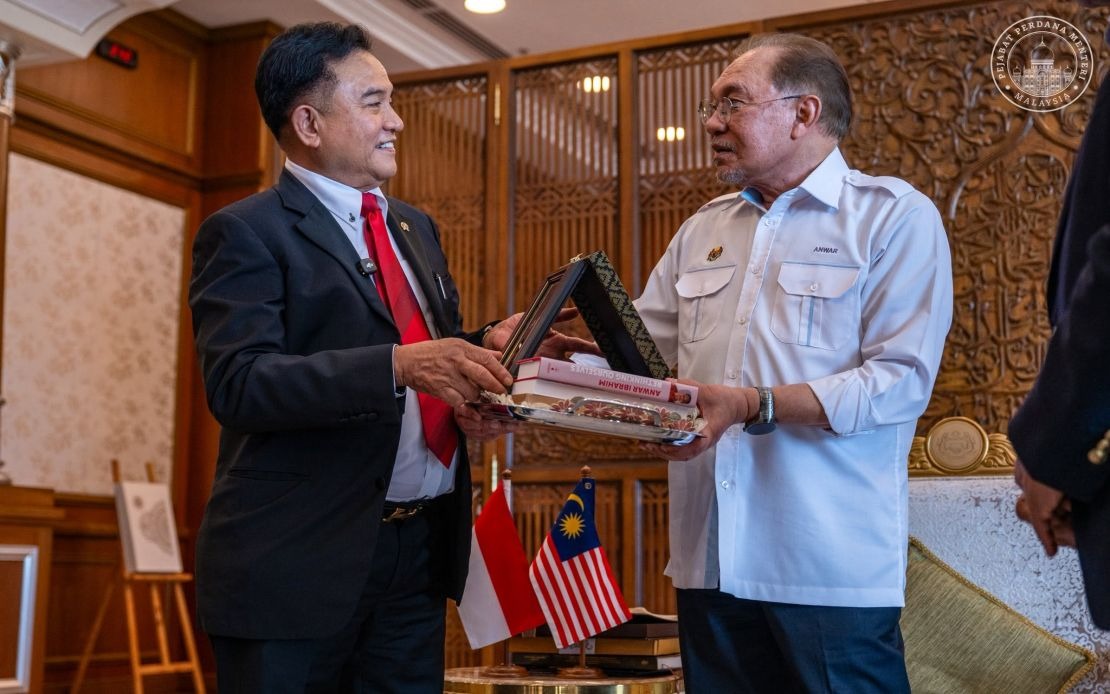
Prime Minister Datuk Seri Anwar Ibrahim has reaffirmed Malaysia's commitment to deepening institutional cooperation with Indonesia across legislative frameworks and governance structures, signalling renewed momentum in bilateral ties between Southeast Asia's two largest economies. The affirmation came during a formal courtesy visit by Indonesia's Coordinating Minister for Legal, Human Rights, Immigration and Correction, Prof Dr Yusril Ihza Mahendra, to the Prime Minister's Office in Putrajaya on June 29, where both leaders discussed concrete pathways for enhanced regional collaboration.
The meeting represents part of an ongoing strategic dialogue that extends beyond ceremonial exchanges. With Anwar also holding the portfolio of Finance Minister, his participation underscores the multifaceted nature of Malaysia-Indonesia relations, which increasingly encompass economic, judicial, and administrative dimensions. The presence of Mahendra, who oversees critical portfolios spanning legal affairs, human rights protection, immigration management, and correctional systems, reflects Indonesia's priority placement on strengthening institutional coordination across sectors that directly affect citizens and business operators in both nations.
The substantive focus on legislative cooperation carries particular significance for the Southeast Asian region. Both countries operate within distinct constitutional and legal traditions, yet face comparable challenges in modernising laws to address contemporary issues such as digital crimes, cross-border disputes, and humanitarian concerns. By establishing stronger legislative frameworks and knowledge-sharing mechanisms, Malaysia and Indonesia can develop parallel approaches to governance that enhance predictability and facilitate smoother interaction between their respective systems. This coordination becomes increasingly important as ASEAN deepens economic integration and cross-border movements of people and capital accelerate.
Governance improvements through bilateral cooperation also bear directly on investor confidence and business operations. Enhanced legal harmonisation and clearer administrative procedures reduce friction points for companies operating across both markets. For Malaysian firms seeking expansion into Indonesia's larger consumer base and Indonesian enterprises eyeing Malaysian expertise in specific sectors, streamlined regulatory frameworks represent tangible benefits. The commitment to strengthen cooperation in governance thus carries economic implications that extend beyond government circles into the private sector and civil society.
The discussion of "various strategic areas of mutual interest" signals openness to broadening the cooperation agenda beyond the explicitly mentioned legislative and governance domains. Regional security concerns, maritime cooperation, labour mobility, and environmental protection represent potential areas where deeper coordination could yield mutual benefits. For Malaysia particularly, enhanced cooperation with Indonesia on managing shared maritime resources and addressing transnational challenges strengthens the nation's position within ASEAN and provides leverage in regional multilateral forums.
The emphasis on "close fraternal relations" in Anwar's statement reflects the cultural and historical foundations underpinning Malaysia-Indonesia ties. Beyond formal government-to-government protocols, the shared Islamic heritage, linguistic similarities, and interconnected family networks create a distinct character to bilateral relations that transcends typical diplomatic engagement. Sustaining and channelling this fraternal goodwill into concrete institutional improvements represents a strategic approach that leverages existing people-to-people bonds to advance state interests.
For Malaysian readers and policymakers, the implications warrant careful attention. Indonesia's size, population of over 270 million, and position as a regional economic powerhouse mean that the trajectory of Malaysia-Indonesia relations influences broader Southeast Asian stability and prosperity. Deepened legislative and governance cooperation positions Malaysia to benefit from knowledge exchange while simultaneously contributing to regional standardisation that enhances predictability across the bloc. Additionally, strengthened institutional ties with Jakarta provide Malaysia with a critical partnership for addressing challenges that transcend bilateral concerns, such as maritime security, human trafficking, and transnational crime.
The timing of this high-level engagement also merits consideration within the broader context of ASEAN cohesion. As the regional bloc navigates geopolitical pressures and economic transition, robust bilateral relationships between major members serve as anchoring mechanisms that prevent fragmentation. Malaysia-Indonesia cooperation modelled around institutional strengthening and governance improvements contributes to ASEAN's credibility as a rules-based organisation capable of managing complex interstate relations through dialogue and structured engagement.
Moving forward, the effectiveness of these cooperation initiatives will depend on translating commitments into concrete mechanisms and deliverables. Establishing joint working groups, facilitating regular high-level exchanges, creating bilateral legal harmonisation programmes, and implementing knowledge-sharing initiatives in public administration represent pathways through which the expressed commitment can materialise into tangible outcomes. Malaysian stakeholders should monitor the implementation of agreements emerging from such dialogues and advocate for mechanisms ensuring transparency and measurable progress.
The reaffirmation of Malaysia-Indonesia commitment to cooperation in legislation and governance reflects continuity in foreign policy while signalling intent to deepen institutional relationships. For regional observers, such engagement demonstrates that despite occasional tensions and differences in approach to various regional issues, the two countries maintain fundamental interest in strengthening their institutional architecture. This sustained commitment to bilateral cooperation provides a stabilising force within ASEAN and contributes to an environment conducive to regional peace, prosperity, and collective problem-solving capacity.

