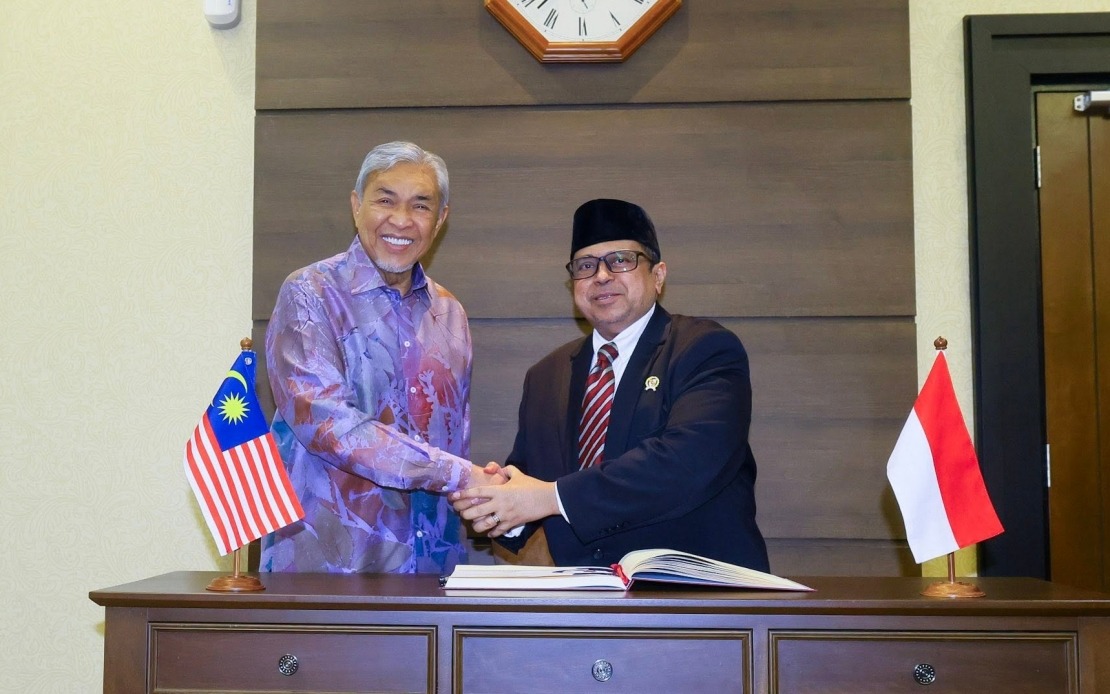
Malaysia and Indonesia are poised to significantly broaden their partnership in the halal industry, with plans to establish coordinating bodies that would elevate collaboration beyond bilateral trade to encompass regional and international frameworks. During a recent meeting at Parliament in Kuala Lumpur, Deputy Prime Minister Datuk Seri Dr Ahmad Zahid Hamidi engaged with Indonesia's Ambassador to Malaysia, Raden Datuk Mohammad Iman Hascarya Kusumo, and Dr Ahmad Haikal Hassan, who heads Indonesia's Halal Product Assurance Organising Body (BPJPH), to chart the course for this expanded cooperation.
The discussions centred on a multifaceted approach to strengthening the halal ecosystem, touching on industry development, cross-border commerce, rural advancement, and workforce capabilities. Both nations recognised that their historic proximity and shared Islamic heritage position them uniquely to lead regional halal market development. The scope of potential collaboration extends well beyond conventional bilateral trade agreements, reflecting growing recognition that halal certification and standards harmonisation have become critical factors in global supply chains.
At the heart of the proposed framework lies the establishment of the Malaysia-Indonesia Halal Council (MIHC), a dedicated platform designed to facilitate direct coordination between the two countries' halal authorities and industry stakeholders. This bilateral body would serve as the foundation for more ambitious regional and international initiatives, including the envisioned ASEAN Halal Council and the World Halal Development Council. These layered structures would enable Malaysia and Indonesia to influence global halal standards while maintaining direct oversight of shared markets and supply chains.
Harmonising halal standards represents a particularly pressing concern for both nations. Currently, divergent certification requirements and testing protocols between Malaysia and Indonesia create friction in trade flows, particularly in processed foods, cosmetics, and pharmaceuticals. By establishing common benchmarks through the MIHC, both countries could reduce compliance costs for manufacturers, streamline cross-border commerce, and present a unified front in international halal certification discussions. This alignment would be especially beneficial for small and medium enterprises seeking to export throughout Southeast Asia.
The emphasis on trade expansion reflects the commercial potential that remains largely untapped across the region. Malaysia's position as a global halal hub, reinforced by its established certification infrastructure and international reputation, complements Indonesia's role as a massive producer of halal-certified goods and raw materials. A coordinated approach would allow Indonesia's manufacturers to leverage Malaysia's international market access and brand equity, while Malaysia could secure preferential supply chains and production opportunities in Indonesia. For Southeast Asian exporters more broadly, Malaysian-Indonesian cooperation on standards would simplify regional market entry and strengthen ASEAN's collective position in global halal commerce.
As chairman of the Malaysia Halal Industry Development Council, Ahmad Zahid emphasised that the longstanding cultural and religious bonds between the two nations provide a sturdy foundation for deepening institutional cooperation. These ties extend beyond government-to-government relations to encompass shared pesantren networks, Islamic scholarship traditions, and consumer preferences that create natural alignment in halal market priorities. This cultural dimension differentiates Malaysian-Indonesian cooperation from purely commercial partnerships, suggesting staying power and shared commitment to advancing Islamic principles in commerce.
The proposed World Halal Development Council would represent an even bolder ambition, positioning Malaysia and Indonesia at the forefront of global halal governance. Such a body could work toward standardising halal definitions internationally, mediating disputes over certification protocols, and establishing benchmarks recognised by major trading blocs. For Malaysian readers, this elevation of halal standards to the global stage validates the country's two-decade investment in halal infrastructure and regulatory frameworks, transforming what was once a niche religious concern into a mainstream commercial and diplomatic asset.
Rural development emerges as an often-overlooked dimension of this cooperation framework. Both Malaysia and Indonesia possess significant agricultural hinterlands where halal-certified farming, livestock rearing, and food processing could unlock substantial economic value. Coordinated rural development policies could establish halal-specific supply chains, create employment in secondary processing, and establish geographic indicators of origin that command premium prices. This approach would help distribute halal industry benefits beyond major urban centres and export-oriented manufacturers.
Human capital development likewise carries strategic importance. Training technicians, certifiers, and managers who understand both countries' regulatory environments would facilitate smoother commercial operations and reduce information asymmetries. Joint educational initiatives, secondment programmes, and certification reciprocity agreements could build a cadre of halal professionals who view themselves as part of a regional ecosystem rather than strictly national frameworks. This human dimension supports institutional longevity and reduces reliance on periodic high-level political meetings.
For regional competitors and international observers, Malaysian-Indonesian halal cooperation presents a significant shift in market dynamics. The two nations together account for over 40 per cent of ASEAN's GDP and encompass the region's largest Muslim-majority populations. Their coordinated approach to halal standards and market development could effectively set regional norms that smaller ASEAN members would need to accommodate. This concentration of halal authority raises questions about market access for non-aligned producers and whether the framework would remain genuinely open or gradually consolidate preferences favouring Malaysian and Indonesian suppliers.
The investment in these institutional structures also signals confidence in halal market growth trajectories. Global halal product demand continues expanding at roughly double-digit annual rates as Muslim populations grow, purchasing power increases in emerging markets, and non-Muslim consumers express interest in halal-certified goods due to perceived quality and ethical standards. By institutionalising cooperation now, Malaysia and Indonesia position themselves to capture disproportionate shares of this expanding market rather than competing for slices of a static pie.
Implementation timelines remain unclear from the initial announcement, and practical challenges will emerge as officials translate ambitious council frameworks into functioning bodies with genuine decision-making authority. Questions persist regarding whether existing bodies like the Islamic Development Bank or the Organisation of Islamic Cooperation would eventually coordinate with these new structures, and how the frameworks would interact with existing trade agreements. Nonetheless, the strategic intent appears clear: Malaysia and Indonesia are committed to deepening halal cooperation as both a religious imperative and a commercial strategy for regional economic leadership.

