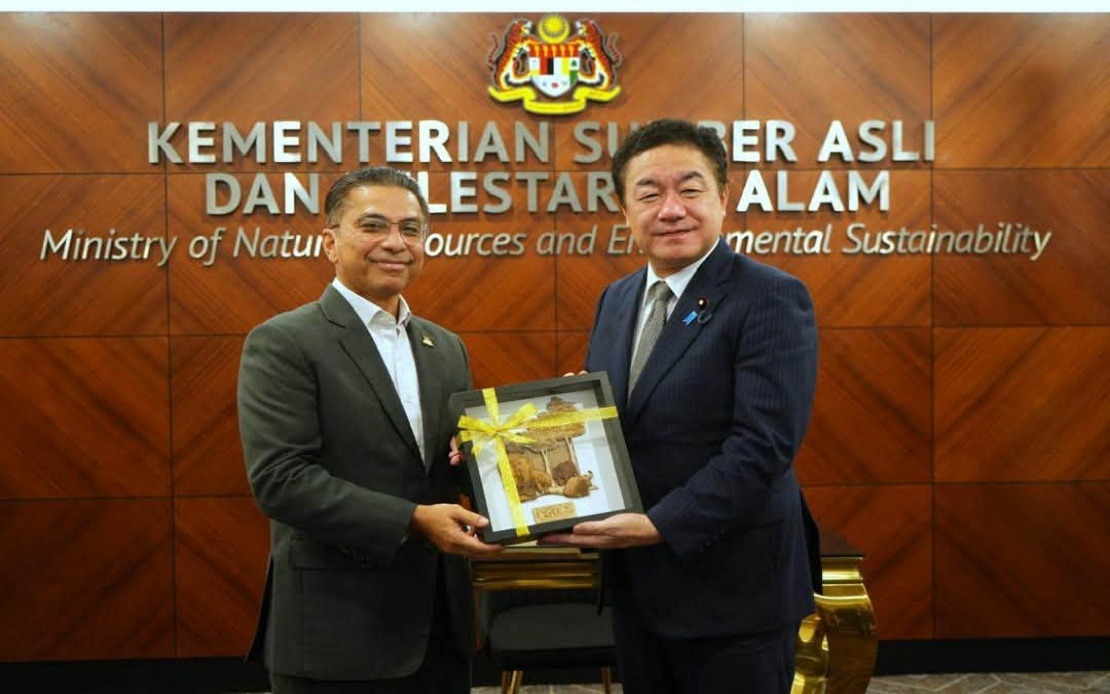
Malaysia and Japan are moving forward with deeper strategic cooperation in critical minerals and climate technologies, following high-level discussions in Putrajaya on August 27. Japan's Parliamentary Vice-Minister of Economy, Trade and Industry Komori Takuo visited the Ministry of Natural Resources and Environmental Sustainability to review progress on bilateral initiatives and chart a course for expanded partnership in sectors vital to both nations' economic and environmental interests.
The engagement reflects the substantive nature of Malaysia-Japan relations beyond traditional diplomatic pleasantries. The meeting, chaired by Deputy Natural Resources and Environmental Sustainability Minister Syed Ibrahim Syed Noh, served to consolidate commitments made during a bilateral summit in June held under the Malaysia-Japan Comprehensive Strategic Partnership framework. For Malaysia, the discussion represented an opportunity to position itself as a reliable partner in Japan's strategy to secure stable supplies of rare earth elements and critical minerals, key inputs for advanced manufacturing and clean energy technologies that Japan heavily depends upon.
A central theme in the dialogue was Malaysia's deliberate approach to rare earth element development. The country has maintained a firm policy stance against exporting raw REE materials, instead prioritising the establishment of domestic processing infrastructure and value-added manufacturing capabilities. This strategy aims to capture greater economic benefits from the nation's mineral endowments and create skilled employment in downstream industries. Malaysia's consistent messaging on this point during the meeting underscores the government's determination to move beyond simple resource extraction toward becoming a regional processing hub, an ambition that requires technological partnership with advanced economies like Japan.
Japan's role in supporting Malaysia's resource sector development carries particular significance given Tokyo's proven expertise in minerals processing and refining technologies. The bilateral relationship benefits substantially from Japan's provision of technical cooperation and technology transfer through established channels including the Japan International Cooperation Agency (JICA) and the Japan Organisation for Metals and Energy Security (JOGMEC). These institutions have developed considerable experience assisting Southeast Asian nations build mineral processing capacity, making them natural partners for Malaysia's development aspirations in this domain.
Beyond mineral cooperation, the discussions revealed substantial progress on climate and clean energy collaboration. Both nations welcomed the finalisation of negotiations surrounding a Memorandum of Cooperation for the Joint Crediting Mechanism (JCM), a bilateral framework for carbon market cooperation operating under Article 6.2 of the Paris Agreement. This mechanism creates pathways for Japanese investment in low-carbon technology projects across Malaysia, with carbon credits accruing to both countries. The framework addresses a critical gap in financing the energy transition while allowing participating nations to make tangible progress toward climate commitments under the Paris framework.
For Malaysia, the Joint Crediting Mechanism holds particular relevance given the nation's obligations under its Nationally Determined Contribution (NDC). The framework is expected to be finalised by year's end, providing concrete momentum toward Malaysia's climate goals. The JCM creates incentive structures for private investment in renewable energy, energy efficiency, and emissions reduction projects without imposing all costs on public budgets. This represents a pragmatic approach to climate financing that acknowledges developing nations' dual imperatives of decarbonising their economies while sustaining growth and development.
The intersection of rare earth elements and climate action in these bilateral discussions reflects evolving global economic realities. The transition toward renewable energy and electric vehicles creates surging demand for rare earth elements used in permanent magnets, batteries, and power electronics. Japan, as a technology leader in these domains, requires assured access to processed materials, while Malaysia possesses natural resources and growing manufacturing capacity. The convergence of interests creates genuine mutual benefit and explains why both nations are investing diplomatic and technical resources in strengthening cooperation.
Malaysia's confidence, as expressed through the Ministry of Natural Resources and Environmental Sustainability, that combining Japanese green technology expertise with domestic sustainable resource potential offers a pathway to building a competitive green economy reflects realistic assessment of comparative advantages. Japan brings technological sophistication, capital, and market access; Malaysia contributes natural resources, geographic positioning, and a substantial manufacturing base. This complementarity extends beyond immediate bilateral benefit to regional implications, as a successful Malaysia-Japan partnership in green minerals processing could establish a model for other Southeast Asian resource-rich nations.
The composition of delegations at the meeting indicates the multi-ministerial coordination required for such partnerships. The Malaysian side included not only natural resources officials but representatives from the Foreign Ministry, signalling that mineral and climate cooperation carries diplomatic significance. Japan's representation through both METI officials and Ambassador Shikata Noriyuki reinforced Tokyo's commitment to these initiatives at the political level. Such high-level engagement typically precedes concrete announcements of investment commitments or project launches.
Looking forward, the momentum generated by these discussions positions Malaysia advantageously within Japan's broader Indo-Pacific strategy. As Tokyo navigates supply chain diversification away from concentrations in China, Southeast Asian nations offering both resource availability and reliable governance frameworks present attractive alternatives. Malaysia's stated commitment to maintaining a moratorium on raw REE exports while building processing capacity aligns with Japanese preferences for sourcing processed materials from trusted partners rather than competing for raw materials globally.
The finalisation of the Joint Crediting Mechanism by year's end will provide concrete institutional infrastructure for climate-focused cooperation. Project development in renewable energy, industrial efficiency, and emissions reduction across Malaysian industries will create pathways for Japanese technology adoption and investment, generating economic activity while advancing decarbonisation. These mechanisms typically require three to five years from finalisation to substantial project deployment, suggesting that meaningful capital flows could commence in 2025 and 2026.
For Malaysian policymakers and businesses, the strengthening of ties with Japan offers both immediate opportunities and strategic positioning. In the immediate term, Japanese technical expertise and JICA-JOGMEC support can accelerate development of domestic rare earth processing capabilities. Over the medium term, the Joint Crediting Mechanism provides financing for green transitions across energy-intensive sectors. More broadly, positioning Malaysia as a reliable minerals processor and clean technology adopter strengthens the nation's appeal to other technology-leading economies seeking supply chain partners in Southeast Asia.

