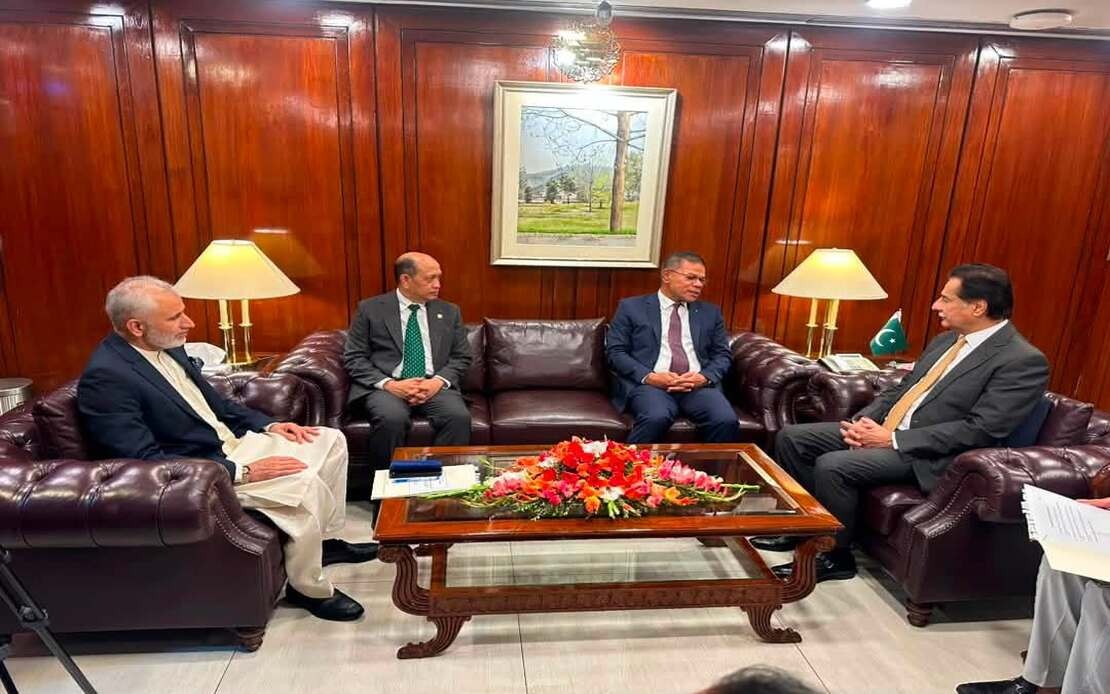
Malaysia and Pakistan have reaffirmed their shared commitment to diplomatic solutions and constructive engagement as essential tools for navigating complex geopolitical tensions and security challenges across Asia. Home Minister Datuk Seri Saifuddin Nasution Ismail conveyed this position during his recent official visit to Islamabad, where he held substantive discussions with two of Pakistan's most senior parliamentary figures: Sardar Ayaz Sadiq, Speaker of the National Assembly, and Syed Yousaf Raza Gilan, Chairman of the Senate. The exchange of views reflected both capitals' belief that dialogue mechanisms and multilateral frameworks remain indispensable for maintaining regional equilibrium during a period of heightened geopolitical uncertainty.
The timing of Saifuddin Nasution's diplomatic mission underscores Malaysia's proactive approach to strengthening ties with key Islamic and South Asian nations while promoting a vision of peaceful coexistence. Pakistan, as a significant regional power with substantial influence across South Asia and the broader Islamic world, represents a strategic partnership for Malaysia. The Home Minister's engagement with parliamentary leadership rather than purely executive-level officials signals an intention to deepen institutional connections and foster people-to-people understanding between the two democracies. Such parliamentary diplomacy serves as a crucial complement to official government channels, enabling legislators to build personal relationships and develop shared perspectives on regional challenges.
A central theme of the discussions involved Malaysia's experience in leveraging ASEAN mechanisms to preserve regional peace and stability. The Association of Southeast Asian Nations has long positioned itself as a forum for resolving disputes through consensus, dialogue, and non-interference in internal affairs. By highlighting ASEAN's track record, Malaysia sought to demonstrate how multilateral platforms can reduce tensions without imposing solutions on member states. This approach holds particular relevance for Pakistan, which faces its own regional security challenges and might benefit from studying how ASEAN manages competing interests among diverse nations with different strategic alignments. The implicit message was that dialogue need not require nations to abandon their interests; rather, structured engagement can help reconcile competing concerns.
The conversations also addressed the expansion of parliamentary cooperation between the two nations. Both Malaysia and Pakistan have functional parliamentary systems that play important roles in their respective democratic structures. Strengthening institutional ties at the legislative level can facilitate knowledge-sharing on governance, committee work, and legislative practices. Such exchanges help build networks of lawmakers who understand each other's political contexts and constraints, potentially creating informal channels for resolving disputes before they escalate into official crises. As both countries grapple with balancing democratic governance with security imperatives, learning from each other's experiences could prove mutually beneficial.
The foundation upon which these discussions rest is the deep historical relationship between Malaysia and Pakistan, rooted in shared Islamic heritage, cultural connections, and democratic values. Both nations emerged as independent states with significant Muslim populations and have consistently emphasised the importance of fraternal bonds between Islamic countries. The people-to-people ties that have developed over decades of interaction—from student exchanges to business relationships to family connections—create a reservoir of goodwill that transcends temporary political differences. This foundation of trust and mutual respect provides essential ballast during periods when geopolitical pressures might otherwise strain bilateral relations.
Saifuddin Nasution's visit to the Parliament Museum in Islamabad demonstrated a commitment to understanding Pakistan's constitutional and democratic history beyond superficial diplomatic courtesies. The museum chronicles Pakistan's journey through multiple constitutional frameworks and parliamentary evolution, offering insights into how the nation has grappled with sustaining democratic institutions amid security challenges. For a Malaysian delegation, studying this history provides valuable perspective on the complexities of maintaining parliamentary democracy in countries facing significant internal and external security threats. Such historical awareness enriches diplomatic engagement by enabling officials to appreciate the constraints and achievements of their counterparts.
The emphasis on dialogue and peaceful solutions reflects a broader strategic calculation by Malaysia regarding its regional role. As a Southeast Asian nation with significant economic interests in South Asia and the broader Indian Ocean region, Malaysia benefits from stability across multiple geographical zones. Tensions in South Asia—whether between India and Pakistan, within Pakistan itself, or involving maritime disputes—can have cascading effects on shipping routes, investment flows, and regional security architectures that ultimately affect Malaysia. By promoting dialogue and peaceful resolution mechanisms, Malaysia positions itself as a responsible voice advocating for stability rather than confrontation, enhancing its diplomatic standing across the region.
The bilateral relationship encompasses practical cooperation mechanisms beyond parliamentary exchanges. Malaysia and Pakistan collaborate through various multilateral organisations, including the Organisation of Islamic Cooperation and the Non-Aligned Movement, where they often coordinate positions on issues affecting Muslim-majority nations and global South countries. They also maintain economic relationships, with Pakistani professionals and students present in Malaysia while Malaysian companies engage in Pakistani markets. Strengthening the diplomatic architecture supporting these connections ensures that commerce and cultural exchange can flourish without being disrupted by political disagreements. The parliamentary dialogue represents one layer in a comprehensive relationship strategy.
From a Malaysian perspective, the timing of deepening engagement with Pakistan carries additional significance given regional developments. As major powers extend their influence across the Indian Ocean and South Asia, smaller to medium-sized nations like Malaysia must carefully calibrate their relationships to maintain strategic autonomy. By strengthening ties with Pakistan through dialogue and institutional engagement, Malaysia reinforces its credentials as a nation committed to non-aligned principles and peaceful conflict resolution—positions that resonate across the Global South and enhance Malaysia's diplomatic influence in multilateral forums. This approach also signals to other regional actors that Malaysia can be a reliable partner for constructive engagement.
Looking ahead, the outcomes of these high-level exchanges are likely to manifest in expanded parliamentary delegations, increased legislative staff exchanges, and potentially joint initiatives on regional security issues where Malaysia and Pakistan share concerns. The meetings also create space for quiet diplomatic problem-solving on bilateral issues that may occasionally arise. More broadly, they contribute to maintaining robust channels of communication at multiple levels of government, reducing the likelihood that misunderstandings could escalate into serious disputes. In an era of rapid geopolitical change and competing power blocs, nations like Malaysia and Pakistan derive significant benefit from reinforcing personal relationships and institutional connections among their leadership, ensuring that engagement remains consistent regardless of electoral cycles or shifting domestic priorities.

