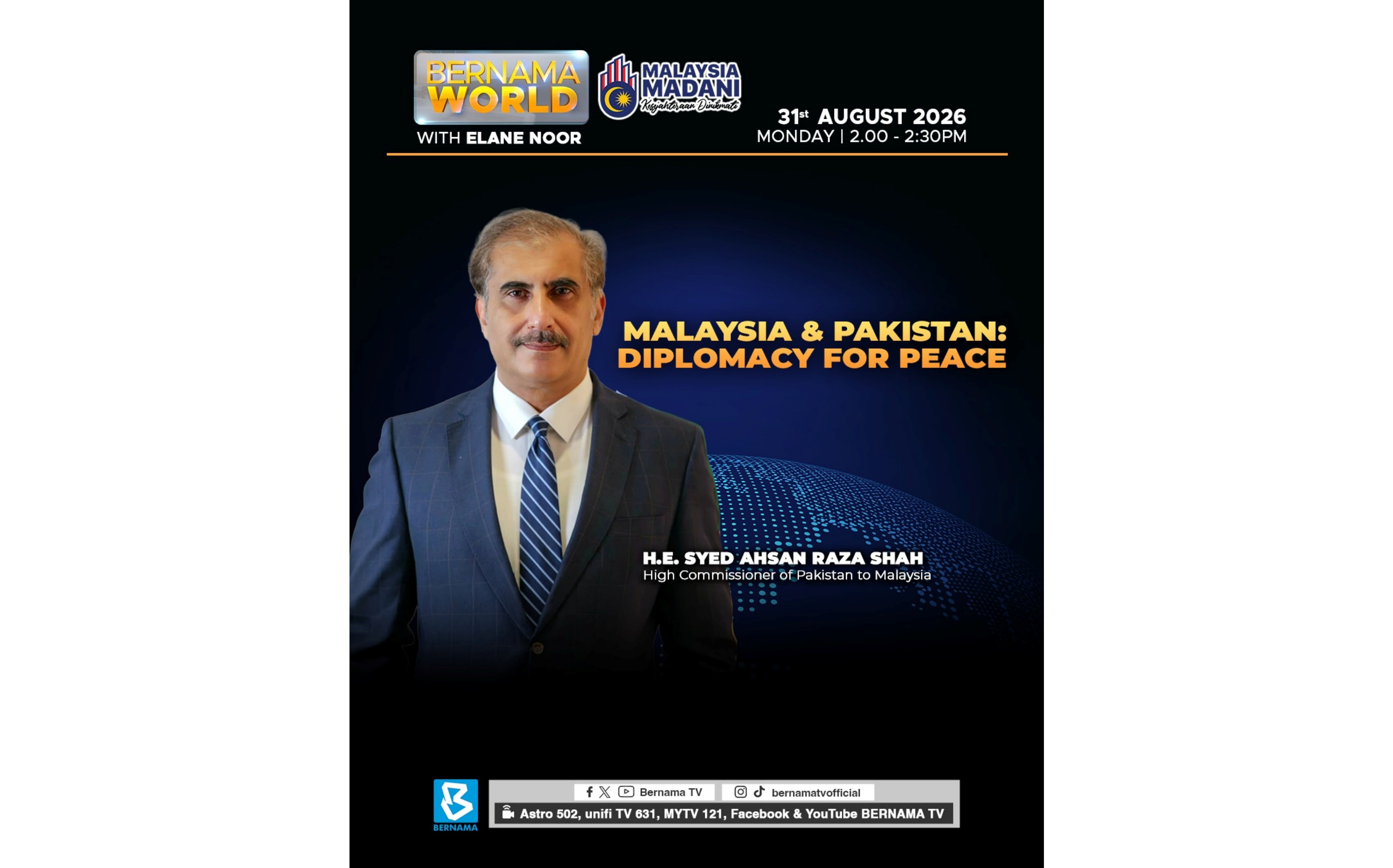
Pakistan High Commissioner to Malaysia Syed Ahsan Raza Shah has issued a compelling call for Malaysia and Pakistan to deepen their partnership in conflict resolution and mediation, framing such collaboration as essential to addressing mounting geopolitical instability affecting both the region and the world. Speaking to Bernama World, Syed Ahsan articulated a vision of strategic cooperation grounded in each nation's demonstrated capacity to bridge divides and facilitate dialogue when international tensions threaten to spiral beyond control. His remarks come at a moment when diplomatic competence has become an increasingly scarce commodity, with traditional power brokers often viewed with suspicion by conflicting parties.
The High Commissioner pointed to concrete examples of both nations' mediatory successes to underscore his argument. Malaysia, under the stewardship of Prime Minister Datuk Seri Anwar Ibrahim, played a pivotal role in de-escalating the Cambodia-Thailand border crisis when existing ASEAN mechanisms proved insufficient to contain the conflict. When hostilities erupted between these two neighbouring states, Anwar's measured approach and diplomatic acumen helped broker a ceasefire and ultimately the signing of the Kuala Lumpur pact, demonstrating Malaysia's capacity to influence outcomes in complex regional disputes. Pakistan similarly positioned itself as an indispensable mediator between the United States and Iran, leveraging its unique geographical position as Iran's neighbour and its longstanding relationship with Washington to facilitate dialogue when bilateral relations had deteriorated to a dangerous impasse.
Syed Ahsan explained that Pakistan's role in the Iran-US mediation reflected its singular position in international affairs. Situated alongside Iran with historical and cultural ties running deep, while simultaneously maintaining close strategic partnerships with the United States, Pakistan possessed an authenticity and credibility that neither party could dispute. When tensions reached a critical juncture where the trajectory of negotiations appeared unknowable and both sides occupied irreconcilable positions, Pakistan's intervention provided the neutral ground and trusted intermediary necessary to restart dialogue. The resulting Islamabad accord represents a tangible achievement that Syed Ahsan regarded with evident pride, suggesting a template for how carefully positioned nations can contribute to global stability.
Crucially, Syed Ahsan articulated a broader philosophical framework underpinning successful mediation that extends beyond technical diplomatic skill. He emphasised that Prime Minister Anwar's approach to conflict resolution exemplifies what the Malaysian leader has termed "post-normal times"—an era when traditional diplomatic playbooks prove inadequate and practitioners must fundamentally reimagine their methodologies. This requires countries to abandon rigid approaches and instead adopt flexible, adaptive strategies informed by practical experience and mutual learning. The capacity to evolve one's diplomatic toolkit becomes as important as the substance of negotiating positions, a point that underscores why Malaysia-Pakistan cooperation would yield mutual benefits.
The foundation of any successful mediation architecture, according to Syed Ahsan, rests upon a single but irreplaceable element: trust. Parties to a conflict will not engage seriously with mediators they perceive as biased, self-interested, or insufficiently committed to impartial resolution. Building and maintaining this trust requires mediators to demonstrate consistently that their intentions remain honourable and their analysis dispassionate. Without this foundation, even the most technically proficient negotiators will find their efforts stymied by suspicion and recalcitrance from conflicting parties.
Beyond trust, Syed Ahsan outlined practical methodologies that distinguish effective mediators from ineffectual ones. He cautioned against the temptation to seek dramatic, single-session breakthroughs that resolve complex disputes in one ambitious negotiating round. Instead, genuinely transformative mediation proceeds through incremental progress, with each modest advance building confidence for subsequent steps. This requires patience born from understanding that conflicts accumulating over years or decades cannot realistically dissolve overnight. Equally important is the mediator's capacity to remain composed when negotiations encounter inevitable setbacks and parties resort to inflammatory rhetoric designed to shift blame or energise domestic constituencies. The mediator who responds emotionally to such provocation risks losing the detachment necessary to guide parties back toward productive dialogue.
Syed Ahsan highlighted another crucial dimension of Malaysia's mediation successes: Prime Minister Anwar Ibrahim's exceptional ability to forge personal rapport with international leaders. This interpersonal skill transcends mere charm or sociability; it reflects a capacity to understand diverse worldviews, communicate authentic respect for different perspectives, and build genuine relationships that survive disagreements and setbacks. When leaders of conflicting nations possess personal respect for and confidence in a mediator, they become more willing to take the diplomatic risks necessary for resolution. Anwar's track record suggests he possesses this quality in abundance, a competitive advantage that Malaysia must leverage strategically in future mediation opportunities.
The High Commissioner connected these mediation principles to the broader geopolitical landscape confronting Southeast Asia and beyond. He warned that contemporary conflicts possess a pernicious characteristic: they refuse to remain contained within their geographical origins. Border disputes, religious tensions, resource competitions, and ideological conflicts that erupt in one region inevitably generate cascading economic and strategic consequences elsewhere. The chaos engendered by unresolved conflicts disrupts trade flows, displaces populations, attracts extremist elements, and forces neighbouring states to choose sides in disputes not of their making. Malaysia, despite its relative stability and prosperity, remains vulnerable to these transnational reverberations, which makes investment in conflict prevention and mediation capacity a rational act of national self-interest rather than mere altruism.
Syed Ahsan's articulation of mediation as a "strategic necessity" reflects a sophisticated understanding of how small to medium-sized powers can exercise disproportionate influence in an anarchic international system. Neither Malaysia nor Pakistan possesses the military or economic dominance to impose solutions through coercion or inducement. Instead, both nations can deploy their geographical positions, historical relationships, diplomatic credentials, and demonstrated competence to create space for dialogue where previously only confrontation seemed possible. This represents a form of soft power uniquely suited to nations that lack hegemonic pretensions but possess enough credibility and connections to facilitate others' interactions.
The practical implications for Malaysia extend across multiple dimensions of national policy. Institutionalising Malaysia-Pakistan cooperation on mediation would mean developing formal mechanisms for sharing best practices, training diplomats in collaborative frameworks, and creating regular forums where officials from both nations discuss emerging conflicts and coordinate potential interventions. Such cooperation could enhance Malaysia's profile as a responsible regional power while strengthening bilateral ties with Pakistan. For Pakistan, closer alignment with Malaysia on mediation efforts provides access to Malaysian networks within ASEAN and the broader Asian region, extending Islamabad's diplomatic reach into quarters where Pakistani interests intersect with regional stability.
The call for deeper Malaysia-Pakistan cooperation must be understood within the context of declining faith in traditional mediation by great powers. As the United States becomes less focused on regional conflicts outside its immediate strategic sphere and as China's mediation efforts remain viewed with suspicion by some parties, space emerges for credible middle powers to assume greater roles. Malaysia and Pakistan, each with their own networks, credibility markers, and strategic interests in regional stability, could together develop a coordinated approach to emerging disputes. This would represent not only an enhancement of bilateral relations but also a meaningful contribution to global peace and security in an increasingly fractious world.
Ultimately, Syed Ahsan's message resonates beyond the specifics of Malaysia-Pakistan relations to illuminate broader truths about international politics in the contemporary era. As geopolitical competition intensifies and trust among great powers erodes, the mediating function becomes more valuable and more difficult simultaneously. Countries capable of playing this role—nations sufficiently respected to be accepted by all parties, sufficiently removed from direct interests in conflict outcomes to be perceived as honest brokers, and sufficiently competent diplomatically to craft solutions acceptable to adversaries—occupy an increasingly important niche in international affairs. Malaysia and Pakistan, by pooling their experience and expertise, could enhance their respective capacities while contributing meaningfully to the peaceful resolution of conflicts that threaten the stability and prosperity of their regions and beyond.

