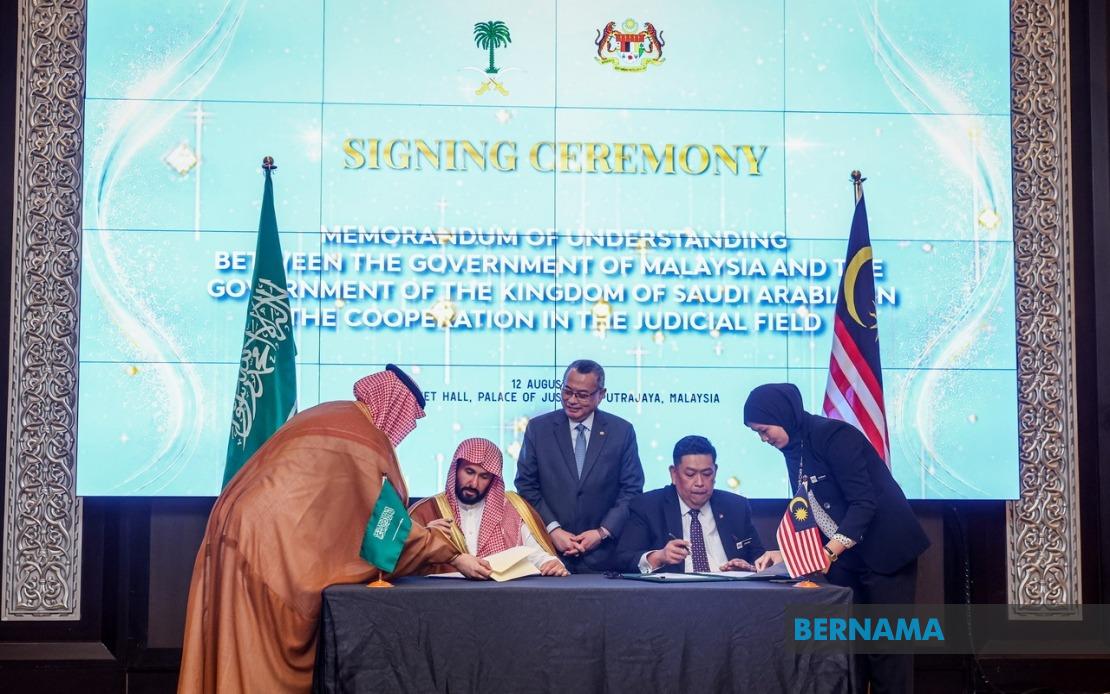
Malaysia and Saudi Arabia have taken a significant step in fortifying their institutional ties by formalising a comprehensive judicial cooperation agreement. The memorandum of understanding, executed at the Palace of Justice in Putrajaya on August 12, represents a deliberate effort by both nations to establish structured mechanisms for sustained engagement between their respective court systems and justice administrations. Chief Registrar of the Federal Court Azhaniz Teh Azman Teh and Saudi Arabian Minister of Justice Sheikh Dr Waleed Mohammed Alsmani signed the agreement, with Chief Justice Tun Wan Ahmad Farid Wan Salleh witnessing the ceremony.
The accord reflects deeper strategic alignment between Kuala Lumpur and Riyadh beyond traditional bilateral relations. Both countries recognise that modernising judicial systems requires cross-border learning and technical exchange, particularly as nations grapple with evolving legal challenges and technological transformation. The framework established by this MoU acknowledges that no single jurisdiction possesses all solutions, and that peer-to-peer engagement among established court systems can yield practical benefits for enhancing justice delivery.
Among the priority areas outlined in the agreement, civil case management emerges as a crucial focus. Malaysia's Federal Court has extensive experience managing diverse civil disputes across a pluralistic society, an expertise directly applicable to Saudi Arabia's ongoing judicial reforms. The exchange of best practices in case scheduling, alternative dispute resolution mechanisms, and court administration can help both nations streamline their civil litigation processes and reduce case backlogs that burden many courts in the region.
Judicial technology and digitalisation form the centrepiece of this partnership. Malaysia's e-Court system, which has gradually transformed how cases are filed, tracked, and adjudicated, represents a significant achievement in bringing court operations into the digital age. The system reduces paper dependency, enhances transparency, and enables litigants and practitioners to access court information more efficiently. By facilitating detailed knowledge-sharing about this infrastructure, Malaysia positions itself as a regional leader in judicial innovation while simultaneously supporting Saudi Arabia's parallel digitisation journey.
The formal exchange of publicly available judicial information constitutes another dimension of the accord. This commitment to transparency supports the broader international push for accessible justice systems where citizens and legal practitioners can readily understand court procedures, decisions, and performance metrics. For both countries, such openness can enhance public confidence in their respective judiciaries and demonstrate commitment to rule-of-law principles.
Institutional visits and regular professional exchanges will facilitate personal relationships between Malaysian and Saudi Arabian judges, registrars, and judicial administrators. These direct interactions often prove more valuable than written guidelines, as they enable participants to understand the reasoning behind specific procedures and the cultural contexts within which different legal systems operate. Regular dialogues create networks of professional relationships that endure and deepen over time.
A particularly significant component of Sheikh Dr Waleed's visit involved a focused dialogue on Malaysia's judicial approach to sexual offences against children. This thematic focus highlights shared regional concerns about child protection and demonstrates Malaysia's willingness to share its jurisprudence and institutional mechanisms designed to safeguard vulnerable populations. Malaysian courts have developed considerable expertise in handling sensitive cases involving minors, balancing the need for robust prosecution with procedural protections for child witnesses and victims.
The timing of this agreement assumes added importance given broader regional developments. Southeast Asia and the Middle East face overlapping challenges including cross-border crime, evolving family law issues, and the need to integrate technology into justice systems while maintaining due process protections. Malaysia's position as both a Southeast Asian nation and an Islamic-majority state makes it a natural bridge between these regions, capable of translating experiences and insights across different legal traditions.
The Office of the Chief Registrar's characterisation of the MoU as marking an important milestone underscores the diplomatic significance attached to this accord. Beyond the specific technical cooperation areas, the agreement symbolises mutual respect and recognition of institutional capacity. Saudi Arabia's willingness to engage with Malaysian judicial expertise validates the progress Malaysia has achieved in developing modern, efficient court systems. Conversely, Malaysia's engagement with Saudi Arabia reflects its ambition to position itself as a trusted knowledge partner within the Islamic world and the broader Global South.
Implementation will test both nations' commitment to the agreement's objectives. Establishing working groups, scheduling exchange visits, identifying specific cases or procedures for comparative study, and creating feedback mechanisms will require sustained administrative effort. Success will depend on adequate funding, staff allocation, and clear metrics for evaluating whether the partnership delivers tangible improvements in either jurisdiction's judicial operations.
Looking ahead, this bilateral accord may catalyse broader regional judicial cooperation frameworks. Other Muslim-majority nations in Southeast Asia and the Middle East might observe Malaysia and Saudi Arabia's experience and consider similar arrangements. If successful, the partnership could contribute to developing shared standards and approaches to emerging legal issues affecting Islamic nations, from fintech regulation to family law harmonisation in cross-border disputes.
The judicial cooperation framework also carries implications for Malaysian legal practitioners and the broader business community. Greater alignment with Saudi Arabian judicial processes could facilitate dispute resolution for the many Malaysian companies operating in Saudi Arabia and Saudi entities investing in Malaysia. Clearer understanding of each other's legal approaches reduces transaction costs and enhances predictability in commercial relationships.
Ultimately, the Malaysia-Saudi Arabia judicial MoU exemplifies how institutional cooperation in justice systems advances national interests while contributing to regional stability. By strengthening the capacity and legitimacy of each country's courts, both nations invest in the foundations of rule of law, economic development, and social cohesion that benefit their citizens and strengthen their mutual partnership.

