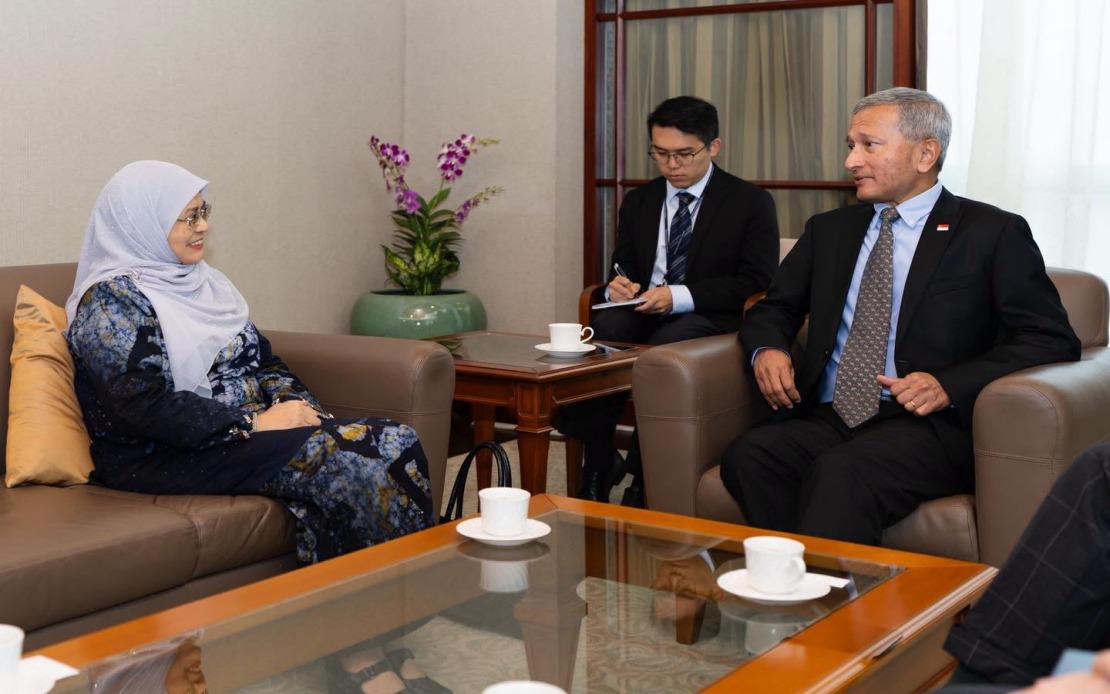
The two neighbouring nations have once again underscored their dedication to sustaining the positive trajectory of their bilateral relationship, with both governments emphasizing the need for continued collaboration across diverse sectors. This reaffirmation came through an official courtesy call in Singapore on Wednesday, where Datin Paduka Anizan Siti Hajjar Adnin, who assumed her role as Malaysian High Commissioner on July 2, 2026, met with Singapore's Foreign Minister Dr Vivian Balakrishnan to chart the course for their shared agenda.
The meeting served as a formal opportunity for the newly appointed High Commissioner to establish diplomatic channels and present Malaysia's priorities for the bilateral relationship. Such introductory engagements between incoming diplomatic envoys and foreign ministers typically set the tone for the next phase of relations, offering both sides a platform to articulate their vision and identify areas of mutual interest. For Malaysia, having its High Commissioner meet with Singapore's Foreign Minister at the outset signals the importance Malaysia places on the relationship with its closest neighbour.
During their discussions, both delegations reflected on the multifaceted nature of Malaysia-Singapore ties, which extend far beyond formal government-to-government exchanges. The conversation touched upon the deep historical bonds and robust people-to-people connections that have developed between the two nations over decades. These grassroots links—encompassing family networks, cultural interactions, and social exchanges—form the bedrock upon which official relations are built and provide resilience to the partnership during periods of diplomatic tension or disagreement.
A significant focus of the dialogue centred on the practical concerns of ordinary citizens who straddle both nations. Thousands of Malaysians and Singaporeans maintain families, employment, and business interests on both sides of the border, creating intricate cross-border dynamics that demand coordinated policy responses. Issues ranging from immigration procedures to employment regulations, taxation, and social services directly affect these communities. By explicitly addressing the need to enhance the lives of such citizens, both governments acknowledged the human dimension of their bilateral relationship, moving beyond abstract diplomatic frameworks to consider lived experiences.
Balakrishnan's public comments underscored Singapore's perspective on what makes the partnership distinctive. He highlighted three pillars: the shared historical narrative that binds the two nations, the dense network of interpersonal connections cultivated over generations, and the operational success of close cooperation across multiple domains including security, trade, infrastructure, and cultural exchange. This characterization reflects Singapore's strategic view of Malaysia as not merely a neighbouring state but as a fundamental component of its regional stability and economic prosperity.
The Foreign Minister's confidence in Anizan Siti Hajjar's ability to advance the relationship reflects faith in her diplomatic credentials and experience. High commissioners and ambassadors serve as crucial intermediaries between governments, tasked with interpreting policy positions, resolving misunderstandings, and identifying opportunities for collaboration that might otherwise remain obscured by bureaucratic channels. Her appointment to one of Singapore's most sensitive diplomatic postings suggests Malaysia's confidence in her capacity to navigate the nuances of the bilateral relationship.
For Malaysian readers and businesses, the reaffirmation of bilateral commitment carries practical implications. A stable and strengthening Malaysia-Singapore relationship typically translates into smoother trade facilitation, fewer barriers to cross-border investment, and more efficient resolution of disputes between private entities and government bodies. The assurance that both governments remain committed to exploring ways to improve bilateral relations can provide confidence to entrepreneurs and professionals operating across both markets.
The emphasis on maintaining positive momentum deserves particular attention in the context of Malaysia-Singapore history. The two nations have experienced periods of friction over territorial disputes, water agreements, and airspace issues, among other matters. Periodic reassertions of commitment to cooperation serve as stabilizing mechanisms, reorienting the relationship toward collaborative problem-solving rather than adversarial positioning. Such statements, while sometimes appearing routine, function as important diplomatic signalling that both governments prioritize the relationship despite occasional disagreements.
Looking ahead, the appointment of Anizan Siti Hajjar as High Commissioner coincides with a period in which regional stability and cross-border cooperation have become increasingly important. Economic interdependence between Malaysia and Singapore continues to deepen, with significant Singaporean investment in Malaysian infrastructure and real estate, while Malaysian labour forms a critical component of Singapore's workforce in certain sectors. Against this backdrop of mutual economic reliance, official commitments to strengthen cooperation take on added significance.
The Malaysian High Commission's decision to publicize the details of this courtesy call through official channels demonstrates how both sides view such engagements as confidence-building measures worthy of public acknowledgment. By transparently communicating their commitment to bilateral cooperation, the governments send reassuring signals not only to their respective populations but also to regional observers and international partners who have stakes in Malaysia-Singapore stability.
Moving forward, the concrete manifestation of the commitments reaffirmed in this meeting will likely emerge through various channels: working group discussions on specific policy areas, joint initiatives addressing shared challenges, and coordinated responses to regional developments. The success of Anizan Siti Hajjar's tenure will ultimately be measured not by courtesy calls or statements of intent, but by the tangible outcomes achieved in advancing Malaysia's interests while maintaining the delicate equilibrium that has defined this crucial bilateral partnership.

