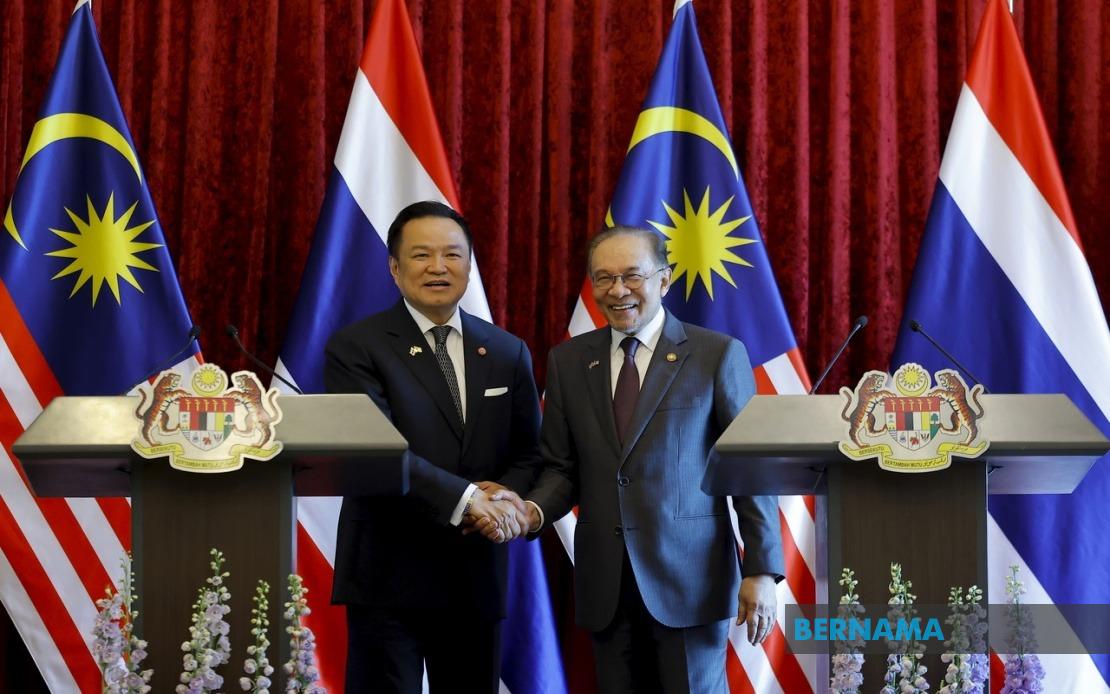
Malaysia and Thailand have committed to accelerating cross-border infrastructure projects and streamlining trade procedures as part of a comprehensive effort to elevate bilateral economic ties, with leaders setting an ambitious target of US$30 billion in two-way commerce within the next three years. The commitment emerged from substantive discussions between Prime Minister Datuk Seri Anwar Ibrahim and his Thai counterpart Anutin Charnvirakul during a high-level bilateral meeting in Putrajaya on July 9, where both governments endorsed a series of measures designed to deepen cooperation across multiple sectors including trade, investment, culture, and historical ties.
The two leaders announced plans to pursue several strategically important initiatives along the shared border, most notably the development of special border economic zones that would leverage geographic advantages and facilitate commercial activity in frontier regions. These zones represent a significant shift in approach, moving beyond traditional customs arrangements to create integrated business environments where investors from both nations can operate with reduced bureaucratic friction. Such initiatives have proven effective in other cross-border contexts within Southeast Asia and could serve as a model for addressing the logistical challenges that have historically constrained trade flows between Malaysia and Thailand.
Crucial to achieving the trade ambition is the harmonisation of immigration and customs procedures, which currently create bottlenecks at major crossing points. By streamlining documentation requirements and adopting compatible digital systems, both countries aim to reduce clearance times significantly and lower transaction costs for legitimate traders. This technical cooperation extends beyond mere policy alignment; it requires substantial investment in modern infrastructure and training for border officials who will implement new protocols. The efficiency gains could prove transformative, particularly for small and medium-sized enterprises that lack the resources to navigate complex cross-border regulations.
Anwar emphasised that the bilateral relationship transcends economic calculation, rooted instead in shared historical experiences and cultural commonalities that bind the two nations. However, he acknowledged candidly that despite these deep connections, the practical dimensions of cooperation—particularly in trade and investment—have not fully reflected the potential inherent in their relationship. This frank assessment suggests both governments recognise that numerous structural barriers and missed opportunities require immediate attention if bilateral commerce is to reach the target level.
The timing of the announcement reflects broader strategic considerations within Southeast Asia. As regional economies grapple with supply chain diversification pressures and shifting trade patterns, enhanced Malaysia-Thailand connectivity could position both nations as more attractive hubs for manufacturing and logistics operations. Companies seeking to reduce dependence on traditional Asian supply chain routes may view the border economic zones as platforms for establishing regional distribution networks or light manufacturing facilities that serve both local and regional markets.
The visit by Anutin to Bukit Kayu Hitam and Sadao tomorrow marks a deliberate departure from the conventional diplomatic protocol of conducting negotiations solely in capital cities. This gesture signals genuine commitment to engaging directly with border communities whose livelihoods depend on cross-border commerce and who possess intimate knowledge of practical impediments to trade. The itinerary acknowledges that border communities are not mere subjects of policy but active stakeholders whose input can shape more effective implementation strategies.
Achieving the US$30 billion trade target will require substantial effort beyond government initiatives. Private sector participation proves essential, as businesses must identify concrete opportunities within the special zones and commit capital to establishing operations. Both governments will need to provide transparent regulatory frameworks, tax incentives, and infrastructure support that make the zones attractive compared to alternative locations. The credibility of the commitment will ultimately be measured by concrete policy changes and investments materialised over the coming months.
Historically, Malaysia-Thailand trade has been constrained not by lack of interest but by practical difficulties in moving goods efficiently across the border. Current bilateral trade volumes, while substantial in absolute terms, remain below what economic theory would predict given the complementarities between the two economies. Malaysian manufacturing expertise and financial services could integrate effectively with Thailand's agricultural and agro-processing capabilities, yet realising this synergy requires removing the friction that border procedures currently impose.
The special economic zones concept also addresses regional inequality concerns, as border regions in both nations have frequently experienced slower development compared to interior areas. By creating concentrated zones of economic activity with supporting infrastructure, both governments can generate employment and investment opportunities that help retain populations in frontier regions. This addresses a broader development challenge within Southeast Asia, where capital and talent tend to concentrate in major urban centers, leaving peripheral areas economically marginalised.
For Malaysian readers, the enhanced Malaysia-Thailand cooperation carries implications extending beyond bilateral relations. Stronger connectivity with Thailand provides Malaysian exporters with improved access to Thai markets and positions Malaysia as a potential hub for further regional commerce. Small Malaysian businesses engaged in cross-border trade stand to benefit most directly from streamlined customs procedures and reduced transaction costs. Additionally, the framework established through these border initiatives could serve as a template for Malaysia's engagement with other neighbouring countries, potentially raising the efficiency of the entire regional economy.
The ambitious timeline—three years to achieve a 30 billion dollar trade target—demonstrates both leaders' determination to move beyond rhetorical commitments to tangible outcomes. Implementation will test the capacity of both governments to coordinate across multiple agencies and withstand the inevitable resistance from stakeholders concerned about increased competition. Success requires sustained political will beyond the initial announcement, particularly when facing practical obstacles that invariably emerge during border infrastructure development and regulatory harmonisation processes.

