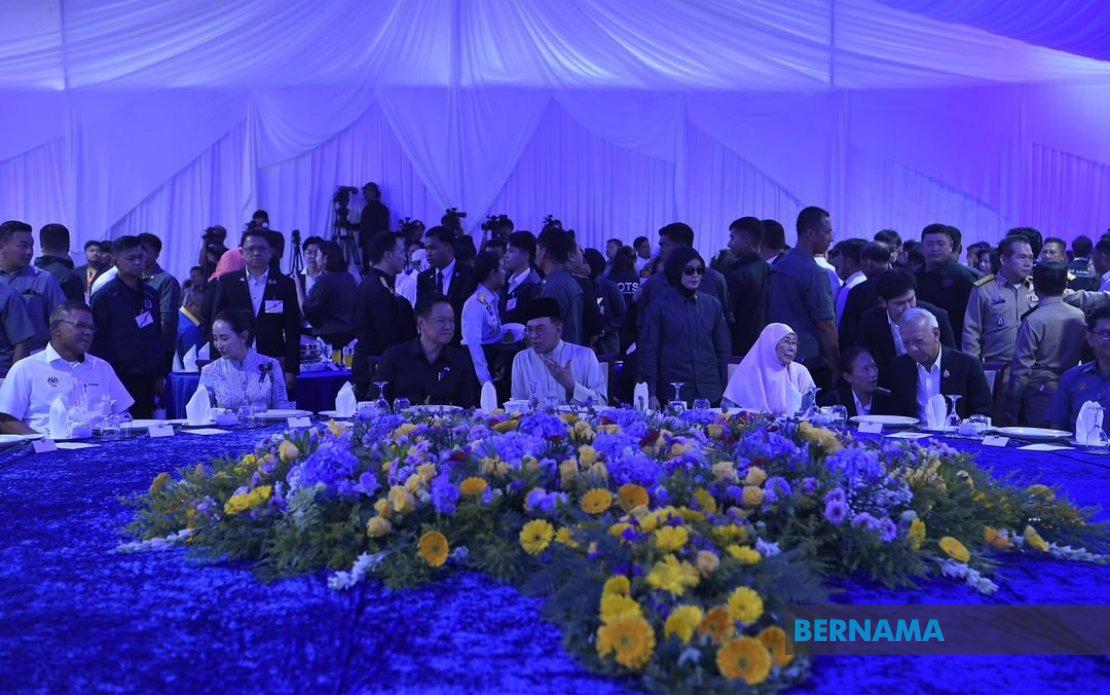
Prime Minister Datuk Seri Anwar Ibrahim and Thai Prime Minister Anutin Charnvirakul have jointly inaugurated a new road corridor linking Malaysia's Bukit Kayu Hitam Immigration, Customs, Quarantine and Security (ICQS) Complex with Thailand's corresponding Sadao Customs, Immigration and Quarantine (CIQ) Complex. The July 10 ceremony underscores deepening cooperation between the two nations on border management and regional connectivity, with the new thoroughfare set to commence operations at 6 am on July 11 while the existing Bukit Kayu Hitam-Danok crossing simultaneously closes permanently.
The Home Ministry characterised the infrastructure development as emblematic of Malaysia and Thailand's mutual dedication to fortifying diplomatic relationships and fostering cross-border strategic collaboration. Both governments view the initiative as instrumental in building enhanced regional interconnectedness that will generate mutual benefits across economic, security and social dimensions. The symbolic significance of the occasion reflects years of negotiation and coordination between multiple government departments, enforcement bodies and strategic stakeholders on both sides of the frontier.
From a practical standpoint, the new road corridor represents a consolidation of border infrastructure that prioritises efficiency and modernisation. The decision to replace the Danok crossing with a unified facility in Sadao demonstrates a strategic recalibration aimed at optimising the flow of cross-border traffic through a single, purpose-built checkpoint rather than managing multiple dispersed entry points. This centralisation approach aligns with contemporary best practices in border management, where integrated facilities allow for streamlined processing of travellers and cargo while maintaining rigorous security protocols.
The Ministry emphasised that the project embodies Malaysia's commitment to the ASEAN Connectivity agenda, which seeks to enhance the seamless movement of people, capital, commodities and tourism throughout Southeast Asia. For Malaysia specifically, the initiative strengthens infrastructure along the ASEAN North-South Economic Corridor, a critical trade route linking regional economies. The upgraded crossing addresses long-standing logistical constraints that have historically complicated bilateral commerce and tourism flows, potentially unlocking significant economic benefits for border communities in both nations.
Trade facilitation emerged as a central rationale for the project. By establishing modern, integrated control systems at the new crossing, both countries anticipate measurable improvements in the speed and transparency of customs clearance operations. Enhanced supply chain efficiency through the corridor is expected to reduce transit times for goods moving between Malaysia and Thailand, thereby lowering logistics costs for regional businesses. The facility's technological integration should also strengthen real-time information sharing between Malaysian and Thai authorities, creating a more coordinated approach to border security and risk management.
The economic implications extend beyond immediate trade benefits. Border regions in both nations, particularly in northern Malaysia and southern Thailand, have historically lagged in development compared to urban centres. The new crossing is positioned to catalyse economic growth in these areas by facilitating increased commerce, investment and tourism. Local businesses anticipate heightened opportunities as cross-border consumer and commercial traffic increases, potentially spurring job creation and infrastructure development in surrounding communities.
Security considerations equally informed the project's conception and execution. The Ministry highlighted that modern infrastructure and integrated control systems would strengthen border security through enhanced surveillance, more efficient personnel deployment and improved intelligence-sharing capabilities. The facility consolidation allows both nations' enforcement agencies to concentrate resources more effectively, potentially improving detection of smuggling activities, transnational crime and other security threats. The transparency improvements embedded in the new system also enhance accountability within border operations.
The initiative aligns with Malaysia MADANI, the government's development framework emphasising prosperity, security and citizen well-being. By improving border management through technological adoption and international collaboration, the project exemplifies how Malaysia is pursuing modern, efficient governance. The Home Ministry explicitly connected the crossing development to broader national security objectives and the goal of fostering prosperity through regional economic integration.
The bilateral nature of the undertaking underscores the maturity of Malaysia-Thailand relations, which have historically been characterised by productive cooperation despite occasional friction points. Both nations recognise that effective border management serves mutual interests, and the joint inauguration ceremony signalled unified commitment to the endeavour. The participation of both premiers demonstrated that the project enjoys top-level political priority in both capitals, suggesting sustained governmental support for implementation and optimisation.
For Malaysian travellers, traders and investors, the new crossing promises tangible improvements in cross-border convenience and efficiency. The modern facility should offer enhanced passenger amenities, more predictable processing times and clearer regulatory procedures. Business communities anticipate that reduced border delays will translate into cost savings and competitive advantages in Thailand's market. Tourism flows in both directions may increase as the physical and procedural barriers to cross-border travel diminish.
The Ministry's acknowledgment of contributions from multiple government agencies, enforcement bodies and strategic partners reflects the complex coordination required for such projects. Successful cross-border infrastructure demands alignment across immigration, customs, quarantine, security and public works functions in both nations. The thanking of all contributors implicitly recognises the labour-intensive negotiations and technical work underpinning the visible achievement.
Looking forward, the Home Ministry indicated that border infrastructure modernisation would remain an ongoing priority. Beyond the Bukit Kayu Hitam-Sadao project, Malaysia intends to continue enhancing entry point management through technology adoption and international cooperation. This signals intention to upgrade other border crossings and ports of entry progressively, potentially transforming Malaysia's gateway infrastructure comprehensively. Such ambitions require sustained investment and continued diplomatic coordination with neighbouring countries, positioning border management as a cornerstone of Malaysia's regional engagement strategy.
The new Bukit Kayu Hitam-Sadao crossing ultimately represents more than a single infrastructure project. It exemplifies how Southeast Asian nations are attempting to balance the imperatives of security and prosperity through modernised border systems. By enabling freer movement of legitimate trade, investment and people while strengthening security mechanisms, Malaysia and Thailand have crafted a model that other regional nations may emulate. The success of this endeavour could influence border management practices throughout ASEAN, establishing new standards for efficient, secure and transparent cross-border operations.

