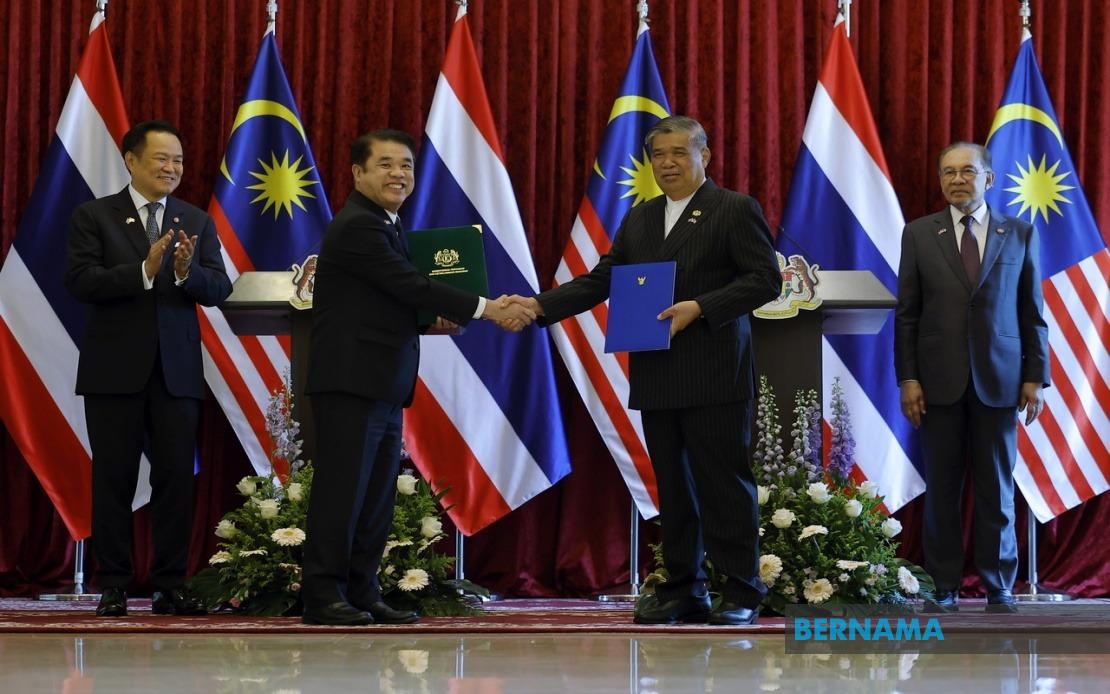
Malaysia and Thailand have moved to settle a contentious dispute over fisheries market access, clearing the way for an accelerated rollout of their agricultural cooperation framework. The breakthrough came during Thai Prime Minister Anutin Charnvirakul's inaugural official visit to Malaysia, where both nations' leadership witnessed the exchange of a comprehensive Memorandum of Understanding designed to deepen agricultural ties and fortify food security across the region.
Prime Minister Datuk Seri Anwar Ibrahim and Anutin oversaw the signing ceremony in Putrajaya, flanked by Malaysia's Agriculture and Food Security Minister Datuk Seri Mohamad Sabu and Thailand's counterpart Suriya Juangroongruangkit. The acceleration of the agreement's implementation—compressed from an originally proposed eighteen months to just seven days—underscores the political will from both governments to prioritise agricultural collaboration in a region increasingly focused on supply chain resilience.
The resolution of fisheries market access represents a tactical diplomatic victory for both parties. Thailand's initial timeline for bringing the MoU into force would have extended into late 2025, but Malaysia's insistence on expedited implementation reflects the strategic importance of settling agricultural trade frictions promptly. Such delays in bilateral frameworks can create uncertainty for exporters and importers, potentially disrupting cross-border commerce in perishable goods where timing is commercially critical.
Anwar characterised the accord as emblematic of shared commitment to fortifying food security and catalysing bilateral commerce. The framing of agricultural cooperation within a food security narrative carries particular weight in Southeast Asia, where supply chain disruptions—whether from climate shocks, disease outbreaks, or geopolitical tensions—pose material risks to public stability and consumer welfare. Malaysia and Thailand, as major agricultural producers and traders, recognise their interdependence in maintaining regional nutritional security.
Thailand's prime minister welcomed the resolution, emphasising that food security had anchored substantive discussions between the agriculture ministers. The convergence on pending cases affecting fisheries and agricultural product market access signals that both nations view trade facilitation in the sector as compatible with domestic agricultural interests. This negotiated outcome suggests that protectionist pressures within each country's farming constituencies have been managed through structured dialogue.
The MoU itself establishes a multifaceted architecture spanning crop production, livestock management, fisheries operations, and agri-product marketing. The framework incorporates research and development coordination, capacity-building initiatives, and biosecurity protocols—technical domains where bilateral cooperation can generate efficiency gains. Critically, the agreement establishes sanitary and phytosanitary measure harmonisation, reducing regulatory friction that often impedes agricultural trade in ASEAN.
The structured coordination mechanism embedded in the MoU addresses a perennial challenge in Southeast Asian bilateral relations: the absence of predictable dispute resolution pathways. By formalising communication channels and establishing transparent procedures for addressing agricultural disputes, Malaysia and Thailand create institutional stability that benefits traders and producers relying on these markets. Such mechanisms prove especially valuable when regulatory disagreements emerge, as occurred in June when Malaysia imposed stricter import controls on Thai fisheries.
Malaysia's import restrictions, implemented on June 1, required Certificates of Analysis for barramundi and introduced temporary import bans on five shrimp species. While ostensibly motivated by quality assurance and food safety considerations, such measures can function as non-tariff barriers affecting bilateral trade flows. The negotiated resolution suggests both governments found acceptable pathways to address Malaysia's food safety concerns whilst preserving Thailand's market access—a balancing act requiring technical expertise and political pragmatism.
The bilateral agricultural trade relationship has demonstrated robust expansion, with total agri-food commerce reaching RM20.33 billion across 2025. Malaysia's export profile leans toward value-added products—coffee, cocoa, tea, spices, and processed foods—reflecting domestic value-addition strategies. Conversely, Thailand supplies Malaysia with substantial volumes of meat and meat-based products, indicating complementary agricultural specialisation between the economies. This asymmetry suggests opportunities for further integration along value chains.
The timing of this agreement reflects broader geopolitical considerations within ASEAN. As major regional agricultural producers, Malaysia and Thailand's bilateral cooperation sends signals about commitment to Southeast Asian integration and mutual prosperity. The agreement also demonstrates capacity for pragmatic dispute resolution at moments when trade frictions might otherwise escalate into protectionist spirals damaging regional commerce.
For Malaysian consumers and agribusinesses, the expedited MoU activation promises smoother cross-border agricultural transactions and reduced regulatory uncertainty. Food importers relying on Thai supply chains gain clarity on compliance requirements, whilst domestic producers exporting to Thailand benefit from structured market access arrangements. The framework's focus on capacity building and R&D coordination may also facilitate technology transfer benefiting Malaysian agricultural productivity.
Looking forward, the agricultural cooperation framework establishes a template for managing bilateral trade relationships centred on shared supply chain interests rather than zero-sum competitive dynamics. In an era of food price volatility and climate-driven production variability, Malaysia and Thailand's collaborative approach to agricultural trade offers a model of regional interdependence grounded in institutional mechanisms rather than ad-hoc diplomacy.

