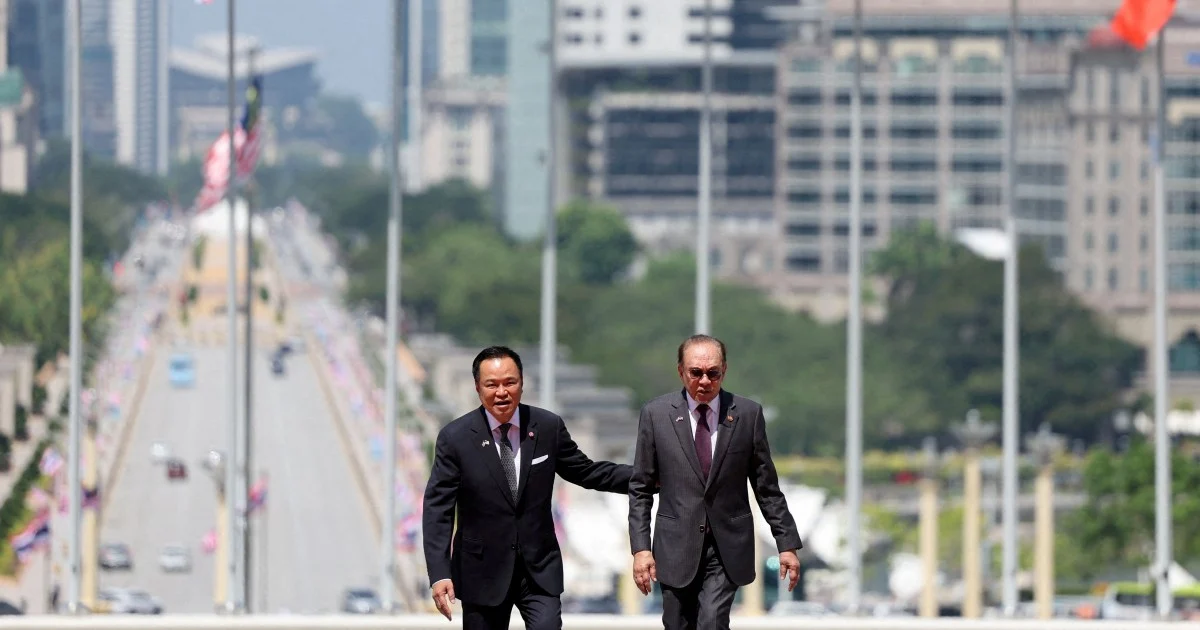
Malaysia has positioned itself as advocating for a comprehensive, participatory approach to Myanmar's escalating political turmoil, with Prime Minister Datuk Seri Anwar Ibrahim articulating this stance at a media briefing in Putrajaya. The position reflects Kuala Lumpur's longstanding concern about regional stability and its responsibility as the current or recent chair of ASEAN, where Myanmar remains a contentious and divisive membership issue.
Anwar's emphasis on inclusive engagement represents a middle-ground diplomatic strategy that seeks to bring together the military junta, civilian opposition groups, ethnic armed organisations, and international actors in a structured dialogue process. This approach sidesteps the question of international military intervention or targeted sanctions championed by Western powers, instead promoting negotiation as the primary mechanism for de-escalation. The appeal to inclusivity also implicitly acknowledges the fragmented nature of Myanmar's political landscape, where multiple power centres compete for legitimacy and control.
The Malaysian position gains significance within the ASEAN context, where Myanmar has emerged as perhaps the organisation's most intractable challenge since the military coup in February 2021. Several ASEAN members, particularly Indonesia and Thailand, have pursued bilateral engagement with various Myanmar stakeholders, while others remain frustrated by the junta's resistance to the bloc's Five-Point Consensus adopted in April 2021. Malaysia's latest articulation suggests Kuala Lumpur believes deeper international involvement, rather than isolation, offers better prospects for movement.
Crucially, Anwar's formulation includes an explicit commitment to Myanmar's self-determination, a phrase that resonates across ASEAN's commitment to non-interference in member states' internal affairs. This language steers clear of explicitly endorsing either the military government or the armed opposition, instead framing external involvement as merely facilitating a genuinely Burmese-led resolution process. Such positioning allows Malaysia to maintain diplomatic channels with multiple parties without appearing to take sides in what many perceive as an intractable conflict.
The Myanmar crisis has devastated the country's economy and triggered a humanitarian emergency affecting millions. Persistent fighting between military forces and the People's Defence Force, alongside factional conflicts among different armed groups, has created overlapping layers of violence. Civilian populations have faced displacement, shortages of basic goods, and severe restrictions on mobility. Regional observers warn that prolonged instability risks creating ungoverned spaces that could attract transnational criminal organisations and extremist groups, potentially destabilising Southeast Asia more broadly.
Malaysia's advocacy for inclusive engagement also reflects the economic and security interests at stake. Myanmar remains geographically central to Southeast Asia, sharing borders with Thailand, Laos, China, and Bangladesh. Instability there cascades throughout the region, affecting refugee flows, trade routes, and internal security. Malaysian policymakers are acutely aware that a humanitarian catastrophe or protracted civil conflict would strain Malaysia's resources and social cohesion, particularly given its existing experience managing displaced populations from Myanmar and elsewhere.
Anwar's framing differs from rhetoric that prioritises human rights documentation or accountability mechanisms, which Western governments increasingly emphasise. While Malaysia formally acknowledges concerns about military conduct, its diplomatic language prioritises political settlement over justice processes. This reflects both ASEAN norms and Malaysia's own domestic sensitivities regarding state sovereignty and military prerogatives. The approach prioritises ending violence over establishing culpability, a pragmatic if controversial calculus.
The inclusivity principle also extends to ethnic armed organisations and regional militias that control significant territory and populations. These groups, many of which predate the modern Burmese state and harbour longstanding grievances regarding autonomy and resource rights, represent essential participants in any durable settlement. International peace processes have often struggled to accommodate such actors effectively, yet excluding them from dialogue nearly guarantees continued fragmentation and violence. Malaysia's emphasis suggests recognition of this reality.
However, structural obstacles complicate even well-intentioned inclusive dialogue initiatives. The military junta shows limited willingness to negotiate from a position of weakness, while various opposition and ethnic groups harbour conflicting visions for Myanmar's future state structure. Some seek federal arrangements protecting minority autonomy, while others envision a unitary system. These fundamental disagreements cannot be bridged through process alone, yet Malaysia's diplomatic language implies faith in dialogue's capacity to generate compromise.
The statement also carries implicit messaging to ASEAN itself, where Myanmar remains dangerously divisive. Members including Cambodia have defended the junta's legitimacy, complicating collective action. By emphasising inclusive engagement rather than condemnation or coercion, Malaysia appeals to consensus-seeking norms that technically bind the bloc, potentially broadening space for continued ASEAN involvement despite persistent disagreements. This diplomatic maneuvering preserves Myanmar's nominal ASEAN membership while acknowledging the impasse.
For Malaysia specifically, the Myanmar question intersects with broader foreign policy priorities including regional stability, ASEAN coherence, and relations with major powers. China's deepening engagement with Myanmar's military, and Washington's sanctions regime, create geopolitical complications for ASEAN mediation efforts. Malaysia's call for inclusive engagement implicitly positions the bloc as a constructive neutral, distinct from both the Western approach and Chinese patronage of the junta.
Moving forward, whether inclusive engagement can generate tangible progress remains unclear. The Myanmar conflict has resisted resolution through multiple previous dialogue initiatives, ASEAN mediation attempts, and international pressure campaigns. Nevertheless, Kuala Lumpur's reiteration of this approach signals continued Malaysian investment in regional stabilisation, even as the practical pathways to success narrow. For Malaysian readers, this underscores both the government's commitment to Southeast Asian peace and the sobering reality that clear solutions to Myanmar's crisis remain elusive.

