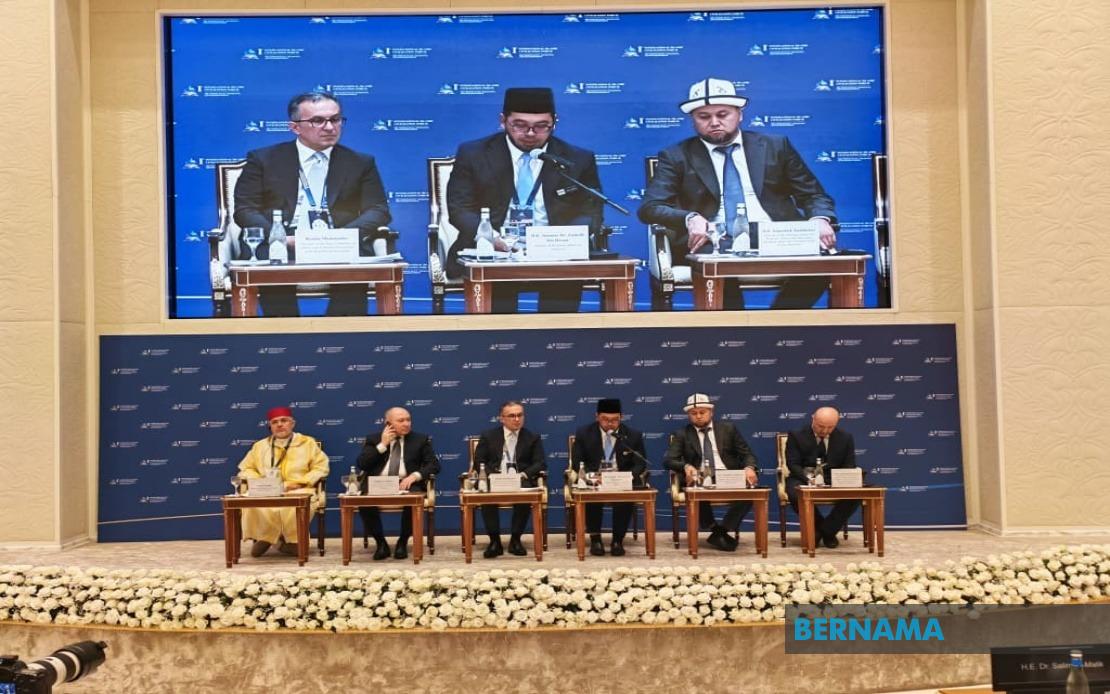
Malaysia has positioned the humanitarian catastrophe unfolding in Gaza as a transformative moment for the Muslim world to recalibrate its role in global affairs, moving beyond reactive positioning towards constructive ethical leadership. Speaking at the International Islamic Civilisation Forum in Tashkent, Uzbekistan, Datuk Dr Zulkifli Hasan, Minister in the Prime Minister's Department (Religious Affairs), articulated a vision of Islamic renewal grounded in principles of justice, compassion, and human dignity. The scale of civilian suffering in Gaza, he argued, transcends regional concern; it challenges the international community's commitment to equitable application of law and demands a fundamental reassessment of how civilisations contribute to human welfare.
Zulkifli's remarks carry particular significance for Malaysia, a nation that has consistently positioned itself as a bridge between Western and Islamic spheres whilst maintaining a multicultural domestic compact. His intervention at the forum reflects Malaysia's diplomatic strategy of framing Islamic identity not as oppositional to global governance structures but as essential to reforming them. The minister contended that the Muslim world faces a critical juncture: rather than remaining preoccupied with historical grievances or defining itself reactively against external pressures, Islamic societies must proactively shape the frameworks through which emerging technologies and global challenges are addressed.
At the core of Zulkifli's argument lies a distinction between nostalgia and renewal. He explicitly cautioned against conflating civilisational pride with contemporary irrelevance, suggesting that simply invoking Islam's scientific and architectural achievements rings hollow if divorced from present-day application. Instead, he proposed that Islamic civilisation's true contribution lies in its potential to infuse modern governance, economic systems, and technological development with ethical foundations. This framing resonates with Southeast Asian concerns about how rapid digitalisation and artificial intelligence deployment can either entrench inequalities or advance human flourishing.
The minister emphasised that today's interconnected world increasingly craves more than material advancement; it seeks moral clarity and principled leadership amid uncertainty. Islamic civilisation, by this logic, offers precisely what contemporary societies lack: a coherent ethical framework developed over centuries and rooted in concepts of stewardship, justice, and human dignity. Zulkifli identified three pillars for this renewal: intellectual engagement with contemporary knowledge systems, moral conviction grounded in enduring religious principles, and collective responsibility underpinning institutional reform. Rather than viewing these as competing imperatives, he presented them as mutually reinforcing.
Historically, the Islamic world's greatest intellectual achievements emerged from precisely this synthetic approach. During the Islamic Golden Age, scholars actively synthesised knowledge from Greek, Persian, Indian, and Chinese sources rather than jealously guarding a monolithic tradition. Zulkifli invoked this precedent to argue that contemporary Muslim societies should similarly position themselves as active participants in shaping ethical standards for artificial intelligence, biotechnology, and quantum computing. For Malaysian policymakers and regional observers, this proposition carries practical implications: Southeast Asian nations could potentially leverage Islamic intellectual resources to develop technology governance frameworks that balance innovation with human rights protection.
The environmental dimension of Zulkifli's address reflects growing recognition within Islamic scholarship of ecological stewardship as a religious obligation. His emphasis on Islamic concepts of humanity's role as custodian of creation addresses a blind spot in much modern development discourse, which has historically separated economic growth from environmental responsibility. In the Malaysian context, where palm oil expansion, deforestation, and pollution remain contested policy areas, invoking religious arguments for environmental protection offers a potentially powerful counter-narrative to purely extractive development models.
Crucially, Zulkifli framed Islamic civilisational renewal not as rivalrous competition with other traditions but as collaborative contribution. This positioning distinguishes Malaysia's approach from rhetoric in some other Muslim-majority nations that frame geopolitical contests as zero-sum civilisational conflicts. Instead, he presented Malaysia and broader Islamic societies as offering value-added perspectives to universal challenges rather than seeking dominance. This reflects Malaysia's actual diplomatic practice, which has maintained constructive engagement with Western institutions whilst building alliances within the Muslim world.
The bilateral dimension of Zulkifli's remarks about Uzbekistan carries regional significance often overlooked in Western analyses. Malaysia explicitly identified Central Asian Islamic heritage, particularly Uzbekistan's scholarly traditions, as complementary to Southeast Asian Islamic governance models. This framing positions Malaysia as a knowledge broker between regions, leveraging its experience in Islamic finance, multicultural governance, and peaceful coexistence as templates potentially adaptable to Central Asian contexts. Such positioning elevates Malaysia's diplomatic weight beyond its economic size, offering intellectual and institutional resources to Muslim-majority nations navigating similar challenges.
The invocation of Gaza's tragedy as catalyst for broader civilisational renewal reflects a pattern in contemporary Islamic diplomacy of converting humanitarian crises into momentum for institutional or intellectual change. Whether such rhetoric translates into substantive policy shifts remains uncertain. Malaysia itself has faced criticism for inconsistency between its stated commitment to humanitarian principles and its actual foreign policy conduct. Nonetheless, the framing articulated by Zulkifli—emphasising ethical leadership, inclusive governance, and constructive engagement—represents an important intellectual current within Muslim-majority Asia.
For regional observers, Zulkifli's address highlights how Malaysia navigates the complex position of representing Muslim interests globally whilst maintaining domestic multiculturalism and pragmatic international partnerships. His emphasis on Islamic civilisation's capacity to contribute to human flourishing, rather than merely assert religious identity, offers a template for how religious tradition and modern governance might be reconciled. Whether the Muslim world collectively embraces this vision of proactive ethical leadership, particularly in relation to technology governance and environmental stewardship, will substantially shape regional and global trajectories in coming decades.

