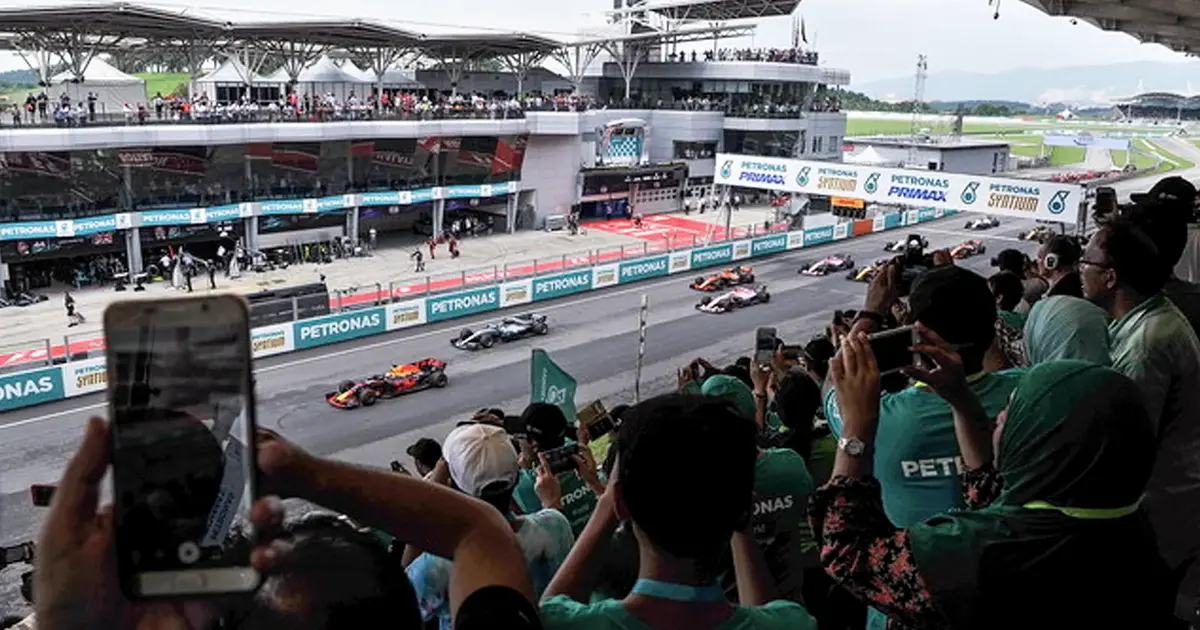
Prime Minister Anwar Ibrahim has sought to allay concerns about the financial burden of hosting Formula 1 racing in Malaysia, arguing that the country can stage the prestigious international motorsport event without requiring substantial additional government expenditure beyond current facility maintenance costs.
Anwar stated that the government's existing annual allocation of RM16 million for maintaining and upgrading the Sepang International Circuit would be sufficient to support an F1 race. This position represents a significant counter to widespread assumptions that attracting and hosting the world's premier motorsport championship demands enormous public investment and infrastructure spending.
The Prime Minister's remarks come amid ongoing discussions about Malaysia's motorsport future and the role of the Sepang circuit, which has served as the country's principal venue for international racing events. The circuit, located in Selangor, has hosted the Malaysian Grand Prix multiple times in the past, establishing itself as a critical asset for the nation's sporting infrastructure and international standing.
The existing RM16 million annual budget reflects the government's baseline commitment to keeping the facility operational and competitive at international standards. According to Anwar's assessment, this recurring allocation could accommodate the requirements of an F1 event without necessitating emergency funding or special parliamentary approvals for extraordinary expenditures. This approach contrasts sharply with the substantial infrastructure overhauls and temporary facility enhancements that many nations undertake when preparing to host major racing championships.
Host nations for Formula 1 events typically face considerable operational costs beyond basic facility maintenance. These include security arrangements, international transportation coordination, visitor accommodation infrastructure, and broadcast facilities. Anwar's assertion suggests that Malaysia possesses sufficient existing infrastructure and institutional capacity to manage these elements within budgetary constraints, though sceptics may question whether RM16 million truly encompasses all necessary expenses.
The Prime Minister's confidence in the adequacy of current funding levels potentially reflects Malaysia's prior experience hosting the Grand Prix. The country successfully staged multiple F1 races between 1999 and 2017 at Sepang, accumulating expertise in event management, regulatory compliance, and spectator accommodation. This historical track record may provide a foundation for cost-effective re-entry into the F1 calendar.
However, the landscape of international motorsport has evolved considerably since Malaysia's last Grand Prix. F1's technical requirements have advanced substantially, venue standards have become more demanding, and the financial expectations of race promoters have increased significantly. Whether the infrastructure and facilities at Sepang remain aligned with contemporary F1 specifications remains an open question, potentially impacting the realistic costs of hosting.
From a regional perspective, Malaysia's potential return to the F1 circuit carries implications for Southeast Asia's standing in global motorsport. The region currently lacks a Formula 1 venue, with Singapore's street race representing the only Asian F1 event in the immediate vicinity. A Malaysian Grand Prix could strengthen the region's profile, attract international investment, and generate substantial tourism revenue, justifying government support regardless of the precise budgetary requirements.
The economic argument for hosting F1 extends beyond direct event expenditure. Grand Prix events typically stimulate hotel occupancy, restaurant spending, retail activity, and international flights during race weekends. For a country seeking to enhance its global tourism profile and demonstrate sporting credentials to international audiences, the indirect economic benefits often justify public investment that appears substantial on its surface.
Anwar's emphasis on financial efficiency aligns with broader government concerns about fiscal responsibility and returns on public spending. By framing F1 hosting as a matter of reallocating existing resources rather than implementing new expenditures, the Prime Minister positions the proposal as fiscally prudent and sustainable. This messaging proves particularly important in Malaysia's current economic environment, where public spending scrutiny remains elevated and taxpayers increasingly demand transparency regarding government allocation of funds.
The practicality of Anwar's position will ultimately depend on detailed technical assessments regarding Sepang's current condition and F1's specific requirements. International motorsport governing bodies maintain rigorous standards for circuit design, safety infrastructure, hospitality facilities, and broadcast capabilities. Determining whether existing systems adequately meet these standards will require comprehensive evaluation by independent experts and F1 officials.
Government officials and motorsport authorities will need to undertake detailed feasibility studies comparing current Sepang infrastructure against F1's technical specifications and contemporary international standards. Such assessments will clarify whether the RM16 million annual allocation proves genuinely sufficient or whether modest supplementary investment becomes necessary for critical safety upgrades or facility enhancements.
Ultimately, Anwar's confidence reflects optimism about Malaysia's capacity to reclaim its position as a significant player in international motorsport without imposing excessive fiscal burdens on public finances. Whether this assessment withstands detailed scrutiny remains to be seen, but the Prime Minister's framing has successfully introduced fiscal constraint and resource efficiency into discussions about potentially hosting Formula 1, shifting conversation away from merely cost-benefit analysis toward questions of smart stewardship and optimal resource deployment.

