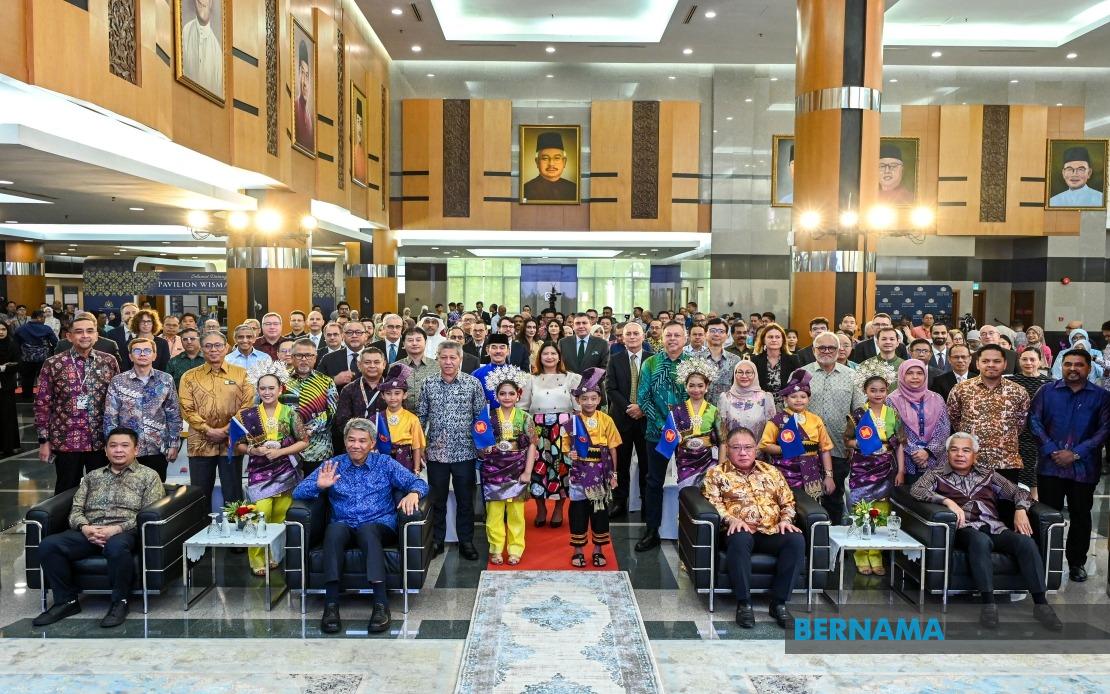
Malaysia formally marked almost six decades of involvement with the Association of Southeast Asian Nations on Monday, gathering some 300 officials, diplomats and representatives at its Foreign Ministry headquarters in Putrajaya to reflect on the bloc's journey since its establishment. The occasion carried particular weight as the nation honoured its place within a regional architecture that has fundamentally shaped Southeast Asia's political and economic landscape, serving as a cornerstone for peace and cooperation across the peninsula and beyond.
The ASEAN founding, signed through the Bangkok Declaration on August 8, 1967, brought together five founding members: Indonesia, Malaysia, the Philippines, Singapore and Thailand. From that compact group has emerged a far more expansive organisation, now encompassing eleven member states after the relatively recent admission of Timor-Leste during the 47th ASEAN Summit in October of the previous year. This expansion reflects both the organisation's attractiveness as a framework for regional stability and the evolving geopolitical interests of Southeast Asian governments seeking a unified voice on the global stage.
Foreign Minister Datuk Seri Mohamad Hasan led the proceedings, overseeing ceremonial elements including a video presentation chronicling Malaysia's trajectory within ASEAN and a symbolic cake-cutting ceremony. The event's official theme, "59 Years of Navigating Together," deliberately emphasised collective problem-solving and shared responsibility—sentiments particularly resonant given the region's contemporary challenges ranging from maritime security disputes to economic competition from larger powers. Malaysia's role as both a founding member and a nation geographically positioned at the crossroads of major shipping lanes lends particular significance to its advocacy for multilateral engagement.
The Foreign Ministry's statement highlighted ASEAN's organisational foundation resting upon three interconnected dimensions: political-security cooperation, economic integration and socio-cultural exchange. This tripartite framework has enabled the bloc to address diverse regional concerns while maintaining cohesion among member states with sometimes divergent interests. Malaysia, as a middle-income nation with substantial manufacturing capacity and strategic geographic importance, has historically championed both the political neutrality principles embedded in ASEAN's non-interference doctrine and the economic liberalisation agenda through mechanisms like the ASEAN Free Trade Area.
The attendance of Tourism, Arts and Culture Minister Datuk Seri Tiong King Sing alongside Deputy Foreign Minister Datuk Lukanisman Awang Sauni demonstrated the whole-of-government approach Malaysia brings to regional engagement. Beyond headline diplomacy, ASEAN cooperation extends into tourism promotion, cultural exchange programmes and people-to-people connectivity initiatives that reinforce community bonds beneath the diplomatic surface. These softer dimensions of regional integration, whilst less frequently discussed than trade negotiations or security forums, prove instrumental in building resilience and mutual understanding across diverse populations.
The timeline of ASEAN's expansion tells a story of gradual regional consolidation spanning three decades. Brunei's accession in 1984 brought a resource-wealthy sultanate into the fold, whilst Vietnam's 1995 entry marked the beginning of normalisation with former adversaries. The near-simultaneous admission of Laos and Myanmar in 1997 extended ASEAN's reach deeper into mainland Southeast Asia, whilst Cambodia's 1999 inclusion completed the association's continental footprint. Each enlargement brought both opportunities for enhanced cooperation and management challenges around consensus-building among increasingly heterogeneous member states.
For Malaysia specifically, ASEAN membership has provided essential scaffolding for regional leadership aspirations without the militaristic posturing that characterises great-power competition. Through ASEAN mechanisms, Kuala Lumpur has helped shape regional norms on maritime conduct, promoted conflict resolution mechanisms and advocated for smaller states' interests in forums increasingly dominated by larger economies. The bloc's commitment to the ASEAN Way—premised on consensus, non-confrontation and respect for sovereignty—aligns broadly with Malaysia's own preferences for pragmatic diplomacy over ideological alignment.
The socio-cultural pillar, often underemphasised in analysis focused on geostrategic competition, assumes growing importance as Southeast Asia navigates demographic transformation and development pressures. ASEAN platforms for cultural exchange, educational cooperation and tourism marketing help reinforce a shared Southeast Asian identity transcending national boundaries. Malaysia's substantial diaspora across the region and its historical role as a crossroads of trade and migration position it well to champion these integrative agendas.
Contemplating ASEAN's trajectory over nearly six decades reveals an organisation that, despite persistent criticism regarding institutional weakness and enforcement capacity, has succeeded in its fundamental objective: preventing conflict and establishing frameworks for dialogue among neighbours with genuine historical grievances and competing interests. The bloc's relevance has intensified as major powers—particularly the United States, China, India and Japan—increasingly vie for influence across Southeast Asia through competing infrastructure initiatives, trade agreements and security partnerships. ASEAN's centrality to regional architecture depends partly on maintaining cohesion and demonstrating that multilateral engagement generates tangible benefits.
Malaysia's continued commitment to ASEAN reflects recognition that regional stability serves national interests more reliably than zero-sum competition. As the nation confronts challenges including managing plural societies, navigating economic transition and balancing great-power engagement, the regional organisation provides both practical mechanisms for addressing transnational issues and normative commitments to peaceful resolution and mutual respect. The 59th anniversary celebration, whilst ceremonial in nature, reaffirmed these foundational principles at a moment when regional unity faces pressures from great-power rivalry and competing development visions.
Looking ahead, Malaysia's role within ASEAN will likely centre on balancing traditionalist approaches emphasising state sovereignty and non-interference against modernising impulses seeking deeper integration on selected issues. The organisation's capacity to address transnational challenges—ranging from pandemics and climate change to irregular migration and cybersecurity—increasingly determines its relevance to member states' populations. Malaysian policymakers recognise that ASEAN's strength ultimately rests not merely on diplomatic protocols but on delivering tangible improvements in prosperity, security and opportunity that justify the compromises inherent in regional cooperation.

