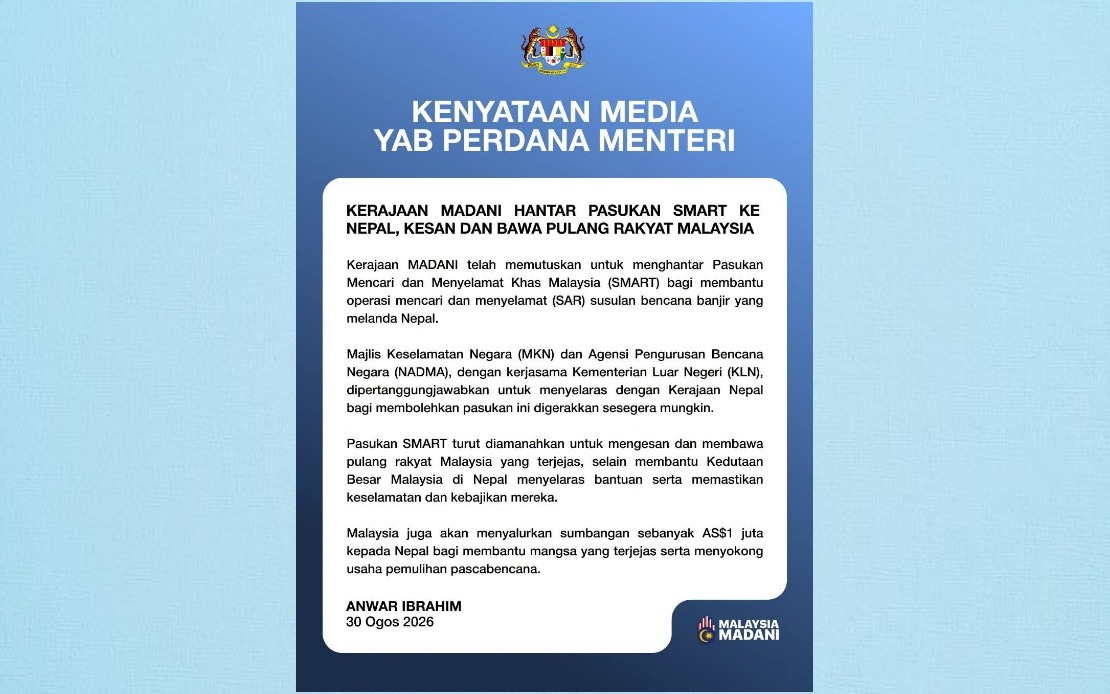
Malaysia has mobilized its specialized disaster response capabilities to assist Nepal following severe flooding and landslide events that struck the Himalayan nation earlier this week. Prime Minister Datuk Seri Anwar Ibrahim announced the decision to deploy the Special Malaysian Disaster Assistance and Rescue Team (SMART) to support ongoing search and rescue operations in the affected regions, marking a significant humanitarian intervention by the MADANI Government in response to the regional crisis.
The catastrophic flooding occurred on August 26 in Rasuwa district, an area in north-central Nepal prone to such natural disasters due to its mountainous terrain and exposure to monsoon weather patterns. The scale of the emergency became apparent when the Foreign Ministry confirmed that 55 Malaysian nationals have been unable to make contact with their families or officials since the disaster struck, leaving their status and whereabouts uncertain. This figure has prompted urgent diplomatic and rescue coordination between Kuala Lumpur and Kathmandu.
Coordinating the deployment is a multi-agency Malaysian effort involving several government bodies. The National Security Council (MKN) and the National Disaster Management Agency (NADMA) have been tasked with managing operational logistics, while the Foreign Ministry oversees diplomatic arrangements with the Nepalese government to ensure smooth access and authorization for the SMART team. This integrated approach reflects Malaysia's institutional capacity to mobilize resources rapidly when nationals face danger abroad, combining security, disaster management, and foreign affairs expertise.
The SMART team's mandate extends beyond general rescue operations. The unit has been explicitly directed to locate and identify Malaysians affected by the floods, prioritizing their safe extraction and return to Malaysia. Additionally, the team will coordinate with the Malaysian Embassy in Kathmandu to manage broader humanitarian assistance efforts, ensuring that Malaysian citizens in the country receive protection and that aid flows effectively to those in need.
Beyond deploying personnel, Malaysia is providing substantial financial support to Nepal's recovery efforts. The government has committed US$1 million in humanitarian assistance, funds designated to help those immediately affected by the floods as well as to support longer-term reconstruction and rehabilitation initiatives. This financial contribution complements the rescue operations and signals Malaysia's commitment to regional solidarity during times of crisis.
The decision to activate SMART reflects Malaysia's evolving role as a responsible regional actor with capacity for international humanitarian response. The team, which has been deployed in previous regional disasters, brings specialized training in urban search and rescue, emergency medical response, and disaster assessment. Its presence in Nepal will augment local Nepalese rescue authorities, who are themselves stretched responding to multiple affected areas across the country.
From a Malaysian domestic perspective, the situation underscores the vulnerabilities faced by citizens traveling or working abroad, particularly in regions susceptible to natural disasters. The 55 unaccounted Malaysians in Nepal—whether tourists, workers, or long-term residents—highlight the government's ongoing responsibility to account for and protect its citizens in foreign countries. The speed with which authorities have responded to this crisis suggests improved coordination mechanisms between relevant government agencies.
Nepal's vulnerability to such disasters is geographical and seasonal in nature. The country's monsoon season, extending through August and September, regularly triggers flash floods and landslides in mountainous districts. Rasuwa district, situated on trekking routes and with accessibility challenges, has historically experienced significant casualties during such events. The topography that makes the region scenic for tourism also renders it hazardous during extreme weather, creating a recurring challenge for emergency response.
Regionally, Malaysia's response sets a precedent for how Southeast Asian nations can mobilize resources to assist neighboring countries. Nepal, though not a Southeast Asian nation, sits within Asia's broader disaster-prone geography, and swift regional assistance demonstrates the principle of mutual aid that increasingly characterizes international humanitarian relations. Other Southeast Asian nations with nationals in Nepal may look to Malaysia's example in coordinating their own responses.
The deployment also carries diplomatic significance, reinforcing Malaysia's bilateral relationship with Nepal. While direct diplomatic interaction between Kuala Lumpur and Kathmandu is less frequent than with some other nations, humanitarian cooperation represents a practical avenue for strengthening ties. Such crisis response can establish goodwill and create foundations for future cooperation on other matters.
The Malaysian Embassy in Kathmandu will serve as the coordination hub for all assistance efforts, leveraging its presence in Nepal to facilitate communication between the SMART team, the Nepalese authorities, and Malaysian nationals. This institutional framework ensures that rescue operations remain connected to broader diplomatic and consular support structures, preventing siloed efforts and maintaining strategic oversight of Malaysia's overall response.
For Malaysians and their families awaiting news of missing relatives or friends in Nepal, the deployment of SMART and the government's visible mobilization offers reassurance that official mechanisms are engaged. Regular updates from authorities and the Malaysian Embassy will be crucial in maintaining public confidence as rescue and recovery operations proceed over what may be an extended period.
Looking forward, the success of this deployment will likely inform Malaysia's approach to future regional disasters. The government's willingness to commit both specialized personnel and significant financial resources demonstrates that disaster response is now an established component of Malaysia's foreign policy and international identity, particularly in contexts where Malaysian citizens face direct danger.

