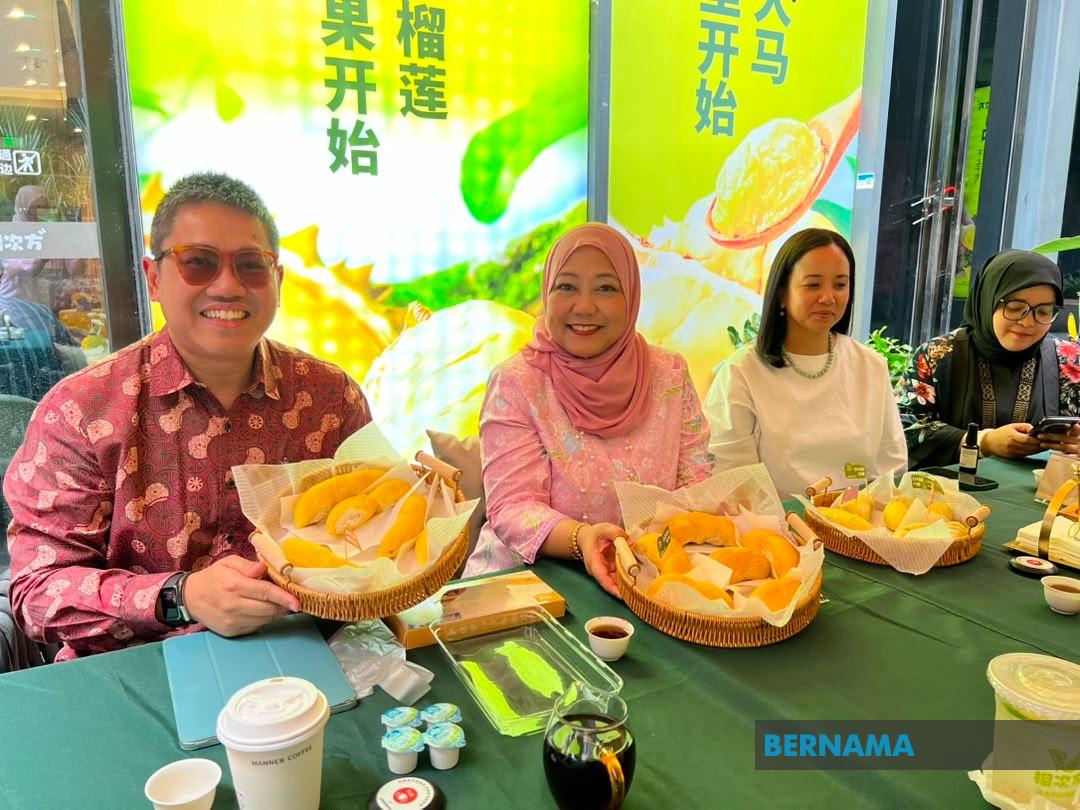
Malaysia is charting an aggressive expansion in its durian trade with China, setting its sights on exports valued at RM932.3 million (US$229 million) by 2030. The objective represents a marked escalation from current levels, underpinned by surging demand from Chinese consumers and a deliberate strategy to position Malaysian durians as premium products rather than compete on volume or cost. The ambition was unveiled in Beijing at the launch of Durian Cube, an exclusive retail outlet dedicated entirely to Malaysian durians, signalling the depth of Malaysia's commitment to capturing a larger share of China's lucrative durian market.
The momentum behind this export drive has already accelerated dramatically since Malaysia gained regulatory approval to ship fresh durians into China in August 2024, a breakthrough that removed a significant trade barrier. Fresh durian shipments have exploded, growing more than fivefold in a single year—expanding from approximately RM20.4 million to RM150.6 million between 2024 and 2025. Concurrently, frozen durian exports have reached nearly RM822.3 million in 2025, demonstrating that Malaysia's durian sector possesses both the production capacity and market appeal to satisfy the enormous appetite for the fruit across China. Early 2026 figures remain encouraging, with exports totalling RM313.5 million in the first quarter alone, suggesting that the upward trajectory is holding firm.
What distinguishes Malaysia's approach in the Chinese market is a deliberate refusal to compete primarily on price. Instead, Malaysian exporters have emphasised quality differentiation, particularly through the promotion of premium varieties such as Black Thorn and Musang King. Niqman Rafaee M. Sahar, Malaysia's trade commissioner at the embassy in Beijing, stressed that the competitive advantage rests on allowing durians to mature naturally on the tree before harvesting and exporting within 48 hours—a practice that preserves flavour and texture while setting Malaysian fruit apart from rivals. This quality-first philosophy reflects an understanding that within China's competitive durian landscape, where nearly US$7 billion worth of the fruit enters annually, volume alone cannot guarantee market dominance.
China's durian market, heavily supplied by other Southeast Asian nations, represents both an opportunity and a challenge for Malaysia. The country currently commands approximately four to five per cent of total durian imports into China, a modest but non-trivial position. Over the next five years, Malaysia intends to grow this share to between eight and ten per cent, a realistic goal given expanding production capacity and the established regulatory pathway for fresh exports. This incremental but substantial increase reflects Malaysia's recognition that achieving outsized market share would require investment and resources beyond what the sector realistically possesses, whilst a more measured expansion allows the industry to maintain its quality standards.
Beyond the fresh and frozen durian trade, Malaysian industry stakeholders are capitalizing on emerging demand for value-added durian products throughout China's hospitality and food service sectors. Hotels, restaurants, catering operations, and manufacturers are importing Malaysian durians as base ingredients for pastries, chocolates, snacks, mochi preparations, and frozen desserts. This downstream diversification creates a multiplier effect across the supply chain, generating revenue opportunities that extend well beyond simple commodity exports. Such product innovation and market expansion also reduce dependency on fresh durian sales alone, thereby insulating the industry from seasonal fluctuations and supply constraints.
Malaysia's durian diplomacy extends beyond commercial considerations. Norfarina Mohd Azmee, the interim Chargé d'Affaires at Malaysia's Beijing embassy, framed the durian trade as a broader cultural and diplomatic tool, capable of fostering people-to-people connections and introducing Chinese consumers to Malaysian agriculture, traditions, and heritage. With 2026 designated as Visit Malaysia Year, the promotion of Malaysian durians serves as a complementary marketing vehicle designed to draw Chinese tourists to Malaysia and deepen bilateral engagement. This framing transforms durian from a purely economic commodity into a soft-power asset, aligning trade objectives with deeper diplomatic and tourism goals—a strategic integration that underscores Malaysia's sophisticated approach to bilateral relations.
Malaysia's portfolio of over 100 durian varieties, with more than 30 already exported to China, provides considerable flexibility in product offerings and market segmentation. This botanical diversity allows Malaysian exporters to serve different consumer preferences, price points, and end-use applications across China's vast and varied markets. The range also insulates Malaysia from over-reliance on a single variety, reducing vulnerability to crop failures, disease outbreaks, or shifting consumer preferences. However, realizing the full potential of this diversity requires continued investment in supply-chain infrastructure, cold-chain logistics, and market intelligence—elements that will prove critical as export volumes expand.
On-the-ground commercial success is already evident. Sri Walis (M) Sdn Bhd, a major exporter, has achieved a threefold increase in sales over the past year and currently ships approximately 1,000 tonnes of fresh durians annually to five major Chinese cities—Shenzhen, Guangzhou, Beijing, Shanghai, and Hangzhou—generating roughly RM30 million in annual revenue. The company anticipates doubling or tripling export volumes to between 2,000 and 3,000 tonnes next year, reflecting robust market demand and confidence in supply capacity. However, preserving fruit quality during China's hot summer months remains technically challenging due to durians' limited shelf life, necessitating ongoing refinement of handling and preservation protocols.
The logistics and operational hurdles underpinning this expansion should not be underestimated. Malaysia's domestic durian production, concentrated in Johor and Pahang, must scale efficiently to meet burgeoning export targets without compromising quality or depleting local supply. Cold-chain infrastructure linking production zones to ports and extending through Chinese distribution networks requires substantial capital investment and coordination among multiple stakeholders. Additionally, Malaysia must navigate evolving Chinese food-safety standards, port regulations, and phytosanitary requirements—regulatory landscapes that shift frequently and demand proactive engagement from government bodies and industry associations.
The RM932.3 million export target by 2030 hinges on sustained demand from Chinese consumers, continued regulatory cooperation, and Malaysia's ability to differentiate through premium quality. If achieved, this goal would represent a transformative expansion of the durian sector's economic footprint, generating employment across production, processing, logistics, and retail functions. For Malaysia's agricultural sector more broadly, the durian success story demonstrates how targeted market access combined with differentiation strategies and downstream value addition can create sustainable competitive advantages in high-value commodity trade—a model potentially replicable for other Malaysian agricultural exports seeking traction in Asian markets.
Beyond the immediate commercial implications, Malaysia's durian ambitions carry significance for ASEAN's broader agricultural trade dynamics. As other Southeast Asian durian exporters seek to expand their shares of the Chinese market, Malaysia's premium positioning and quality-focused approach offer a template for non-price competition. The success of this strategy may influence how other ASEAN members approach their own horticultural exports to China and broader Asian markets, potentially elevating quality standards and innovation across the region's agricultural sectors. In this sense, the durian export drive represents not merely a commercial initiative but an experiment in how Southeast Asian nations can compete effectively in global value chains whilst preserving agricultural distinctiveness and cultural identity.

