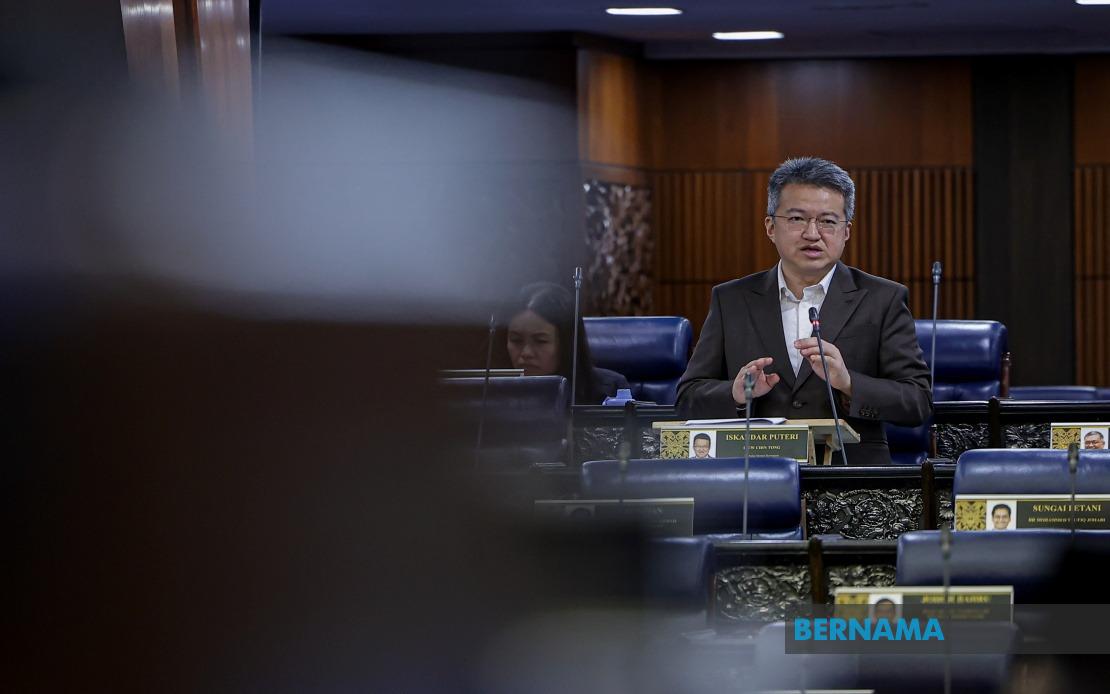
Malaysia's government is embedding structural safeguards into its financial management systems to ensure the 1Malaysia Development Berhad debacle cannot be repeated, Deputy Finance Minister Liew Chin Tong told Parliament, signalling that institutional reform remains central to the MADANI administration's agenda nearly two years after taking office. Speaking during Question Time in the Dewan Rakyat, Liew articulated how Prime Minister Datuk Seri Anwar Ibrahim's government has shifted focus from investigating past wrongdoing toward building defensive governance architecture designed to restore both domestic credibility and international confidence in Malaysia's fiscal probity.
The 1MDB scandal fundamentally altered global perceptions of Malaysia's administrative capacity and institutional integrity. Beyond the immediate financial devastation—a staggering RM18.7 billion in government outlays since 2017 to service the fund's obligations—the reputational damage penetrated deep into investor consciousness, creating lingering doubts about whether Malaysian public institutions could effectively steward national resources. Foreign enforcement agencies initiated parallel investigations, cross-border litigation ensued, and international media narratives framed Malaysia as a cautionary tale of institutional capture and financial mismanagement. This erosion of trust directly threatened Malaysia's ability to attract foreign direct investment, maintain favourable market conditions, and compete effectively for regional economic influence during a period when Southeast Asia faced intensifying competition for capital flows.
The MADANI government's legislative response has been methodical and comprehensive. The Public Finance and Fiscal Responsibility Act 2023 represents the cornerstone of this effort, establishing binding constraints on how executive authority can deploy public money and creating mechanisms for internal fiscal discipline that did not previously exist. By codifying rules around government spending, the legislation removes discretionary spaces where 1MDB-style mechanisms might flourish—entities created outside traditional appropriations frameworks, financed through guaranteed bonds rather than budgetary allocations, and operating with minimal parliamentary visibility. The law essentially forecloses the institutional pathways that enabled earlier misadventure.
Complementary to fiscal legislation, the government has expanded the Auditor-General's investigative mandate through amendments to the Audit Act. The "follow the public money" approach grants auditors broader authority to trace government funds through complex financial structures, government-linked companies, and cross-border transactions. This represents a meaningful shift from conventional auditing, which typically examines whether spending aligned with appropriations and regulations, toward a more forensic capability to interrogate whether spending served legitimate public purposes. For Malaysia's institutions, this enhancement addresses a critical gap revealed by 1MDB: previous audit frameworks could not effectively penetrate entities designed to obscure the destination and ultimate use of government-backed financing.
Liew emphasised that governance reforms extend beyond financial auditing into procurement processes and state-owned enterprise administration. A forthcoming Government Procurement Bill aims to introduce greater transparency and competitive discipline into how government contracts are awarded and executed, reducing the discretionary allocation of public money to connected parties. Simultaneously, reforms to the legal framework governing SOEs respond to 1MDB being structured as a state-owned entity that operated with minimal oversight and reported to no clearly defined authority within the civil service hierarchy. By tightening governance standards for all SOEs, the government seeks to eliminate the ambiguity that allowed 1MDB to function as essentially a private venture capital fund financed with sovereign guarantees.
The economic implications of these institutional reforms extend beyond Malaysia's borders. For Southeast Asia more broadly, the region's standing as an investment destination depends partly on whether individual economies can demonstrate credible institutions capable of protecting foreign capital and maintaining predictable policy frameworks. When one major economy experiences a high-profile governance scandal, it creates spillover effects on regional risk assessments. International investors and rating agencies apply generalised caution across the region, perceiving weaker institutional oversight as endemic rather than exceptional. Malaysia's deliberate institutional reconstruction therefore carries significance for Thailand, Indonesia, and other regional peers, potentially raising confidence in Southeast Asian markets as institutional guardrails prove effective.
Liew highlighted that these efforts have already yielded tangible economic benefits. Malaysia recorded its highest-ever approved investments and improved its standing in global competitiveness rankings during the period when governance reforms were implemented. This is not coincidental: institutional reforms that credibly limit arbitrary state action, improve fiscal transparency, and establish independent oversight mechanisms constitute precisely the conditions that international investors evaluate when allocating capital. The correlation between governance improvements and investment inflows demonstrates that institutional credibility functions as economic infrastructure as vital as physical port capacity or digital connectivity.
The financial burden of servicing 1MDB's legacy obligations remains substantial. Since the MADANI government assumed office in March 2023, it has allocated RM13 billion from the development budget specifically to redeem government-guaranteed 1MDB bonds maturing during that fiscal year—USD3 billion in nominal principal, representing approximately 13.1 per cent of the annual development budget. This extraction of resources from productive investment toward legacy liability remediation constrains the government's capacity to fund infrastructure, education, and other forward-looking priorities. Governance reforms thus operate under pressure: they must prove effective enough to prevent future scandals that would further degrade Malaysia's fiscal position, because the country cannot afford repeated cycles of institutional failure followed by expensive remediation.
Liew's parliamentary statement underscores that Malaysia's political leadership recognises governance reform not as a peripheral accountability exercise but as foundational to economic recovery. The MADANI administration inherited a fiscal and reputational position severely compromised by 1MDB. Rather than attempting to obscure or minimise the scandal's impact, the government has chosen transparency regarding the damage inflicted and explicitness about institutional gaps that must be closed. This approach carries political risk—it acknowledges prior governance failure and implies that previous administrations lacked adequate controls—but it also establishes credibility with both domestic stakeholders and international observers that systemic reform is genuinely prioritised.
The sustainability of these reforms depends on institutional continuity beyond the current political cycle. If governance legislation and expanded audit powers prove dependent on which ministers occupy key offices, then investors will assess the reforms as cosmetic rather than structural. Malaysian policymakers therefore face the challenge of embedding these institutional innovations sufficiently deeply within the bureaucracy and legal framework that they persist regardless of electoral outcomes. This requires not only legislation but also the development of institutional cultures, career incentive structures for civil servants, and parliamentary oversight practices that reinforce reformed governance protocols across multiple administrations.
Looking forward, Malaysia's governance architecture will be tested by future fiscal pressures and the inevitable temptation for governments to circumvent established constraints. The Public Finance Act, expanded audit powers, reformed procurement processes, and tightened SOE governance represent genuinely constraining institutions only if political leaders actively respect them. The MADANI government has signalled its commitment, but whether these reforms endure as living institutional practices or devolve into symbolic legal language remains to be determined. For Malaysia's economic future and for regional perceptions of Southeast Asian governance capacity, the answer carries considerable weight.

