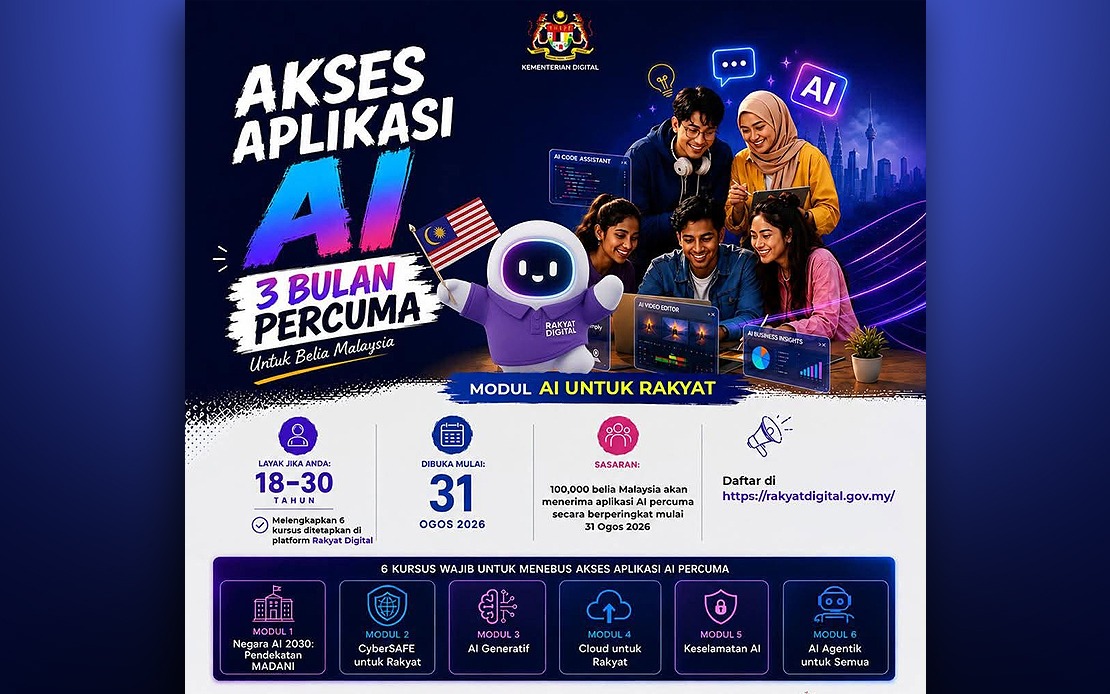
The Malaysian government has rolled out an ambitious digital skills initiative designed to democratise access to artificial intelligence technology among young adults. Launched by Prime Minister Datuk Seri Anwar Ibrahim during the 2026 National Day Premier Address at the Putrajaya International Convention Centre, the AI for the People (AI Untuk Rakyat) programme represents a significant investment in youth digital literacy across the nation. Running until 2027, the scheme aims to reach 100,000 Malaysians aged between 18 and 30, marking one of six major initiatives announced to expand digital opportunities for the country's younger population.
Prospective participants can register immediately through the Rakyat Digital portal at rakyatdigital.gov.my, with the programme being rolled out in phases starting from the announcement date. The structured approach requires learners to successfully complete and pass six specifically designed modules before gaining eligibility for the central benefit: a complimentary three-month subscription to premium artificial intelligence applications and software. This certification pathway ensures that participants develop foundational knowledge before accessing advanced tools, creating a coherent learning progression rather than simply distributing technology without accompanying skill development.
The curriculum structure reflects a comprehensive vision of AI literacy spanning multiple dimensions of the technology. The six mandatory modules cover AI Nation 2030: The MADANI Approach, which contextualises artificial intelligence within Malaysia's development framework, CYBERSAFE for the People addressing digital security concerns, Generative AI exploring the rapidly evolving landscape of large language models and creative tools, AI Security focusing on protective measures and ethical deployment, Agentic AI for All examining autonomous systems, and Cloud for the People introducing cloud infrastructure fundamentals. This breadth indicates an effort to move beyond basic awareness toward practical competency across the AI ecosystem.
Upon successful completion, eligible participants will gain privileged access to a carefully curated selection of AI tools from both established international technology leaders and promising local providers. Google's Gemini Enterprise offers access to the technology giant's latest large language model capabilities, while Alibaba's Wonderclip and MuleRun provide alternative platforms for productivity and content creation. Local innovation features prominently through YTL AI Labs' IlmuChat, ensuring that Malaysian companies developing artificial intelligence solutions benefit from this demand creation whilst offering culturally and contextually relevant tools. The Digital Ministry has signalled that this initial roster represents merely the beginning, with additional software and applications from other technology firms scheduled for phased introduction to continuously enrich the learning ecosystem.
For Malaysia's policymakers, this initiative addresses a critical gap in digital preparedness. Whilst artificial intelligence adoption accelerates globally, ensuring equitable access to both education and tools prevents a widening skills divide within the population. The focus on young adults aged 18 to 30 targets those at critical career junctures, enabling them to integrate AI competencies into emerging professional identities rather than attempting remedial reskilling later. The inclusive framing emphasises that AI benefits should extend beyond technology sector specialists to encompass broader segments of the population, a principle aligned with the government's Malaysia Digital 2030 aspirations and the broader MADANI framework emphasising shared prosperity.
Digital Ministry secretary-general Datuk Fabian Bigar contextualised the programme within governmental strategy, emphasising that the initiative serves not merely to familiarise youths with AI technology but to establish genuine practical capability. By providing actual tool access during the learning phase, participants can develop portfolio-ready experience rather than theoretical knowledge alone. This bridges the employment relevance gap that often plagues digital training schemes, enabling graduates to demonstrate applied competency to prospective employers. The combination of structured learning and premium tool access creates conditions for meaningful skill acquisition rather than superficial exposure.
Regional implications deserve consideration as Southeast Asian nations compete intensely for technology sector investment and talent. Malaysia's proactive approach to building AI-ready human capital positions the country competitively against regional peers. Countries seeking to establish themselves as regional technology hubs typically recognise that talent pipelines require cultivation years in advance, and early investment in youth digital literacy directly translates to workforce readiness. The scale—targeting 100,000 individuals across multiple cohorts until 2027—suggests commitment to meaningful penetration rather than token initiatives.
The Rakyat Digital portal, overseen by MyDIGITAL Corporation under the Digital Ministry, serves as the implementation backbone for this and related programmes. Centralising registration and course delivery through a single national platform enables consistent quality control, data collection for programme evaluation, and potential integration with other government digital initiatives. The portal approach also removes geographical barriers, enabling rural youths equal access to opportunities that might otherwise concentrate in urban technology hubs.
Industry partnerships reveal pragmatic programme design. By collaborating with established technology firms rather than developing proprietary tools, the scheme leverages existing ecosystems whilst creating market incentives for technology companies to integrate with Malaysian educational pathways. This reduces government development burden whilst creating natural constituencies among technology providers who benefit from pipeline talent introduction. The inclusion of both international giants and local innovators suggests deliberate balance between accessing cutting-edge capabilities and nurturing domestic technology entrepreneurship.
The long implementation timeline through 2027 allows for iterative improvement and responsiveness to technological change. Artificial intelligence evolves rapidly, and a seven-year rollout period permits curriculum adjustments, module updates, and tool substitutions as the landscape shifts. Early cohorts will likely influence programme refinement based on completion rates, employment outcomes, and participant feedback, allowing subsequent cohorts to benefit from optimised design.
For Malaysian youth, programme participation offers tangible value beyond skills acquisition. The three-month free subscriptions to enterprise-grade tools provide practical experience with technologies that would otherwise require significant personal investment. For students exploring career possibilities, this reduces barriers to experimentation. For early-career professionals, it enables demonstration of contemporary technical literacy to employers. The certification from completing all six modules creates a verifiable credential signalling structured artificial intelligence education.
Success metrics will ultimately determine the initiative's impact. Completion rates, participant employment outcomes, and eventual contribution to Malaysia's artificial intelligence capability development will reveal whether the programme achieves its ambitious scope. Early evidence from participation patterns and completion data could influence expansion or modification as the initiative proceeds through its phased rollout. The programme represents a strategic recognition that technological advancement's benefits accrue most broadly when coupled with deliberate capability development across diverse population segments.

