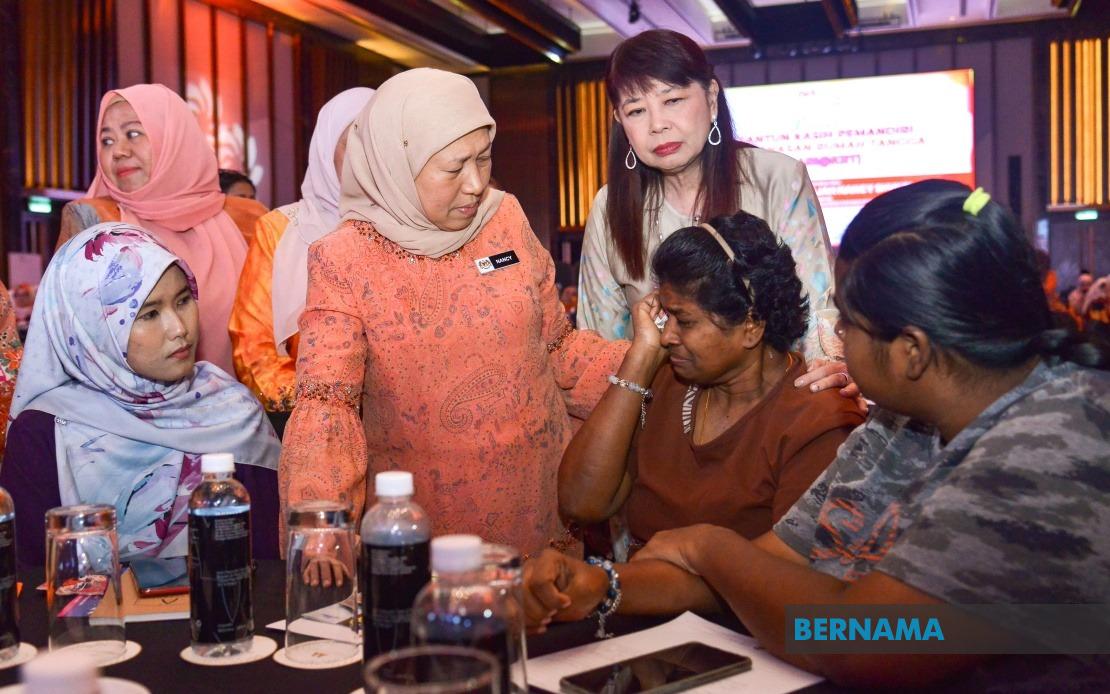
The Ministry of Women, Family and Community Development has unveiled SARI@KRT: Road to Eliminate Violence Against Women (EVAW) 2026, an ambitious support initiative designed to reach approximately 1,400 survivors of domestic violence across the country. Unveiled by Minister Datuk Seri Nancy Shukri in Kuala Lumpur on August 20, the programme represents a significant policy commitment to addressing one of Malaysia's persistent social challenges. The initiative seeks to deploy comprehensive assistance mechanisms across all states, with each region targeted to accommodate at least 100 participants, marking a structured, nationwide approach to victim support.
The programme's core architecture rests on three interconnected pillars: strengthening psychosocial support networks, enhancing access to legal remedies, and facilitating economic independence for affected women. Rather than limiting its scope to awareness campaigns alone, SARI@KRT aims to fundamentally reshape how survivors perceive their circumstances and recovery prospects. Shukri emphasised that the government's role extends beyond public education to actively restoring victim confidence and demonstrating that viable solutions exist through established institutional channels. This philosophical reorientation—from passive acknowledgement of the problem to active confidence-building—reflects evolving approaches to victim support across Southeast Asia.
Recent crime statistics underscore the urgency of such interventions. Data from the Royal Malaysia Police reveal that domestic violence cases surged to 4,014 incidents during the first six months of 2024, representing a notable increase from 3,678 cases during the corresponding 2023 period. This nine per cent year-on-year rise, whilst alarming in absolute terms, presents a more nuanced picture when examined through the lens of victim reporting behaviour. Shukri characterised the increase partly as a reflection of enhanced public awareness and growing willingness among survivors to seek official intervention—suggesting that improved reporting, rather than solely increased violence, may account for a portion of the statistical climb. Nevertheless, the absolute numbers demand urgent policy attention.
Geographic disparities in reported cases reveal distinct regional patterns. Johor emerged as the state with the highest caseload, recording 721 incidents in the first half of 2024, followed by Selangor with 614 cases and Perak with 405. These concentrations in Malaysia's most populous states partly reflect population density but also raise questions about resource allocation, cultural factors, and the effectiveness of existing support infrastructure across different regions. For Malaysian policymakers, these geographic hotspots offer targeted intervention opportunities where community programmes and support services can be strategically concentrated.
Underlying causes of domestic violence demonstrate the complexity of interventions required. Misunderstandings and communication breakdowns constitute the dominant trigger, accounting for 1,967 of the 4,014 recorded cases. This preponderance of relational and communicative factors suggests that conflict resolution training, mediation services, and couple counselling could play significant preventive roles. Drug abuse emerged as the second leading cause with 444 incidents, highlighting the intersection between substance addiction and domestic violence—a connection that demands coordinated responses from both health and law enforcement sectors. Financial stress accounted for 378 cases, underlining economic anxiety's profound destabilising effect on family relationships.
Fiscal pressures warrant particular attention given their documented prevalence. Shukri drew specific focus to financial abuse as a distinct harm category, encompassing scenarios where one spouse possesses financial capacity but deliberately withholds resources from the family. She characterised such withholding as a form of coercive control with profound consequences for women's dignity and autonomy. This conceptualisation of financial abuse—extending beyond outright destitution to encompass deliberate deprivation despite available means—reflects contemporary understandings of domestic violence as encompassing control mechanisms beyond physical harm. By framing financial non-contribution as a breach of shared family responsibility rather than merely a personal choice, the government signals an evolving legal and cultural position on spousal obligations.
To facilitate victim participation in judicial proceedings, the Ministry established a special allowance scheme enabling survivors to attend court hearings related to child maintenance claims. This practical support addresses a significant barrier to justice: the financial costs of pursuing legal remedies. For many survivors navigating custody disputes or seeking child support orders, court attendance expenses create substantial hardship. By subsidising these costs, KPWKM removes an administrative obstacle to accessing formal legal protections. Such measures reflect recognition that formal rights possess limited utility if economic constraints prevent their enforcement.
The SARI@KRT programme's emphasis on economic empowerment addresses a critical reality for domestic violence survivors: financial dependence frequently traps victims within abusive relationships. By combining psychosocial rehabilitation with skills development and livelihood support, the initiative targets the structural vulnerabilities that perpetuate victimisation. Economic independence represents both a practical pathway to safety and a psychological declaration of capacity and autonomy. For survivors rebuilding lives post-separation, employment opportunities and income generation constitute essential components of durable recovery.
Shukri's appeal for public participation through information-sharing and early intervention utilisation recognises that institutional programmes function optimally when integrated with community awareness and engagement. The success of SARI@KRT depends partly on whether communities, neighbours, family members, and workplaces recognise warning signs and encourage victims toward available support. This community dimension transforms the programme from a reactive service mechanism into a preventive social infrastructure. For Malaysia, where family-oriented cultural values remain predominant, leveraging community social capital rather than relying exclusively on formal institutional responses may prove strategically advantageous.
The initiative arrives at a critical juncture in Malaysian gender equality policy. Domestic violence remains deeply entrenched despite decades of legal reforms and awareness campaigns, suggesting that legislative change alone proves insufficient. SARI@KRT's holistic approach—combining immediate trauma response, legal navigation, and long-term economic reintegration—acknowledges this reality. By targeting 1,400 survivors, the programme establishes a significant foothold, though the scale of need likely extends considerably beyond these figures. For observers across Southeast Asia grappling with similar domestic violence epidemics, Malaysia's coordinated, multi-sectoral approach offers a potentially replicable model emphasising victim agency and sustainable recovery pathways rather than punitive measures focused exclusively on perpetrators.

